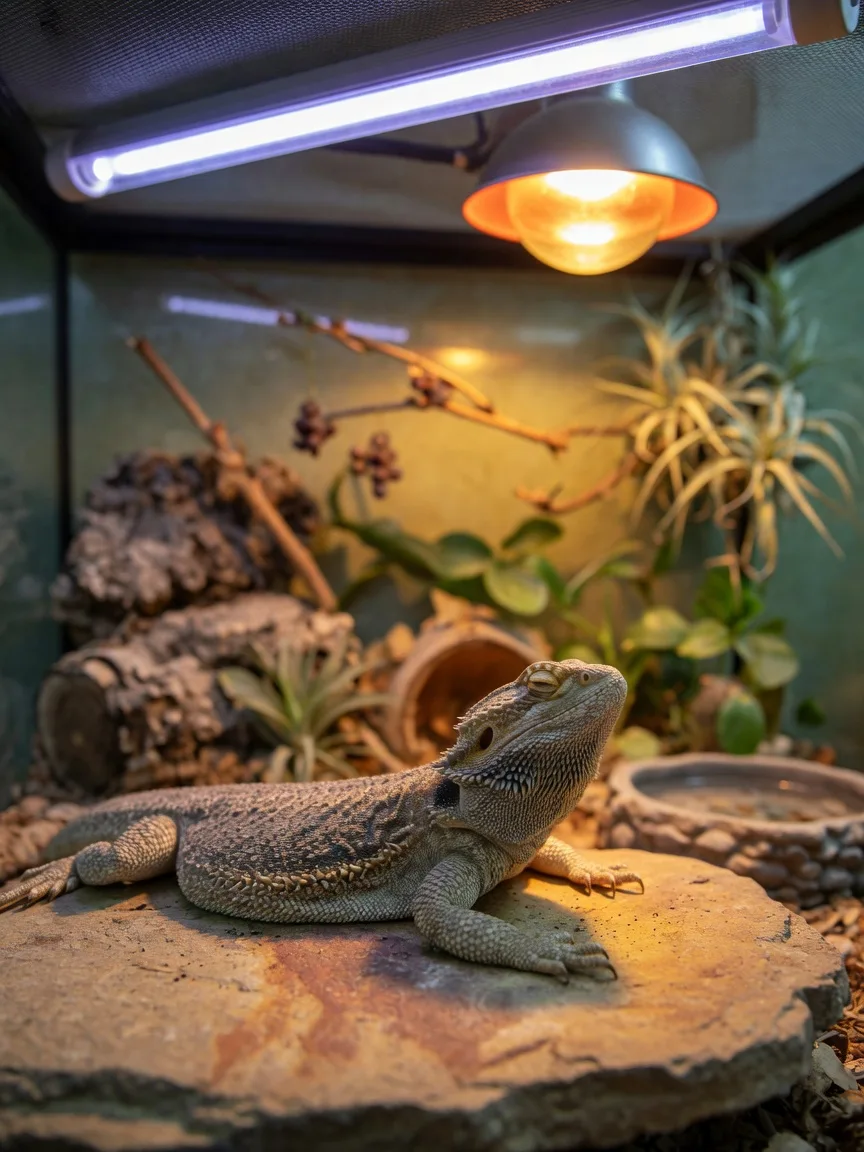
The Perfect Day/Night Light Schedule for Bearded Dragons
Every bearded dragon care sheet says “12 hours of light, 12 hours of dark.” It’s not wrong — but it’s the whole story the way “eat food” is a diet plan. Wild dragons live under a sun that shifts with the seasons: 14-hour summer days, 10-hour winter days, and dawn/dusk transitions their bodies use as cues. You can replicate all of it with a $10 timer.
Pick your season below and get a complete daily schedule — when each light clicks on and off, and what’s happening in the tank at each stage.
Why the schedule matters as much as the bulbs
Here’s what the 12/12 shorthand misses: it’s not just how much light, it’s the rhythm. Bearded dragons run on circadian and circannual clocks — daily and yearly. The daily clock drives basking, feeding, and sleep. The yearly clock drives appetite cycles, breeding behavior, and brumation. A dragon under identical 12/12 lighting year-round with zero seasonal variation often shows a muted version of all of these: okay, but flat. Seasonal shifts wake the system up.
You don’t need to be precise to the minute. Shifting your timer by an hour or two between summer and winter is enough to give the yearly clock something to read.
💡 Did you know? In central Australia, summer days run about 14 hours and winter days about 10 — and bearded dragons brumate through the short-day season. When keepers hold a rigid 14-hour summer schedule all winter, they’re fighting the exact cue the dragon’s body is waiting for. Shorter winter days aren’t neglect; they’re nature.
The seasonal photoperiod table
| Season | Lights on | Lights off | Day length | Notes |
|---|---|---|---|---|
| Summer | 7:00 AM | 9:00 PM | 14 hrs | Peak growth/feeding season for juveniles |
| Spring / Fall | 7:30 AM | 7:30 PM | 12 hrs | The default most of the year |
| Winter | 8:00 AM | 6:00 PM | 10 hrs | Short days cue rest; expect lower appetite |
Shift gradually — move the timer 15 minutes a week over a month when changing seasons, not all at once. In practice, most keepers just do two settings: summer (14h) and winter (10h), with 12h as the shoulder default.
Which lights follow the schedule
| Light / heat source | Day | Night |
|---|---|---|
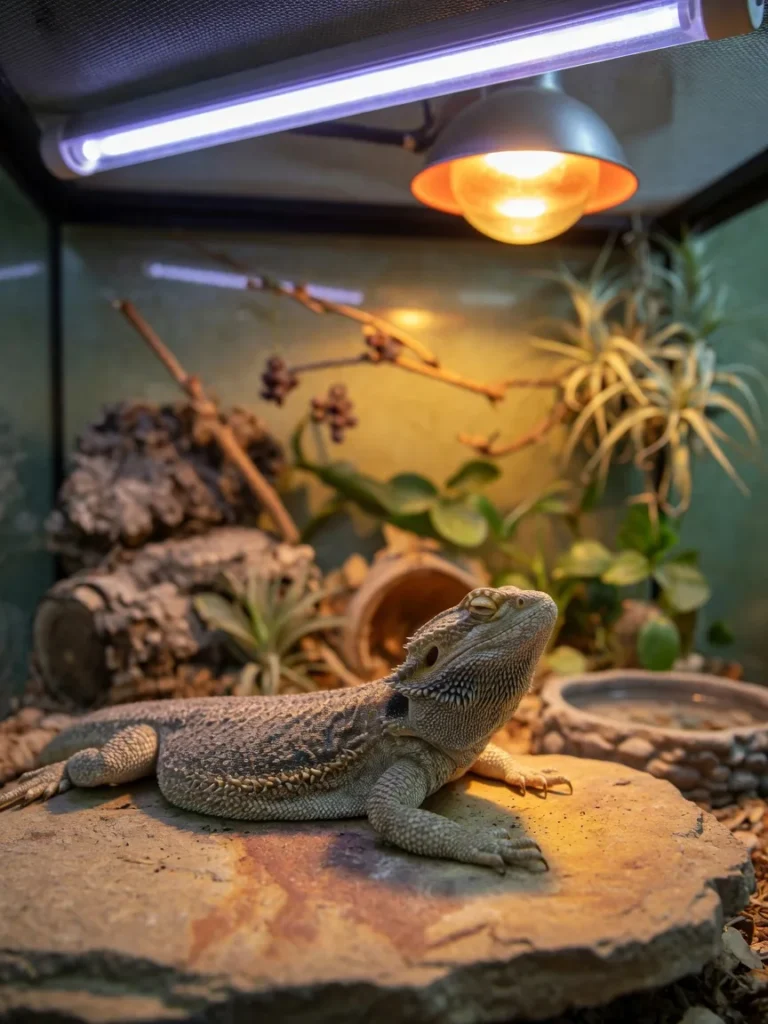
| UVB tube | ON with the schedule | OFF — always |
| Basking lamp | ON with the schedule | OFF — always |
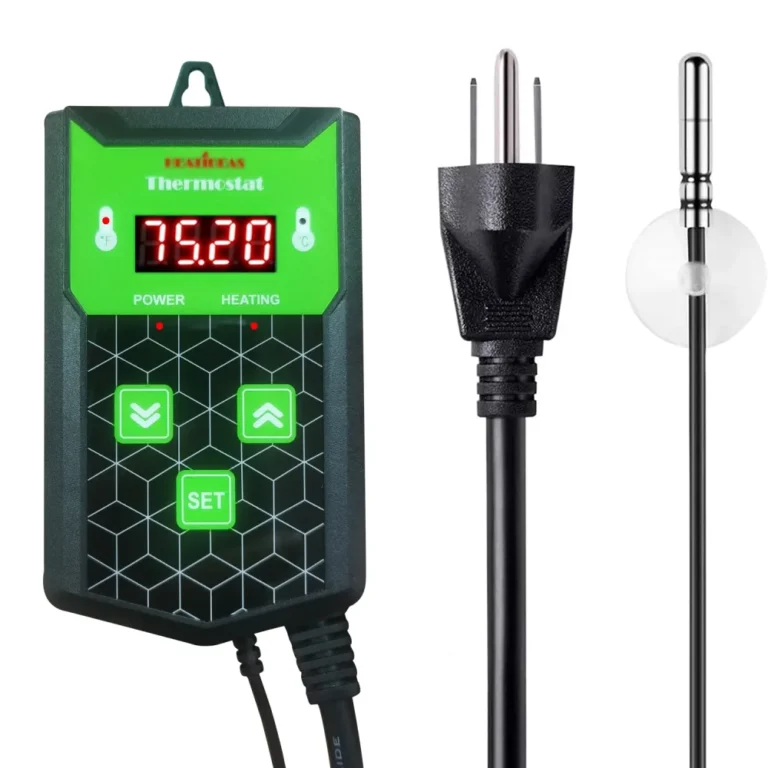
| Ceramic heat emitter | Usually OFF (basking lamp covers it) | ON only if room < 65°F, via thermostat |
| Any colored “night” bulb | Never | Never — dragons see the light |
The rule is absolute: if it emits visible light, it follows the day schedule and only the day schedule. Night heat is invisible (CHE/DHP) or nothing.
Timers: the highest-ROI purchase in the hobby
A $10–$15 outlet timer is the single best automation you can buy. Manual light switching fails — you sleep in, you work late, the dragon’s “sunrise” drifts by hours. Inconsistent photoperiods stress reptiles more than most keepers realize; the circadian system can’t entrain to a moving target.
What to get: a simple digital outlet timer with a battery backup (so power blips don’t reset it). Smart plugs work too and add phone control, but a dumb timer can’t be broken by a Wi-Fi outage. Put the UVB and basking lamp on the same timer — in nature, heat and light arrive together. If you run a CHE at night, it goes on a thermostat, not the timer — temperature, not time, should control it.
The vacation test is the real argument: a tank on a timer plus a thermostat runs itself for days. Lights cycle, heat self-regulates, and your pet sitter only handles food and water — no “can you come at 7 AM to turn the lights on” texts. Manual switching doesn’t just fail on busy weekdays; it fails the moment you leave town. Automate the sun and the tank becomes dramatically more resilient.
💡 Did you know? Dawn and dusk transitions matter. In the wild, light ramps up and down — it doesn’t snap on like a warehouse. Keepers with dimmable fixtures or a 30-minute “ramp” timer report calmer morning behavior. It’s a refinement, not a requirement — but it’s cheap if your hardware supports it.
Feeding around the schedule
The schedule isn’t just about light — it organizes the whole day:
- Wait 30–60 minutes after lights-on to feed. A cold dragon can’t digest properly. Basking first, breakfast second.
- Last feeding 2–3 hours before lights-off. Food needs heat and time to digest. Late-night feeders sitting in a cooling gut are an impaction risk — this is a real, documented cause of digestive trouble.
- Babies eat within the same window — just more meals inside it (3–5 feedings between lights-on and mid-afternoon).
- Winter: shrink the feeding window with the day. Shorter days, smaller appetite, earlier last meal. If brumating, no food at all — check the brumation guide before assuming illness.
Troubleshooting schedule problems
- Dragon still “asleep” hours after lights-on: check basking temps first — a cold basking spot means the day never really starts. Then check the timer actually fired (power blip wiped it?).
- Restless at night, scratching: light leak. Even a bright room lamp or a glowing power strip near the tank can disturb sleep. The tank’s surroundings should go dark too.
- Appetite crashed in fall: probably seasonal, not sickness — shorter days cue the slowdown. Verify temps and UVB age, then rule out illness vs. brumation before worrying.
- You keep forgetting to switch lights: that’s the timer’s job, not yours. Automate it this weekend.
- Dragon basks with eyes closed all day: that’s not in the schedule’s control — it’s usually a UVB problem (too strong, too close, or a coil bulb). Audit the UVB setup before touching the timer.
💡 Did you know? Reptiles can sense day length through their parietal eye — the tiny light-sensitive “third eye” on top of a bearded dragon’s head. It’s not for seeing; it’s a dedicated light meter wired straight to the brain’s clock. When you shift the photoperiod, you’re talking directly to that sensor. Yet another reason the schedule is real biology, not keeper superstition.
Light schedule questions, answered
Is 12/12 fine if I don’t want seasonal changes?
Yes — 12 on / 12 off year-round is the safe default and what most keepers run. Seasonal shifting is an upgrade, not a requirement. Consistency beats perfection: a steady 12/12 is far better than a sloppy attempt at seasons.
Should the schedule match my local sunrise/sunset?
It can, but it doesn’t need to. What matters is consistency and roughly matching the season’s day length. A dragon in Seattle doesn’t need Seattle’s 4 PM winter sunset — just a 10-hour day.
Can I use a smart plug instead of a timer?
Yes, with one caution: if your Wi-Fi drops, some smart plugs default to off (or on). A dumb digital timer with battery backup is more failure-proof. Either beats manual switching.
Do I change the schedule for a baby?
Keep babies on longer days (13–14 hours) year-round for the first 6–12 months — they’re in peak growth and shouldn’t get brumation cues. Shift to seasonal schedules after the first year.
My power went out — do I need to fix the timer?
Check it. Battery-backup timers survive blips; cheap mechanical ones don’t. A timer stuck 6 hours off-phase will quietly wreck the rhythm for weeks before you notice. Verify after every outage.