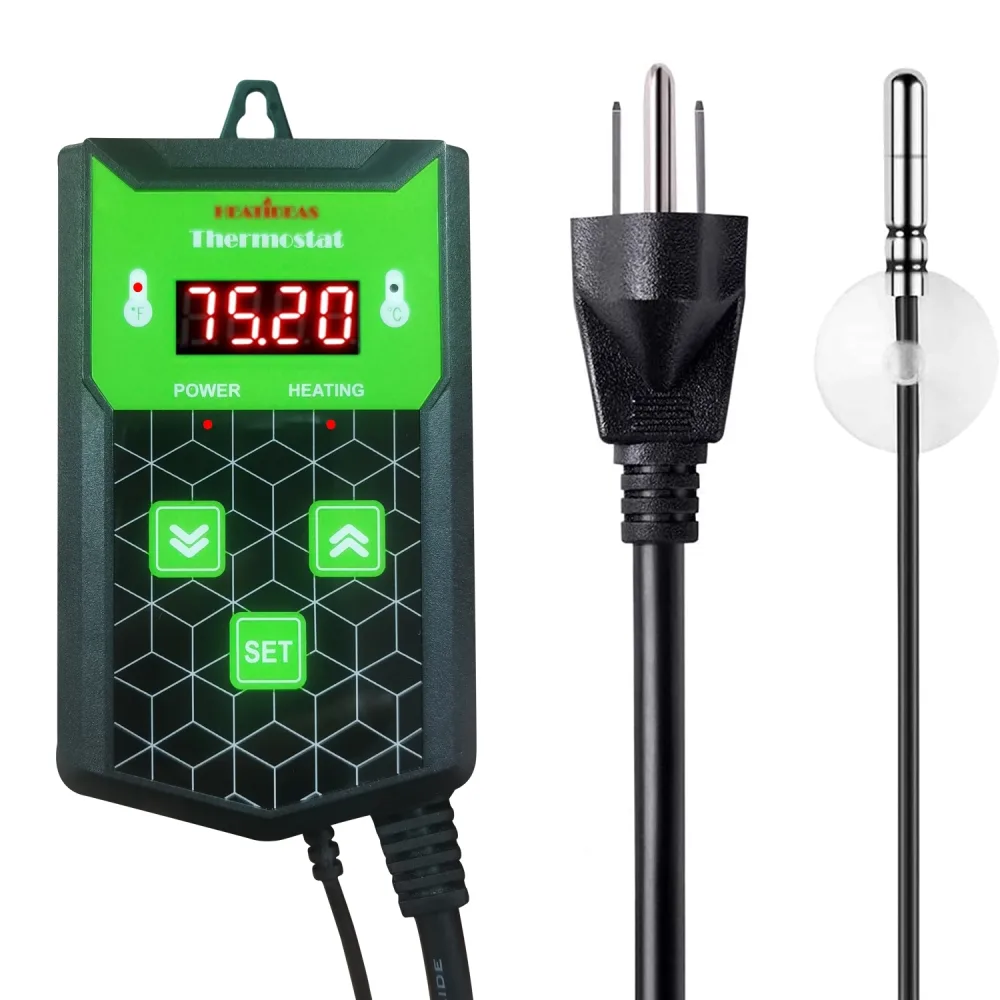
How to Set Up a Thermostat for Your Bearded Dragon
A thermostat is the cheapest life-insurance policy in reptile keeping. Heat sources fail — bulbs surge, CHEs run hot, heat mats develop hot spots — and without a thermostat, the failure mode is a cooked dragon. Every experienced keeper has a story about the thermostat that caught a malfunction at 2 AM. The keepers without stories are the ones who never needed it… until they do.
But “get a thermostat” is incomplete advice, because there are three types and the wrong one for your heat source is barely better than none. Pick your heat source below and get the right thermostat type, why, and where the probe goes.
What a thermostat actually does
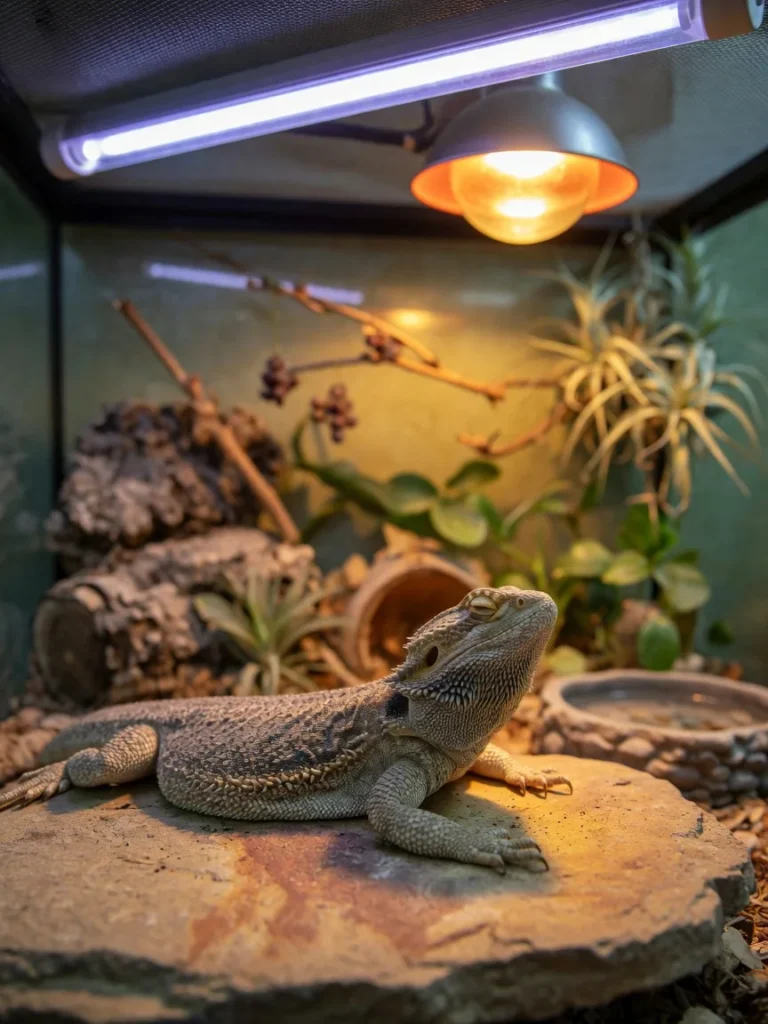
Simple version: it’s a thermometer with a power switch. You set a target temperature, place the probe where the animal lives, and the thermostat cuts or adjusts power to the heat source to hold that temperature. Without one, your heat source runs at whatever the bulb wattage and room temperature produce — which drifts with the seasons, the time of day, and whether someone opened a window.
The failure it prevents is specific and ugly: heat sources don’t usually die quietly. A stuck-on heat mat, a CHE in a heat wave, a basking bulb in a small tank on a hot day — temperatures climb past 120°F and the dragon, which can’t sweat and can’t escape a glass box, cooks. Thermostats turn “malfunction” into “mild inconvenience.”
💡 Did you know? Bearded dragons can’t sense overheating the way you do — they evolved to seek heat, not flee it. A dragon will sit under a dangerously hot lamp because its instincts say “heat = good,” long past the point a mammal would move. Your thermostat is the off-switch their biology doesn’t have.
The three thermostat types, compared
| Type | How it works | Best for | Cost |
|---|---|---|---|
| On/off | Full power until target, then cuts; clicks back on when temp drops | Heat mats only | $25–$40 |
| Pulse proportional | Rapid micro-bursts of power, proportional to need | CHEs, DHPs | $40–$70 |
| Dimming | Smoothly varies power like a dimmer switch | Basking lamps, DHPs | $60–$120 |
Why the match matters: an on/off thermostat on a basking bulb causes visible flickering and thermal shock that kills bulbs in weeks. A dimming thermostat on a heat mat is wasted money. Buy the type for the heat source you actually own.
Probe placement: where everyone gets it wrong
The thermostat is only as smart as its probe position. The probe must measure the temperature the dragon experiences, not the air near the lamp, not the glass wall.
| Heat source | Probe goes… | Common mistake |
|---|---|---|
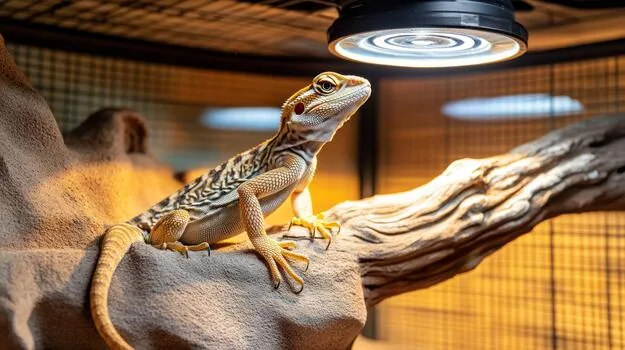
| Basking lamp | On the basking surface, at dragon-back height | Hanging in mid-air (reads cool, lamp overpowers) |
| CHE (night) | Warm-end sleeping area, dragon height | On the cool end (warm end runs away unchecked) |
| Heat mat | Between mat and tank floor, outside | Inside the tank (dragon moves it, readings lie) |
| DHP | Basking zone surface | Too close to the projector (short-cycles) |
Secure the probe so the dragon can’t drag it — a dab of hot glue or a probe clip, never tape inside the tank (adhesive + heat + claws = bad). And verify with a second thermometer: the thermostat’s display tells you what the probe reads, which is only trustworthy if the probe is in the right place. Trust, but verify — a $12 digital thermometer as backup has saved more dragons than any single gadget.
💡 Did you know? The #1 thermostat failure isn’t the unit — it’s the probe getting moved. Dragons bulldoze probes, knock them off basking spots, and wedge them into cool corners. A probe in a cool corner tells the thermostat “it’s cold, full power!” while the basking spot climbs past 130°F. If temps suddenly go weird, check the probe position before blaming the hardware.
Anatomy of a heat malfunction (why this isn’t hypothetical)
Here’s how it actually happens, because “heat sources fail” is abstract until it isn’t. The most common scenario: a heat mat’s internal wiring develops a hot spot — a small area running 30°F hotter than the rest. Without a thermostat, there’s nothing to interrupt it. The dragon, programmed to seek belly heat, parks directly on the hot spot. Thermal burns in reptiles are insidious — they don’t flinch away like mammals, and by the time the owner notices the darkened scales, the burn is deep.
Scenario two: summer heat wave. The basking lamp calibrated for a 68°F winter house is suddenly working against an 85°F room. Basking spot climbs past 130°F while the owner is at work. A thermostat would have dimmed the lamp to nothing hours ago. Scenario three: the CHE everyone said “doesn’t need” a thermostat because “it’s only 60W” — in a small tank, in July, 60W unregulated is plenty to push the warm end into the 90s overnight, night after night, slowly stressing the animal.
None of these require exotic bad luck. They’re normal equipment drift meeting normal weather. The thermostat is the one component whose entire job is to notice.
💡 Did you know? Thermal burns are one of the most common preventable injuries reptile vets treat — and heat mats are implicated more than any other source. The pattern is almost always the same: no thermostat, or a thermostat whose probe had been dragged out of position. A $30 stat prevents a $300 vet bill.
How many thermostats do you need?
One per independently-controlled heat source:
- Basking lamp → one dimming thermostat.
- Night CHE → one pulse thermostat (only if you run night heat).
- Heat mat (if used) → one on/off mat thermostat.
That’s two or three for a full setup. Multi-channel thermostats exist (one unit, 2–3 probe/channel pairs) and are worth it once you’re past two heat sources — cleaner wiring, one display, often cheaper than separate units.
Setup checklist
- Mount the heat source and position the probe per the table above — before the dragon moves in.
- Set the target temperature (basking: 95–110°F by age; night CHE: ~70°F).
- Run the empty tank for 24 hours and log the min/max. Adjust the setpoint until the actual basking surface — measured with an IR gun or probe thermometer — hits your target.
- Check that the thermostat’s safety cutoff works: briefly warm the probe in your hand and confirm the heat source powers down.
- Re-verify seasonally. Summer room temps shift the whole system’s baseline — a setpoint that was perfect in January may run hot in August.
Thermostat questions, answered
Can I use one thermostat for two heat sources?
Only a multi-channel unit designed for it. Never split one probe/channel across two different heat sources — the thermostat can’t control what it can’t measure, and the uncontrolled source runs wild.
My thermostat clicks loudly — is it broken?
That’s the on/off relay — normal for on/off and some pulse stats. If the clicking bothers you (bedroom tanks), a dimming thermostat is silent. Don’t “fix” it by bypassing the stat.
Do I need a thermostat if my room is always 75°F?
Yes. Room temperature doesn’t cap a heat source — a 100W basking bulb in a 75°F room still pushes the basking spot past 120°F without regulation. Ambient room temp and basking temp are different numbers.
What’s the difference between a thermostat and a thermometer?
A thermometer only measures and displays. A thermostat measures and controls — it switches the heat source on/off or dims it. You need both: the thermostat to regulate, the thermometer to verify the thermostat.
Are cheap thermostats reliable?
The basic $30 on/off stats are fine for heat mats — it’s simple technology. For dimming/pulse, buy from reptile-specific brands (Vivarium Electronics, Herpstat, Habistat) rather than generic seedling mat controllers; the temperature algorithms and safety cutoffs are meaningfully better.