How to Set Up UVB Lighting for Your Bearded Dragon
Here’s the uncomfortable truth about bearded dragon care: the most common cause of serious illness in pet bearded dragons isn’t bad food or a small tank. It’s bad lighting. Specifically, bad UVB. Metabolic bone disease — the bent limbs, the soft jaw, the tremors — is almost always a UVB story, and it’s almost always preventable.
This guide covers the three things that actually matter: which bulb to buy, exactly how far to mount it, and when to replace it. And since “replace every 6–12 months” is the kind of advice everyone forgets, there’s a tool right below that does the remembering for you.
Why UVB is non-negotiable
In the wild, bearded dragons bask under some of the harshest sun on the planet. UVB light lets their skin manufacture vitamin D3 — and D3 is what lets them absorb calcium from their food. No UVB means no D3. No D3 means no calcium absorption. And when blood calcium drops, the body starts dissolving its own skeleton to make up the difference.
That’s metabolic bone disease: rubbery jaws, kinked spines, tremors, fractures from everyday movement. It is the most common serious illness in captive bearded dragons, and it is a husbandry disease — caused by the setup, not bad luck. The good news is the fix costs about forty dollars: one tube, mounted at the right distance, replaced on time.
Which bulb to actually buy
Buy a linear T5 HO fluorescent tube that spans roughly two-thirds of your tank. That’s the whole answer. The two fixtures the reptile community has trusted for years are the Arcadia ProT5 12% and the Zoo Med ReptiSun 10.0 T5 HO — either one, in a fixture with a reflector, is a solved problem.
What not to buy: the small spiral “compact” UVB bulbs that come in starter kits. They produce a narrow cone of UVB instead of a wide gradient, their output varies wildly between individual bulbs, and your dragon ends up with bright spots and dead zones it can’t navigate. Mercury vapor bulbs (heat plus UVB in one) work, but they run extremely hot and can’t be dimmed or thermostatted easily — fine for huge enclosures, fiddly for beginners. Keep it simple: linear T5 HO, 12% or 10.0 strength.
Exact mounting distances
Distance is everything. Too far and the UVB reaching the basking spot is a rumor. Too close with a strong bulb and you can burn their eyes — photo-kerato-conjunctivitis is real and miserable. Measure from the bulb to the dragon’s back at the basking spot, not to the tank floor.
| Bulb | On top of mesh screen | Mounted inside (no mesh) |
|---|---|---|
| T5 HO 12% / 10.0 | 12–18 inches | 18–24 inches |
| T8 10.0 | 6–10 inches | 10–14 inches |
| Compact / coil | Don’t use — replace with a linear tube | |
One more variable: mesh type matters. Fine insect screen can block up to half the UVB; wide-hole screen blocks roughly a third. When in doubt, mount the fixture inside the tank — it’s the single biggest upgrade most setups can make.
Mounting it right
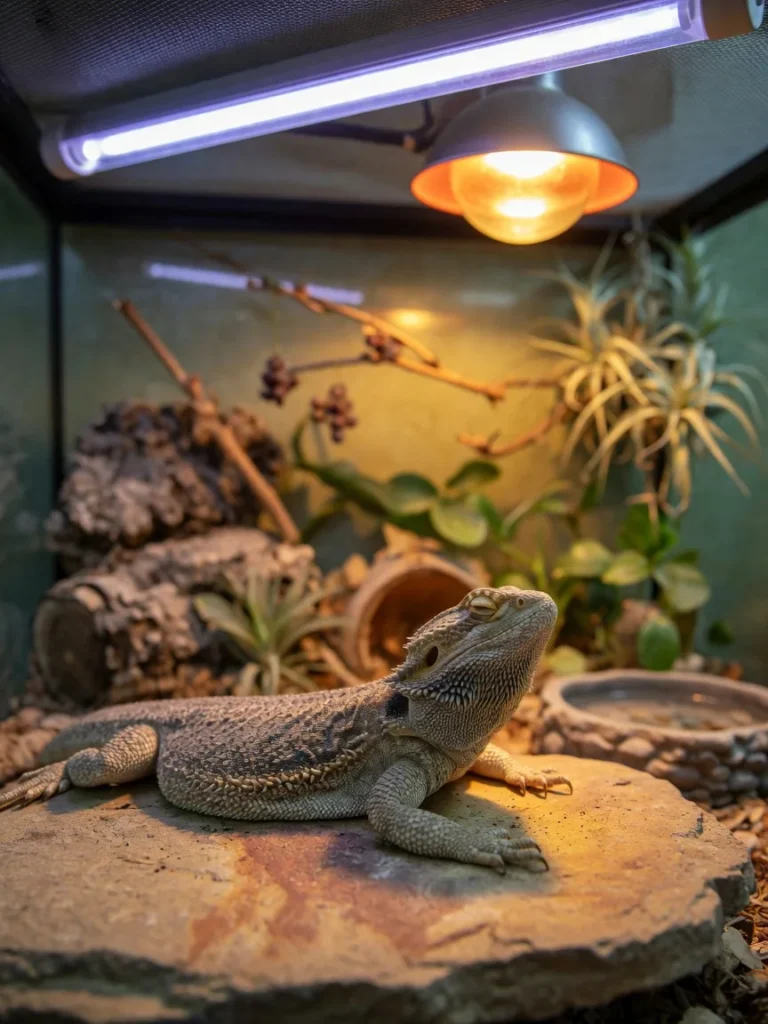
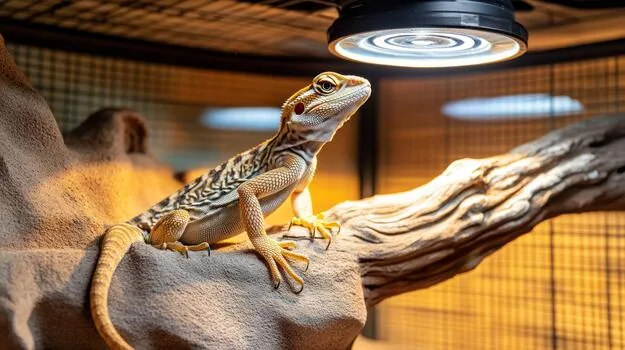
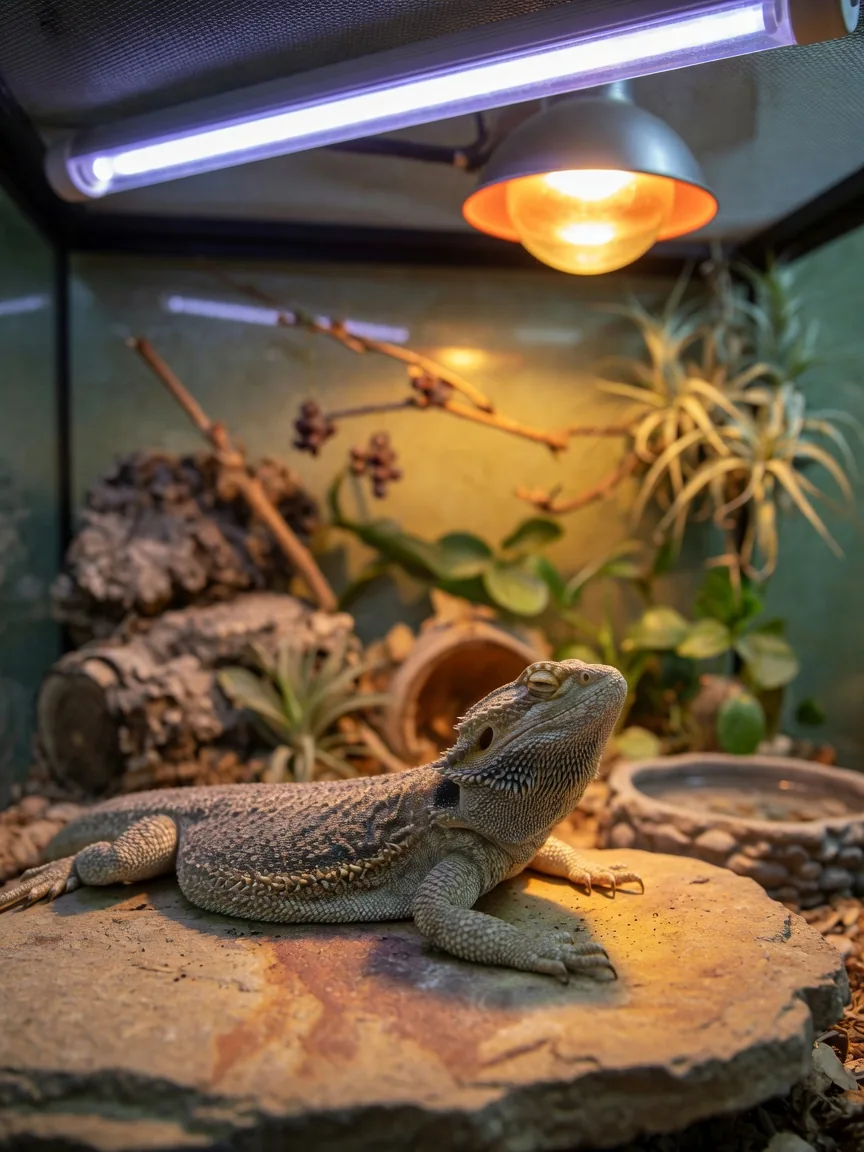
- Span two-thirds of the tank, overlapping the basking zone — your dragon should never have to choose between heat and UVB.
- Nothing between the bulb and the dragon except screen. Glass and clear plastic block UVB completely — a tube sitting on a glass lid is a very expensive night-light.
- Basking bulb and UVB side by side, so heat and UVB overlap the way the sun does it.
- 12–14 hours a day on an outlet timer. Consistency beats duration.
- Replace on schedule even if it still lights up. Set the reminder above and forget about it.
How to tell your UVB is actually working
Here’s the annoying part: you can’t see UVB, and your dragon can’t tell you about it. But there is exactly one way to know for sure — a Solarmeter 6.5 UV index meter. It’s the tool reptile vets and serious keepers use to check a setup: hold it at the basking spot, at your dragon’s back height, and it reads out the actual UV index hitting that spot. No guessing, no mesh-percentage math. If the reading lands in the healthy basking range for a bearded dragon and your tube is within its rated life, your setup is verified — done.
Without a meter, behavior is a rough signal, not a diagnosis. A dragon that basks eagerly under the tube, stays alert through the day, and eats with enthusiasm is consistent with a setup that’s working. A dragon that starts avoiding the basking zone, goes lethargic at the cool end, or loses interest in food is telling you to recheck the basics: tube age, mounting distance, and what’s sitting between the bulb and the animal. Behavior never replaces a meter reading — but a sudden change in basking habits is always worth investigating before it becomes a health problem.
The reflector is half the purchase
A UVB tube radiates in every direction — including straight up into your ceiling. A polished reflector inside the fixture bounces that wasted upward output back down toward your dragon. Without one, you’re throwing away a large share of the UVB you paid for, and buying a stronger tube doesn’t properly compensate for it.
The practical upshot: if your fixture has no reflector, upgrading the fixture matters more than upgrading the tube. Quality fixtures like the Arcadia ProT5 ship with a built-in reflector, which is part of why they’re the default recommendation. A bargain shop-light fixture holding the best tube in the world is still a compromised setup.
Replacement day: the five-minute protocol
- Buy the new tube a week before it’s due. The gap between “UVB faded out” and “replacement arrived” is exactly when the damage happens. The reminder tool above exists so you never have that gap.
- Swap it in minutes. Power off, old tube out, new tube in. Nothing else in the setup changes.
- Write the install date on the tube end with a marker. Twelve months from now you won’t remember when you installed it — the marker will.
- Re-check the distance while you’re up there. Same fixture position, but confirm the bulb-to-basking-spot measurement. Tanks get rearranged and decor shifts over a year.
- Set the reminder above for next year. Then forget about UVB entirely until it pings you.
What about the old tube? It still makes perfectly good visible light — keep it as an emergency spare or use it as a room light. Just don’t put it back over the tank thinking it’s “still got some life in it.” Its UVB life is over, and that’s the only life that mattered.
The 5 UVB mistakes that cause MBD
- The starter-kit coil bulb. It came free with the tank. It’s also the weakest link in the whole setup.
- UVB on fine mesh, 24 inches from the dragon. By the time the rays arrive, there’s nothing left.
- A glass or plastic cover between bulb and tank. Blocks 100% of UVB. The most expensive way to do nothing.
- Running the same tube for two years because “it still turns on.” The visible light is fine; the UVB died a year ago.
- UVB at one end, basking heat at the other. The dragon picks warmth every time — and gets zero UVB all day.
UVB questions, answered
Can I just use a regular fluorescent tube?
No. Standard fluorescents produce visible light but essentially zero UVB. The bulb must be specifically rated for reptile UVB output (10.0 / 12%).
Do they need UVB at night?
No. Bearded dragons need a day/night cycle: 12–14 hours of UVB and heat, then darkness. Light at night disrupts their sleep.
My bulb still lights up — is it still good?
Probably not, if it’s past its rated life. UVB phosphors degrade with use while the visible light stays bright. Use the reminder tool above instead of trusting your eyes.
Is sunlight through a window enough?
No — window glass filters out UVB. Supervised outdoor time in real sun is a fantastic bonus, but it’s not a lighting plan.