What Wattage Basking Bulb Does a Bearded Dragon Need?
“What wattage basking bulb do I need?” is one of the most-asked questions in bearded dragon keeping — and one of the most misleadingly simple. A 100W bulb that nails 105°F in one person’s 40-gallon tank might barely hit 90°F in another’s drafty 120-gallon, or roast a third person’s well-insulated setup. Wattage is not a temperature; it’s a starting guess. The real target is always the number on your thermometer.
This guide explains why wattage is only a starting point, the actual temperature you’re aiming for, sensible starting wattages by tank size, how room temperature changes the math, why a dimming thermostat beats endlessly swapping bulbs, and the test-and-adjust method that dials in any setup in an afternoon. Use the finder below for your personalized starting wattage.
Why Wattage Isn’t One-Size-Fits-All
A basking bulb’s job is to heat a surface to a target temperature — but how much wattage that takes depends on everything around it: tank volume, room temperature, screen top vs open top, how high the bulb hangs, even how drafty the room is. Two identical 100W bulbs in two different living rooms can produce basking spots 15°F apart. That’s why “just buy 100W” is folk wisdom, not engineering.
The professional approach flips the question. Don’t ask “what wattage?” Ask “what temperature?” — then use wattage as the adjustable input that gets you there. The finder above gives you the smart starting guess; the thermometer gives you the answer.
The Real Target: 100–110°F Basking Surface Temperature
Memorize this, not a wattage number:
- Babies/juveniles: 105–110°F basking surface
- Adults: 100–110°F basking surface
- Cool side: ~80°F (all ages)
- Night: 65–75°F (no light needed)
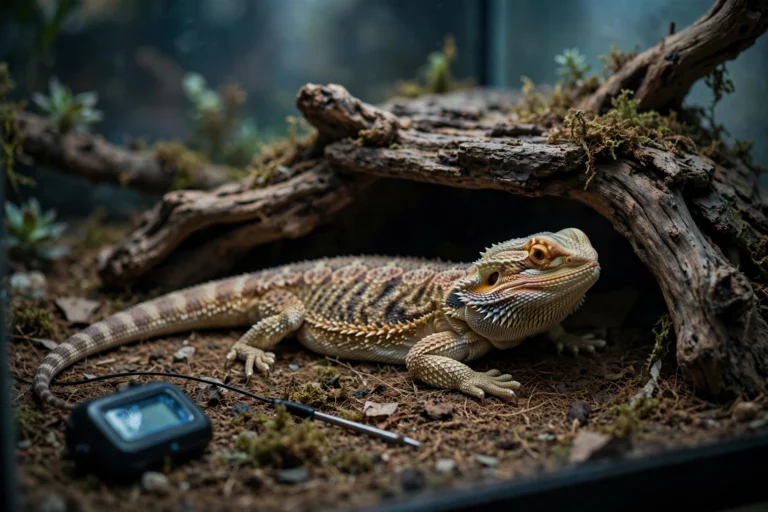
“Surface” means the actual basking platform — measured with an infrared temp gun pointed at the rock or branch, not the air. Air thermometers read 5–10°F cooler than the surface your dragon’s belly touches, which is why gun-vs-gauge confusion causes so many “my temps are fine but my dragon won’t bask” mysteries.
Starting Points by Tank Size
| Tank | Typical starting wattage | Room-temp adjustment |
|---|---|---|
| 40 gal (36×18×18″) | 75W | Cold room → 100W; warm room → 50W |
| 75 gal (48×18×21″) | 100W | Cold room → 150W; warm room → 75W |
| 120 gal (48×24×24″) | 150W | Cold room → 150W + check gradient; warm room → 100W |
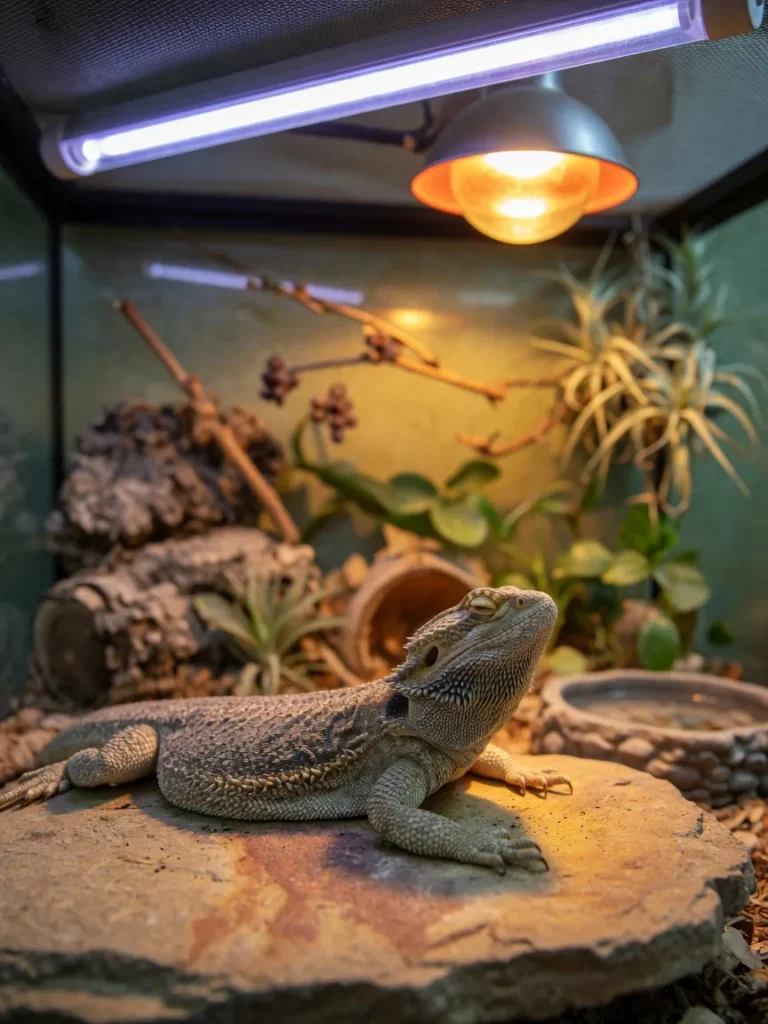
These assume a bulb 8–12 inches above the basking surface through a screen top. Hanging the bulb higher? You’ll need more watts. No screen? You’ll need fewer. Every variable moves the number — which is exactly why you verify with the temp gun.
How Room Temperature Changes the Math
Your room is the thermal baseline the bulb builds on. A tank in a 62°F basement needs dramatically more heating power than the same tank in a 76°F living room — the bulb isn’t just warming the basking spot, it’s fighting the room’s pull on the whole enclosure. Winter is when most “my bulb stopped working” complaints appear; the bulb is fine, the room got colder.
Rule of thumb: for every ~10°F your room drops below 70°F, expect to need roughly one wattage step up (or a dimming thermostat opened wider). If your room regularly sits below 65°F in winter, plan for supplemental heating — a night heating setup covers the after-hours drop too.
Dimming Thermostats: Why They Beat Swapping Bulbs
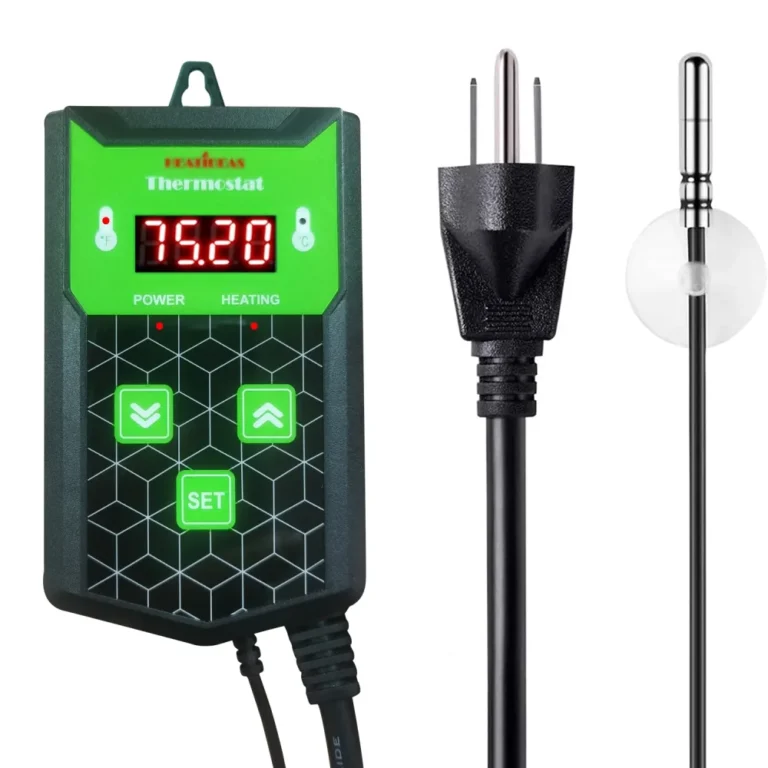
Here’s the upgrade that ends the wattage guessing game forever: put the basking bulb on a dimming thermostat with its probe at the basking zone. Instead of swapping 75W → 100W → 75W across the seasons, you buy one sensibly-sized bulb and let the thermostat trim its output to hold exactly your target temperature — automatically compensating for cold mornings, warm afternoons, and seasonal room shifts.
Dimming (not on/off) matters: on/off stats click the bulb fully on and off, causing temperature swings and visible flicker that stresses dragons. A dimming stat smoothly throttles power — stable temps, no flicker, longer bulb life. Our thermostat guide covers types and probe placement in detail.
Test and Adjust: The IR Temp Gun Method
The definitive procedure, start to finish:
- Install your starting-wattage bulb (from the finder) 8–12″ above the basking surface.
- Turn everything on and wait 45–60 minutes — temperatures need time to stabilize. New keepers measure at 10 minutes and chase ghosts.
- Point the IR temp gun at the basking surface itself. Record the number.
- Check the cool side too — you need the full gradient, not just the hot spot.
- Adjust: under 100°F → step up a wattage (or raise the dimmer); over 110°F → step down, raise the bulb, or trim the dimmer.
- Re-check after any adjustment — and again the next morning, since room temps shift overnight.
Signs the Wattage Is Wrong
Too hot: dragon avoids the basking spot entirely, presses against the cool-side glass, gapes constantly even when not basking, or shows stress marks. Check immediately — overheating is the urgent direction.
Too cool: dragon basks all day without ever leaving the spot, stays dark-colored (trying to absorb more heat), eats less, digests slowly. A dragon that never leaves the basking platform is telling you the platform isn’t hot enough to finish the job.
When in doubt, trust the behavior and the thermometer together — they’re two instruments measuring the same thing.
Quick Wattage FAQ
Halogen or incandescent? Halogen flood bulbs are the current favorite — brighter, more efficient, better heat focus. Standard incandescent spots work fine too. Avoid “spot” bulbs with extremely narrow beams; a flood pattern heats the basking zone more evenly.
How high above the platform? 8–12 inches is the standard starting range. Closer = hotter and more focused; higher = cooler and more diffuse. Never let the dragon touch the bulb or fixture.
Do I need a dome fixture? Yes — a ceramic-socket dome rated above your bulb’s wattage. Plastic sockets melt; underrated domes are a fire risk.
When should I replace the bulb? When it burns out, or when you notice it struggling to hold temperature (filaments degrade). Unlike UVB, heat output doesn’t invisibly decay — if the thermometer reads right, the bulb is fine.