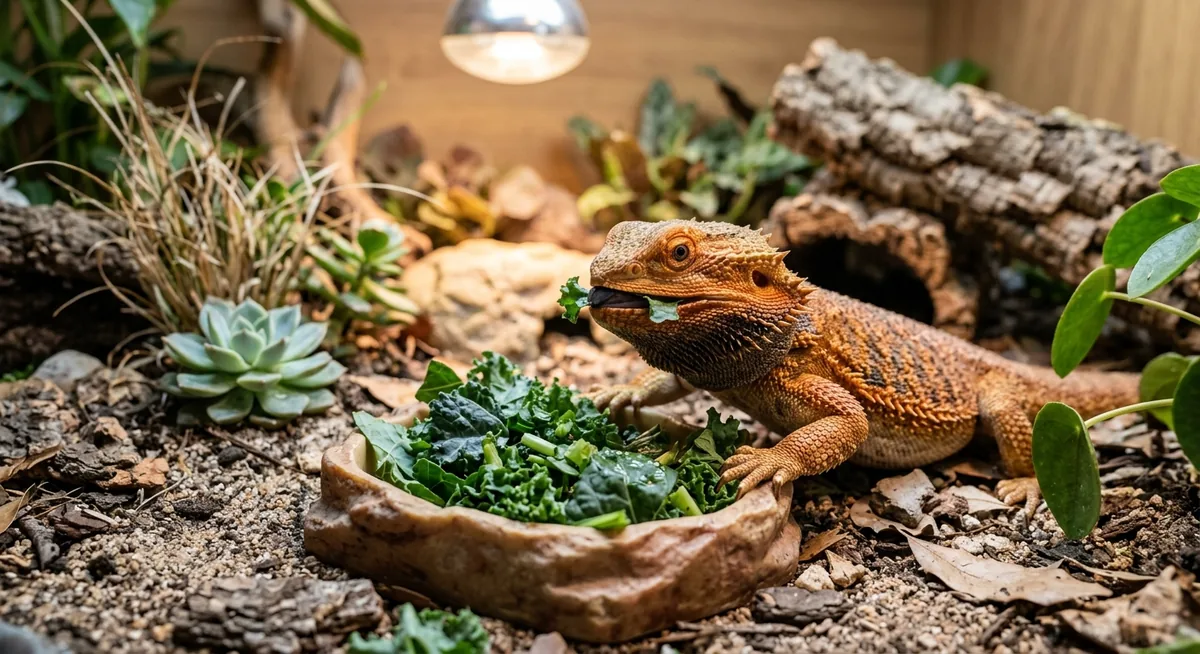
What Can Bearded Dragons Eat? The Safe Food List
You’re standing in the produce aisle, phone in one hand, wondering if bearded dragons can eat bell peppers. (They can.) This page is the searchable database I wish someone had handed me on day one: 47 foods, each labeled by how often it belongs in the bowl. Search it, filter it, bookmark it.
How to use this list
The labels are the whole system. Daily staples are the base of every salad, every day. Veggies rotate through the bowl for variety. Fruit is a treat — a few pieces a couple of times a week, not a meal. Insects are the protein: babies get them two to three times a day, adults every other day. And Never means never, no matter how pleading the face.
If you want the full routine — how much, how often, by age — that’s on the bearded dragon feeding schedule. This page is your grocery-store companion.
The big 5 staple greens
If the database above feels like a lot, start here. These five greens can carry the entire salad rotation on their own — everything else is variety:
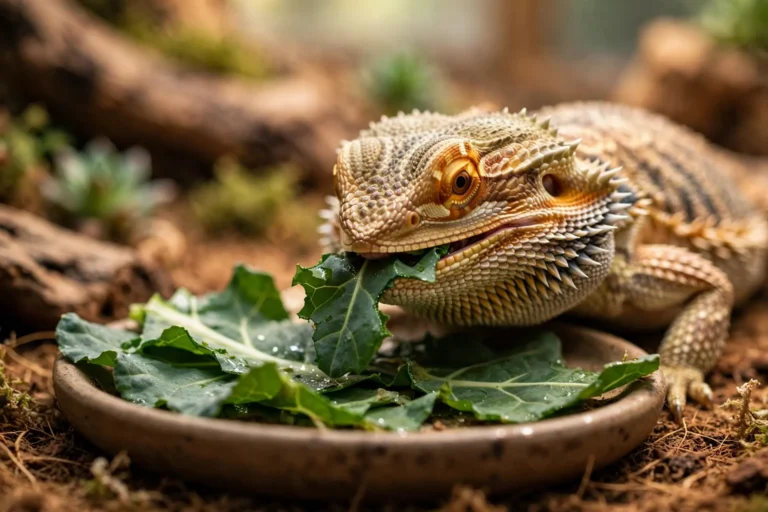
- Collard greens — the default. Cheap, calcium-rich, available in every grocery store. If you buy one green, make it this one.
- Mustard greens — slightly peppery, excellent nutrition. Most dragons love them.
- Turnip greens — a calcium powerhouse that doesn’t get enough credit.
- Dandelion greens — free, if your yard is pesticide-free and away from roads. The ultimate budget green.
- Endive & escarole — mild, hydrating, and great for picky eaters who reject stronger flavors.
Rotation tip: buy two or three types and rotate weekly. Variety covers nutritional gaps that no single green fills on its own.
Getting them to try new foods
Bearded dragons are suspicious of new things — it’s a survival instinct. Mix the new food with a familiar favorite, chop it fine so it can’t be picked around, and offer it in the morning when they’re hungriest. A sprinkle of bee pollen over the top has converted an absurd number of skeptics. Give any new food three or four tries before declaring it rejected.
The calcium-to-phosphorus rule
Here’s the reason the label system exists at all: a bearded dragon’s diet needs roughly twice as much calcium as phosphorus. That ratio is the whole game. When phosphorus wins, the body raids its own bones for calcium to balance the books — which is exactly how metabolic bone disease starts.
And here’s the problem: most feeder insects are phosphorus-heavy. Crickets and dubias bring plenty of protein and very little calcium, so every insect meal quietly tips the ratio the wrong way. That’s why staple greens aren’t just filler — collards, mustard greens, and turnip greens are genuinely calcium-rich, and they push the ratio back toward where it belongs.
It’s also why calcium dusting exists. A light coating of plain calcium powder on the insects corrects the imbalance at the source. Think of it as a two-part system: calcium-rich greens in the bowl, lightly dusted insects in the feeding tongs. Neither one alone covers the gap; together, they do.
One more thing this explains: iceberg lettuce isn’t just “not nutritious” — it’s actively counterproductive, because it fills the stomach with water and displaces foods that would have fixed the ratio. Stomach volume is finite. Spend it on calcium.
The 10 foods to never feed
Most “can they eat it” questions have a boring answer. These ten don’t — they’re the ones that can genuinely hurt your dragon:
| Food | Why not |
|---|---|
| Avocado | Contains persin — toxic to bearded dragons |
| Rhubarb | Extremely high oxalic acid — toxic |
| Onion & garlic | Toxic, even in small amounts |
| Citrus fruits | Too acidic — causes digestive upset and diarrhea |
| Iceberg lettuce | Almost entirely water — zero nutrition, runny stool |
| Fireflies / lightning bugs | Contain lucibufagins — a single firefly can be lethal |
| Spinach & kale (as staples) | Oxalates bind calcium — fine occasionally, harmful daily |
| Mushrooms | Toxins impossible to rule out — not worth the risk |
| Wild-caught insects | Pesticide exposure and parasite risk |
| Eggplant | Nightshade family — avoid |
The firefly one deserves repeating because it kills dragons every summer: if you take your dragon outside at dusk, keep them away from fireflies. One is enough.
Oxalates and goitrogens in plain English
Two words that show up on every “feed sparingly” list, explained once:
Oxalates are compounds in certain greens that grab onto calcium in the gut and lock it away — the calcium is there, your dragon just can’t use it. That’s why spinach and kale sit in the veggie rotation instead of the staple list: they’re nutritious on paper, but their oxalates make their calcium less available. Fine a couple of times a month; a bad daily habit.
Goitrogens are compounds in cruciferous vegetables (broccoli, cauliflower, cabbage) that can interfere with thyroid function in large amounts, which is why some keeper lists flag them. There’s no need to panic over a piece of broccoli — but these are garnish-tier foods, not bowl-fillers.
Building the perfect salad
A great salad is a formula, not a recipe: two or three staple greens as the base, one chopped veggie for color and variety, and a fruit topper twice a week to make it interesting. Chop everything to bite-size pieces — roughly the width between your dragon’s eyes is the rule for anything going in the bowl.
For picky eaters who turn their nose up at greens: sprinkle a little bee pollen over the salad. It smells interesting, tastes sweet, and has converted an absurd number of salad refusers. And pull uneaten salad in the evening — wilted greens in a hot tank get gross fast.
What “occasional” actually means
The middle tier of the database is the one people overthink. Here’s the decoder:
- Vitamin-A veg (carrots, sweet potato, pumpkin): genuinely nutritious, but not bowl bases. Grate them in once or twice a week for color and variety.
- Watery veg (cucumber, zucchini): hydration with a side of fiber. Fine in the rotation, but they dilute the calcium density of the meal — never the main event.
- Sweet fruit (banana, grapes, mango): sugar is sugar. A few pieces a couple of times a week as a topper, not a course.
- The “weird” staples (cactus pads): nopales look exotic, but they’re one of the best calcium-rich greens available. If your grocery store carries them, treat them exactly like collards.
The pattern: “occasional” means a guest appearance, not a starring role. The base of the bowl never changes — staple greens, every day.
Food questions, answered
Can bearded dragons eat bananas?
As a rare treat, yes — a thin slice occasionally. They’re high in sugar and phosphorus relative to calcium, so they don’t belong in the regular rotation.
Can they eat meat, like chicken?
No. Insects are their meat. Cooked chicken, beef, and other human proteins aren’t part of their diet and can cause digestive problems.
Do I need to wash produce first?
Yes — always. Pesticide residue is the main concern, and a good rinse under running water handles it. Organic is nice but not required if you wash well.
Can baby bearded dragons eat fruit?
Tiny amounts are fine, but babies should focus on protein and staple greens — insects two to three times daily plus salad offered. Fruit is a treat at any age.