Can Bearded Dragons Eat Dandelion Greens?
Every spring it happens: the lawn erupts in yellow, and a bearded dragon owner stares out the window doing mental math. Those dandelions are free, they are everywhere, and the internet keeps calling them a superfood. So is this actually dragon salad growing in the yard — or a pesticide-soaked trap? The short answer is good news with one big condition. This guide covers the nutrition that makes dandelions a staple, the exact rules for picking them safely, and how to serve them.
Can Bearded Dragons Eat Dandelion Greens? The Verdict
Dandelions sit comfortably in the top tier of the 47 safe foods for bearded dragons, alongside collards and turnip greens. Unlike occasional treats that need strict portion control, dandelion greens can anchor the daily salad bowl in rotation with other staples.
Dandelion Greens Nutrition: Why They Rank So High
The number that matters most is the calcium-to-phosphorus ratio. Bearded dragons need roughly twice as much calcium as phosphorus in their diet, so greens with a Ca:P ratio above 2:1 are the ones you build meals around. Dandelion greens test at 2.8:1 on the widely used Carolina Designer Dragons nutritional dataset — comfortably in staple territory.
Per cup, dandelion greens deliver roughly 104 mg of calcium against 36 mg of phosphorus (Ness Exotic Wellness Center data), plus vitamins A, C, K, E, and B6 and a useful dose of digestive fiber. That fiber is doing quiet work: it keeps the gut moving, which matters for a species prone to constipation on insect-heavy diets.
How Dandelions Compare to Other Staple Greens
| Green | Ca:P ratio | Role in the bowl |
|---|---|---|
| Dandelion greens | 2.8:1 | Daily staple — excellent calcium, free if foraged |
| Collard greens | 14.5:1 | Daily staple — the calcium champion |
| Kale | 2.4:1 | 1–2x per week — goitrogens limit daily use |
| Romaine lettuce | 1.1:1 | Hydration filler, not a nutrition source |
Dandelions will not dethrone collards on pure calcium — see the full breakdown in our calcium supplement guide — but they win on the combination of good nutrition, palatability, and price. For the full staple-green picture, the collard greens deep-dive and the kale guide show exactly where each green fits.
The Safe-Foraging Rules (Read Before You Pick)
A dandelion is only as safe as the ground it grew in. Plants absorb what is in their soil, and no amount of rinsing removes herbicide residue from inside the leaf. Every rule below exists because someone learned it the hard way:
1. Know the spray history. If the lawn has been treated with weed killer, fertilizer-herbicide mixes, or insecticides at any point in the last year, the dandelions there are off the menu. The most common lawn herbicides (2,4-D, dicamba, MCPP) are the exact chemicals researchers keep finding in pets’ urine after lawn treatments.
2. Skip pet bathrooms. Any spot dogs, cats, or raccoons use as a toilet is out — urine and feces carry bacteria and parasites that washing cannot fully remove. This rules out most front yards in dog-heavy neighborhoods.
3. Stay away from roads and runoff. Do not pick within sight of busy roads, driveways, or parking areas. Exhaust residue settles on leaves, and storm runoff carries oil, brake dust, and de-icing salts into roadside soil.
4. Be 100% sure it is a dandelion. True dandelions have jagged, tooth-edged leaves growing in a flat rosette, a hollow stem that oozes white milky sap when snapped, and exactly one yellow flower per stem. If any of those markers is missing, do not feed it — several look-alikes exist, and guessing is never worth it.
5. Check what is uphill. Even an unsprayed patch is suspect if it sits downhill from a treated lawn, a farm field, or a golf course. Runoff travels.
6. Watch for industrial neighbors. Avoid patches near pressure-treated fences, fresh paint, construction sites, or old dumping spots — heavy metals and solvents linger in soil for years.
How to Serve Dandelion Greens
Wash everything, every time. Even from a clean spot, rinse harvested greens thoroughly under running water — the same chemical-caution mindset behind proper cleaning routines applies to food. A salad spinner gets them dry enough to store in the crisper for several days.
Chop to bite size. Tear or chop leaves into pieces no wider than the space between your dragon’s eyes — the standard rule that keeps greens easy to swallow. Mix dandelions into the salad base rather than serving a whole bowl of one green; rotation across staples is what delivers full-spectrum nutrition. Our salad-building guide shows the ratios that work.
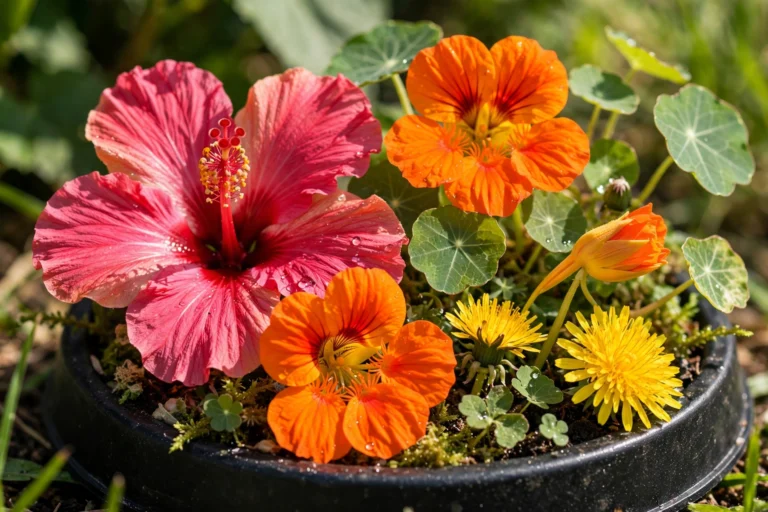
Offer the flowers too. The bright yellow heads are safe, most dragons find them irresistible, and they double as enrichment — a flower “hunted” from the salad bowl triggers foraging behavior. Dandelion blooms also appear on our list of 12 edible flowers your bearded dragon will love.
Frequency: daily, in rotation. Dandelion greens can appear in the salad bowl every day as part of a staple rotation with collards, turnip greens, mustard greens, or endive. There is no toxicity concern at normal salad quantities — the only real limit is your dragon’s willingness to eat greens at all, in which case bee pollen as an appetite enticer is worth trying.
Grow Your Own (The Zero-Worry Option)
If foraging spots near you fail the checklist, growing dandelions is almost comically easy: scatter seeds in a pot of organic soil, water, and ignore them. A pot on a sunny windowsill produces a steady supply of guaranteed-clean greens, and dandelions are one of the plants you can grow right inside the enclosure — see safe plants for bearded dragon tanks for the full list. Grocery-store dandelion greens (usually $2–3 a bunch in spring) are the other reliable fallback.
When Foraging Is a Bad Idea
Live in an apartment complex with a landscaping service? Near farmland or a golf course? In a neighborhood where every lawn gets the full chemical treatment? Then the honest answer is: do not forage. The risk is not the dandelion — it is everything humans put on the ground around it. Buy grocery-store greens or grow your own instead.