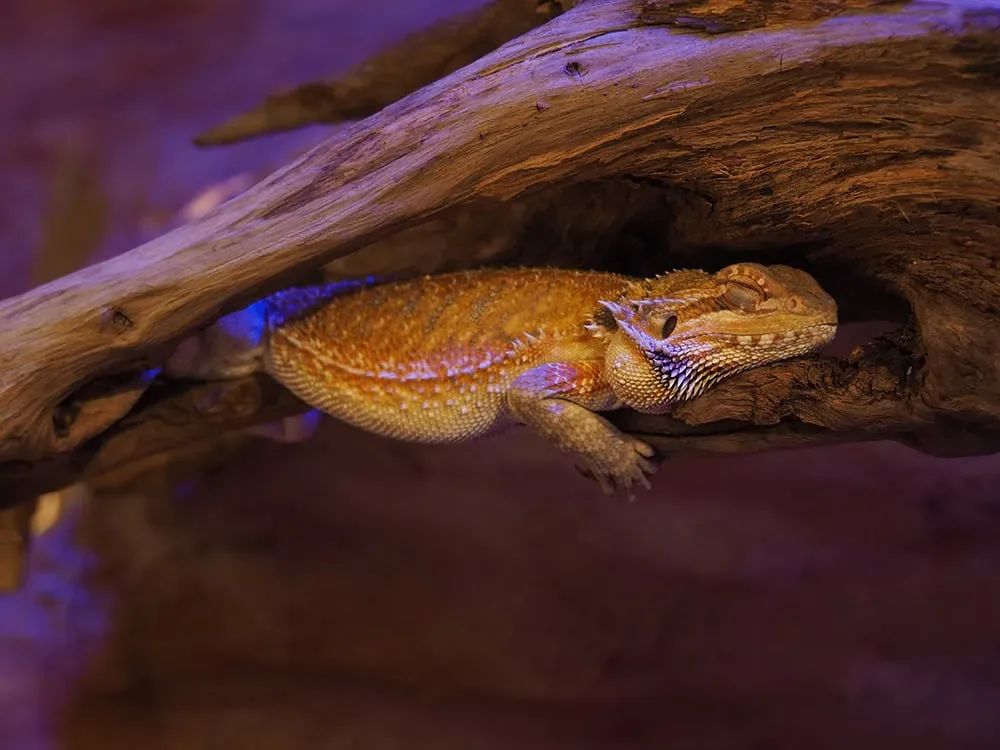
Do Bearded Dragons Need Night Heating?
Here’s a question that costs bearded dragon owners real money: is your house too cold at night for your dragon? Most of the time, the answer is no — and the “night heat” kit the pet store sold you is doing nothing but raising your electricity bill. But sometimes the answer is yes, and getting it wrong means a cold, stressed dragon.
The rule is simple: bearded dragons need nighttime temperatures above 65°F (18°C). If your home stays above that, turn everything off and let them sleep in the dark. If it drops below, you need heat without light. Enter your coldest overnight room temperature below and get a straight answer.
Why darkness matters more than warmth
Bearded dragons come from Australian deserts where nights are dark and cool — often dropping into the 60s. Their bodies expect a nightly cool-down. Melatonin cycles, digestion, immune function: all of it runs on the day/night rhythm. A dragon kept at 85°F around the clock under a glowing red bulb isn’t “cozy” — it’s chronically sleep-deprived.
This is the core mistake: owners feel cold at night, project it onto the dragon, and add heat the animal never asked for. Your dragon is not a mammal. It doesn’t need your 72°F living room; it needs the dark.
What does disrupted sleep actually look like? Dragons kept under 24-hour light or glow bulbs tend to show it as daytime lethargy — sluggish mornings, poor appetite, restless glass surfing at odd hours. Owners usually blame diet or UVB and buy supplements, when the fix is a $10 outlet timer and the courage to let the tank go dark. If your dragon’s days look tired, audit the nights first.
💡 Did you know? The “nighttime” red and blue bulbs sold in every pet store are one of the hobby’s longest-running scams. Reptiles can see red light — it washes out their night just like a white bulb does. Studies on reptile vision keep confirming it, and the bulbs keep selling. If it glows, it doesn’t belong on at night. Period.
Safe nighttime temperatures
| Overnight low | Verdict | Action |
|---|---|---|
| 75°F+ (24°C+) | Perfect | Everything off. Enjoy the dark. |
| 70–75°F (21–24°C) | Ideal range | Everything off. This is the sweet spot. |
| 65–70°F (18–21°C) | Safe | Everything off, but verify on the coldest winter nights. |
| 60–65°F (16–18°C) | Too cold | Add a CHE on a thermostat set to ~70°F. |
| Below 60°F (16°C) | Dangerous | CHE on thermostat immediately; find why the room is that cold. |
Night heating options, ranked
| Option | Light? | Verdict |
|---|---|---|
| Ceramic heat emitter (CHE) | None — pure infrared heat | ✅ The correct answer. Screws into a standard dome, lasts years. |
| Deep heat projector (DHP) | None | ✅ Also excellent; penetrates deeper, slightly pricier. |
| Under-tank heat mat | None | ⚠️ Only as a supplement; dragons sense heat from above, and mats can malfunction. Thermostat mandatory. |
| Red “nighttime” bulb | Yes — visible to dragons | ❌ Disrupts sleep. Marketing, not husbandry. |
| Blue “moonlight” bulb | Yes — visible to dragons | ❌ Same problem, prettier color. |
| Leaving the basking lamp on | Yes | ❌ Destroys the day/night cycle entirely. |
Setting up a ceramic heat emitter properly
A CHE is simple, but “screw it in and walk away” is how accidents happen:
- Use a ceramic-socket dome — CHEs get far hotter than bulbs; plastic sockets melt. The dome must be rated for ceramic emitters.
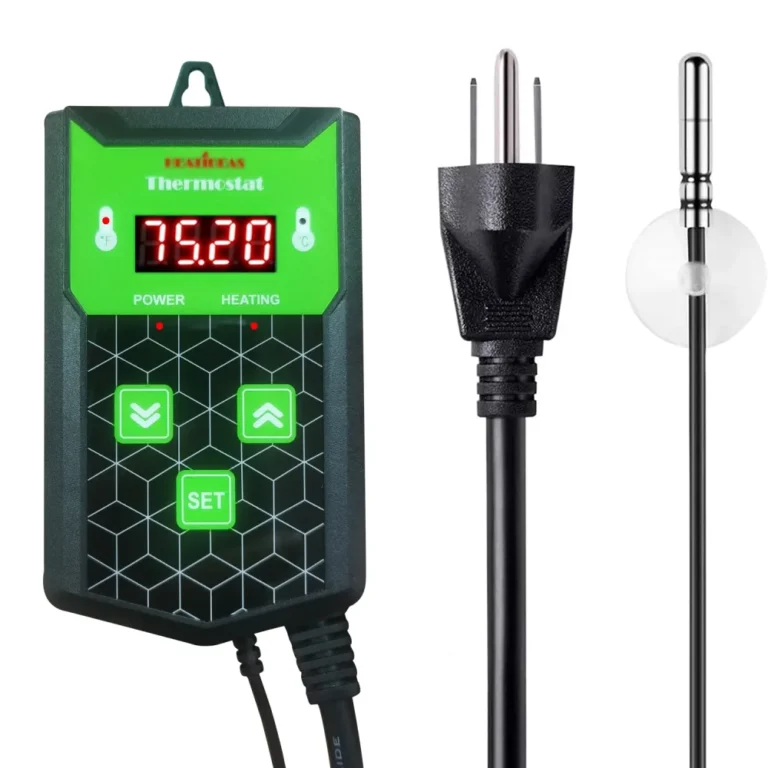
- Put it on a thermostat — set to ~70°F with the probe near the sleeping area. A CHE without a thermostat can push a small tank past 90°F overnight.
- Mount it where the dragon can’t touch it — inside the tank, a CHE needs a guard cage. Burns from unguarded CHEs are a real vet-visit cause.
- Only heat one end — even at night, give them a gradient. CHE over the warm third, cool end left alone.
- Size it right — 60W is plenty for most 4×2×2 tanks in a normal house. 100W+ is for genuinely cold rooms; oversized just means the thermostat cycles harder.
💡 Did you know? A CHE on a thermostat typically runs only minutes per hour in a normal house — it clicks on, nudges the warm end to 70°F, and clicks off. Owners who expect it to glow or hum think it’s broken. Silence is the sound of it working.
The thermometer is the whole game
Every night-heating decision above hinges on one number: your actual overnight low in the tank, not the thermostat on your hallway wall. Rooms stratify — the floor of a tank in a drafty corner can run 5°F colder than the room’s thermostat reading. Measure where the dragon sleeps.
The right tool is a digital thermometer with min/max memory (under $15): place the probe at the sleeping spot, check the recorded minimum in the morning. An infrared temp gun is great for basking spots but useless overnight — you’re not awake to point it. And those stick-on dial thermometers? Decorative. They measure the glass temperature, lag by hours, and are routinely 5–10°F off. One accurate overnight reading settles the entire “do I need night heat” question permanently.
💡 Did you know? The 65°F nighttime floor isn’t arbitrary — it mirrors the Australian desert nights bearded dragons evolved in, where temperatures regularly dip into the 60s even in summer. Your dragon’s physiology is literally built for cool, dark nights. “Room temperature” in most homes is already warmer than what wild dragons sleep in.
The winter problem
Most “do I need night heat?” cases are seasonal. The house is 72°F in October and 62°F in January. The smart move: put a cheap digital thermometer with a min/max memory in the tank in late fall and check the overnight low on a cold night. One measurement beats a season of guessing.
If you do add winter night heating, remember to remove or dial it back in spring. Year-round CHE use in a house that doesn’t need it just dries the air and wastes power.
What about brumation?
During brumation, dragons sleep for weeks with reduced heating — and that’s normal, not an emergency. Brumating dragons still shouldn’t drop below ~60°F, but the daytime basking routine goes quiet. Don’t confuse brumation cool-down with a heating failure: one is seasonal biology, the other is a cold house in July.
Night heating questions, answered
Can I just leave a low-wattage basking bulb on?
No. Any visible light disrupts sleep — wattage doesn’t matter, photons do. Heat without light (CHE/DHP) or nothing at all.
My dragon sleeps under the CHE — is that okay?
Yes, that’s exactly what it’s for. As long as it’s thermostat-controlled and guarded, sleeping in the warm zone is normal and healthy.
Do babies need night heating more than adults?
The temperature thresholds are the same (above 65°F), but babies have less thermal mass — they cool faster. In a borderline 65–68°F room, a baby benefits from a CHE set to 70°F where an adult would be fine without.
How long do CHEs last?
Years — typically 3–5 with normal use. They don’t burn out like bulbs because there’s no filament. If yours dies in months, suspect power surges or a cheap unit, and check that the dome is ceramic-rated (overheating kills them).
Is a heat mat enough instead of a CHE?
Not as the primary. Bearded dragons are basking animals wired to sense radiant heat from above; belly heat alone doesn’t register the same way, and mats are the most failure-prone heating element in the hobby. CHE first, mat only as backup — always on a thermostat.