Do Red Heat Lamps Hurt Bearded Dragons at Night?
Walk into a dark room where a bearded dragon sleeps under a red heat lamp and you will see a dim ruby glow — harmless-looking, barely brighter than a nightlight. The packaging said reptiles can’t see red light, so it should be invisible to the animal. There is just one problem: your bearded dragon can see red light perfectly well, and that faint glow is landing on its eyes all night.
The “invisible red light” claim is one of reptile keeping’s most persistent myths, and it survives because it sounds scientific. Below: the real biology of bearded dragon vision, where the myth came from, what constant dim light does to sleep and stress, and the night setup that actually works.
The Short Answer: Yes, Red Heat Lamps Can Hurt Bearded Dragons
Yes — red heat lamps can harm bearded dragons at night. Not because red light is toxic, but because a bearded dragon’s eyes register it, and a light that never goes out disrupts the sleep the animal needs. Chronic dim light at night is linked in reptile research to restless behavior, elevated stress hormones, and weakened immune function. The bulb’s label says “night”; the dragon’s eyes disagree.
In the wild, bearded dragons live in the Australian desert, where nights are dark and cool. Their whole biology runs on a hard contrast: blazing sun by day, real darkness by night. A red bulb replaces that darkness with a permanent dusk the animal never evolved to handle.
What Bearded Dragons Actually See
Humans are trichromatic: three cone types (roughly blue, green, and red) build our entire color world. Bearded dragons are tetrachromatic: four cone types, including one sensitive to long red wavelengths and another tuned to ultraviolet (UV-A) — a band of light your eyes cannot detect at all. Studies of diurnal lizard vision consistently show these extra channels in action: oil droplets inside the cones sharpen color discrimination, and behavioral tests confirm sensitivity stretching from UV on one end into deep red on the other.
The practical upshot is simple: a red glow that looks faint to you looks obvious to them. We see the bulb as a dim nightlight because our red sensitivity fades fast at low brightness; their dedicated red-sensitive cones keep registering it. “Reptiles can’t see red” was never true for a sun-basking, sharp-eyed diurnal lizard like Pogona vitticeps.
Myth: Reptiles can’t see red light, so red “night” bulbs are invisible to bearded dragons. Reality: Bearded dragons are tetrachromatic, with dedicated red-sensitive and UV-sensitive cones — they see red clearly, plus UV wavelengths you cannot see at all. To them, the bulb glows all night.
Where the “Night Bulb” Myth Came From
The red night bulb was invented for nocturnal reptiles — snakes and night geckos that are active after dark and do most of their seeing with rod cells rather than color cones. For those animals, a dim red bulb was a reasonable compromise: enough glow for the keeper to watch, dim enough that a rod-dominated eye barely notices. Then the product crossed over to diurnal species it was never designed for, sold by pet stores that treat “reptile” as one interchangeable category.
The packaging did the rest. A bulb labeled “nighttime” sounds purpose-built, and the claim that reptiles can’t see red sounds like biology, so keepers repeated it to each other for years. It belongs in the same drawer as other zombie myths — the persistent brumation myths that refuse to die among them — advice that survives because it was printed on a box, not because it was ever tested on a bearded dragon.
What All-Night Dim Light Does to a Sleeping Dragon
Bearded dragons sleep with their eyes closed, but closed eyelids are not blackout curtains — light still reaches the retina, and the brain still registers the difference between true dark and not-quite-dark. Research on light at night across vertebrates keeps finding the same pattern: chronic dim light flattens the day/night signal the circadian system depends on, fragments sleep, and keeps the animal in a low-grade state of alertness instead of deep rest.
Over weeks and months, that adds up. Keeper reports and veterinary observations link persistent nighttime light to restlessness after lights-out, suppressed appetite, and a general failure to settle — and stress research in reptiles connects chronic low-level disturbance to elevated stress hormones and reduced immune function. None of this shows up as a dramatic overnight collapse, which is exactly why the myth survives: the damage is gradual, cumulative, and easy to blame on something else.
65°F (18°C) — the nighttime temperature floor for bearded dragons. Above it, a healthy dragon needs zero supplemental heat at night, and most heated homes never drop below it. The red bulb is usually solving a problem that doesn’t exist.
Signs the Night Glow Is Bothering Your Dragon
Because the effects are gradual, look for patterns rather than single incidents: restlessness or scratching at the glass after lights-out, sleeping in odd exposed positions instead of a chosen hide, reluctance to settle at the usual bedtime, daytime lethargy, or a soft appetite with no other explanation. A dragon that sleeps soundly in a truly dark room and paces in a red-lit one is running the experiment for you.
One caution: these signs are not specific. Appetite changes and lethargy have many causes, from seasonal slowdown to illness — if removing the light doesn’t help within a week or two, or if you see weight loss, runny stool, or labored breathing, see a reptile vet before more husbandry tweaks.
The Night Setup That Actually Works
For most keepers the correct night setup is gloriously simple: lights off, room dark. Bearded dragons tolerate nighttime temperatures down to about 65°F (18°C) without any issue — Australian desert nights get properly cool, and the animals are built for it. A consistent bearded dragon day/night light schedule with a clean lights-out does more for sleep quality than any product on the shelf.
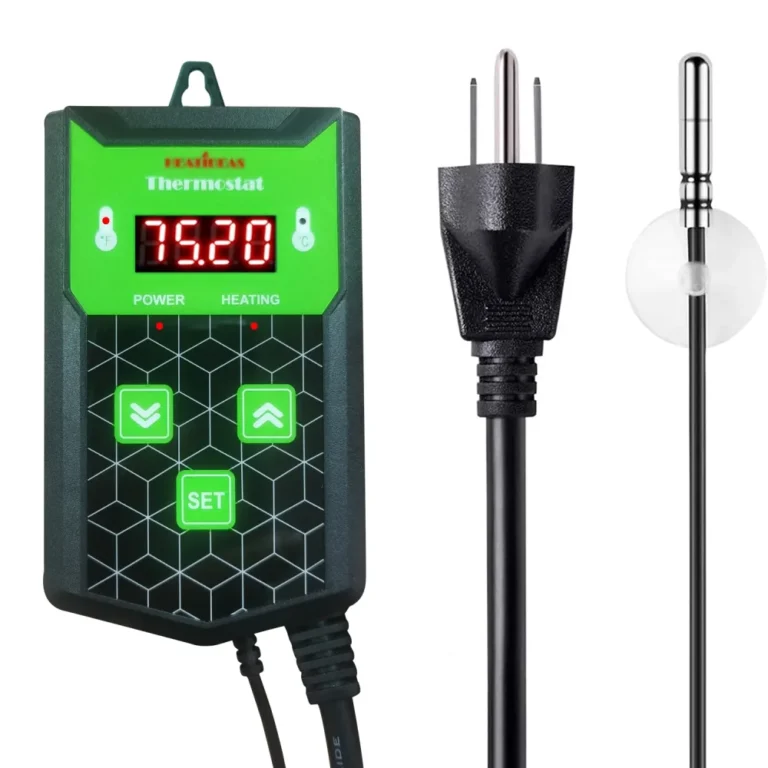
If your enclosure genuinely drops below 65°F — drafty rooms, cold climates, winter nights — the answer is a ceramic heat emitter (CHE): a bulb-shaped element that produces heat with zero visible light. Run it on a thermostat so it only kicks in when needed, and position it over the warm end so the cool end still drops naturally. Our night heating guide for bearded dragons walks through wattage, placement, and thermostat settings.
Note that black “moonlight” and blue “night” bulbs are not the fix — any visible glow is the same problem in a different color. Darkness is the product; the CHE just keeps the temperature honest.
Claim: Black “moonlight” or blue “night” bulbs are safer than red ones. Verdict: false. Bearded dragons detect those wavelengths too. The only supplemental heat source that emits truly zero light is a ceramic heat emitter — everything else is a compromise.
Making the Switch: Ditching the Red Bulb
- Measure first. Put a digital thermometer probe at the cool end and check the overnight low for two or three nights. Most keepers discover the tank never drops below 68–70°F and the red bulb was unnecessary all along.
- Swap the bulb. If temps hold above 65°F, simply stop using the night bulb — darkness is the upgrade. If they dip below, install a ceramic heat emitter on a thermostat instead.
- Give it a few nights. Expect the dragon to settle into a hide or sleeping spot earlier and sleep more soundly; the change is usually visible within days.
- Leave the day setup alone. Your daytime UVB lighting setup and basking temperatures stay exactly as they are — this change only affects the night.
In the wild, bearded dragons experience some of the sharpest day/night contrasts on the planet: fierce sun by day, pitch-dark cool desert by night. Their eyes and hormones are tuned to that contrast — a red bulb turns every night into a dusk that never ends.
👉 Next step: The right way to heat at night — CHE guide