What Tank Size Does a Bearded Dragon Need?
Here’s the mistake almost every new bearded dragon owner makes: they buy the tank the pet store recommends, and six months later they’re buying another one. The “starter kit” 20-gallon looks reasonable next to a four-inch baby. It looks absurd next to a ten-month-old dragon doing laps like a caged tiger.
Buy the right tank once and you never think about it again. Below is an interactive size recommender — tell it your dragon’s age and it tells you the minimum tank — plus a to-scale visual showing what the common sizes actually look like next to each other.
See the sizes to scale
Gallons are abstract. Here’s what the common tanks look like next to each other, drawn proportionally by footprint:
20 gal
nursery only
40 gal breeder
temporary
75 gal
short-term
4×2×2 ft / 120 gal
the buy-once standard
Drawn to proportional footprint scale. That little 20-gallon isn’t a home — it’s a waiting room.
The numbers, by age
| Age | Typical length | Minimum tank | Dimensions |
|---|---|---|---|
| 0–2 months | 4–6 in | 20 gal long | 30×12×12 in |
| 2–6 months | 6–11 in | 40 gal breeder | 36×18×18 in |
| 6–12 months | 11–16 in | 75 gal | 48×18×21 in |
| 12–18 months | 16–20 in | 120 gal (4×2×2 ft) | 48×24×24 in |
| 18+ months (adult) | 16–24 in | 120 gal minimum | 48×24×24 in |
The rule behind the numbers: a bearded dragon should be able to turn around comfortably and walk a proper heat gradient — hot end to cool end — without the gradient collapsing. That takes length. A 24-inch dragon in a 36-inch tank has 12 inches of gradient, which isn’t a gradient at all.
One caveat on the ages: growth rates vary enormously. A well-fed, properly-heated baby can hit juvenile size months ahead of schedule, while a rescue with a rough start may run small for its age. When in doubt, size the tank to the dragon in front of you, not the birthday — measure snout-to-tail and compare against the tank’s length. If the dragon is longer than half the tank, you’re already overdue for the next size up.
💡 Did you know? The “gallon” rating is almost useless for bearded dragons — it’s a fish measurement (volume). What matters is floor space: length × width. A tall 55-gallon has less usable space than a short 40-gallon breeder. Always shop by dimensions, not gallons.
Why the 4×2×2 is the buy-once answer
Three reasons this specific size became the community standard:
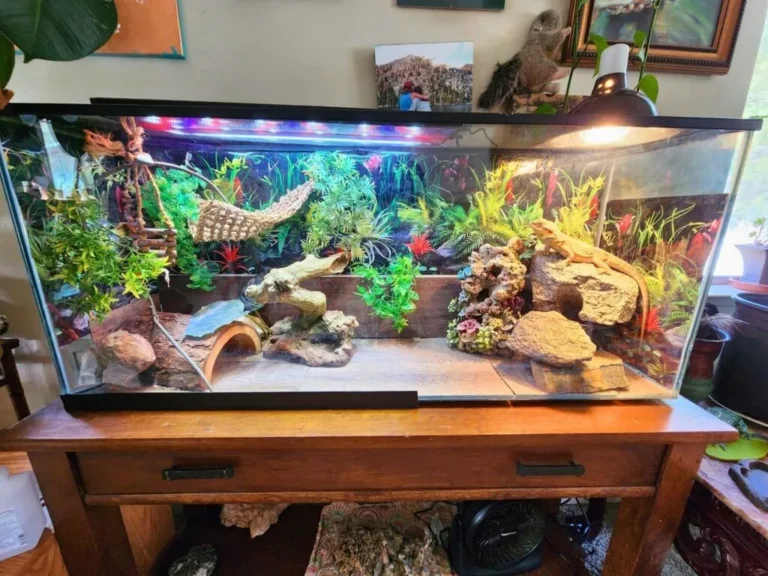
- It fits a real heat gradient. Four feet of length gives you a genuine 95–110°F basking zone on one end and a true 75–85°F cool end on the other, with usable middle ground. Shorter tanks compress the gradient until the “cool end” isn’t cool.
- It’s the last tank you’ll buy. A baby looks lost in it for about three months — feed in a separate bin during that phase if hunting seems hard — then grows into it and never outgrows it. Total tanks purchased: one.
- It’s the standard everything is built for. UVB tube lengths, background inserts, substrate quantities, decor sizing — the whole product ecosystem assumes 4×2×2. Odd sizes mean custom-cut everything.
The “but it’s too big for a baby” worry is the main objection, and it’s solvable: babies in big tanks sometimes struggle to find food. The fix isn’t a smaller tank — it’s feeding in a separate container or placing food in a consistent, visible spot. Don’t buy a $150 problem to solve a free one.
💡 Did you know? Glass surfing — frantic scratching at the walls — is one of the most common signs of an undersized tank. Before buying anti-stress gadgets or rearranging decor, measure the tank. A huge percentage of “behavior problems” are actually square-footage problems.
Tank types compared
| Type | Pros | Cons | Price range |
|---|---|---|---|
| Glass terrarium (front-opening) | Great visibility, holds humidity out, front doors = less stress | Heavy, expensive at 120 gal | $250–$500 |
| PVC enclosure | Lightweight, holds heat well, stackable | Scratches, less “display” look | $300–$600 |
| Wood/melamine vivarium | Best insulation, furniture look | Heavy, must seal against moisture | $200–$400 DIY |
| Standard glass aquarium (top-opening) | Cheap, widely available used | Reaching in from above stresses dragons; poor ventilation | $100–$250 |
Front-opening beats top-opening for one behavioral reason: bearded dragons are prey animals, and a giant hand descending from above reads as “hawk.” Front doors let them see you coming. If you already own a top-opening aquarium, it works — just approach from the side and let them see your hand first.
The used-tank playbook
A 120-gallon tank at retail stings. The secondhand market is the open secret of the hobby: reptile keepers upgrade, downsize, and leave the hobby constantly, and big tanks depreciate like cars. Check local reptile groups, marketplace listings, and expo “used equipment” tables — 4×2×2 enclosures regularly go for half retail or less.
What to check before you pay: run your hand along every silicone seam (glass tanks) or corner joint (PVC) feeling for gaps or peeling; look for cracks, not scratches — scratches are cosmetic, cracks are structural; and ask what lived in it last. Then disinfect properly regardless of the answer: scrub with a reptile-safe disinfectant or a 10% bleach solution, rinse thoroughly, air-dry in sunlight if you can, and replace any porous decor that came with it. A used tank plus an hour of cleaning beats a new 40-gallon at the same price every single time.
💡 Did you know? The single most expensive way to house a bearded dragon is buying tanks in sequence: a 20-gallon kit ($150), then a 40-gallon ($200), then finally the 4×2×2 ($350). That ladder costs $700 and every step was avoidable. The cheapest way is one used 4×2×2 for $150–$200 on day one.
Signs the tank is too small
- Glass surfing — persistent scratching at the walls, especially after ruling out temperature and reflection causes
- No real gradient — cool end reads above 85°F because the basking lamp heats the whole box
- Can’t turn around — the dragon’s body length approaches the tank’s width
- Decor Tetris — basking spot, hide, food dish, and water can’t all fit without blocking the walking lane
- Lethargy — some dragons in cramped tanks simply shut down and stop exploring
If you’re seeing two or more of these, the tank isn’t a preference issue — it’s a welfare issue. Upgrade before buying anything else.
Tank size questions, answered
Can a tank be too big for a baby?
Not in any way that matters. The concern is hunting difficulty, which you solve by feeding in a separate bin — not by buying a tank you’ll replace in four months.
Is a 40-gallon breeder okay for an adult?
No. It’s the most common undersized-adult setup in the hobby. A 40 breeder is 36 inches long; an adult dragon is up to 24 inches. There’s no room for a gradient, enrichment, or turning around comfortably.
What about height — do they need a tall tank?
Bearded dragons are terrestrial, not climbers. Floor space matters far more than height. 24 inches of height is plenty and keeps UVB distances manageable; taller tanks just push the lights further from the basking spot.
Can I build my own enclosure?
Absolutely — DIY melamine or plywood vivariums are popular and cheap. Seal all surfaces against moisture, ensure ventilation, and keep the 48×24×24 in minimum footprint.
How do I upgrade without stressing my dragon?
Set up the new tank fully first — temps verified, decor placed — then move the dragon over in one go. Keep one familiar hide or branch so something smells like home. Expect 2–3 days of cautious exploring; that’s normal, not a problem.