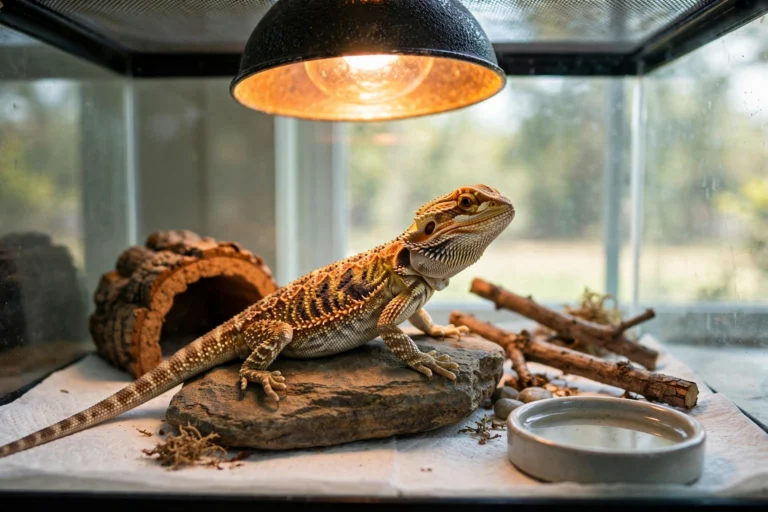
How Humid Should a Bearded Dragon Tank Be?
Every bearded dragon owner obsesses over temperature — basking spot, cool side, nighttime drop. But there’s a second invisible number quietly shaping your dragon’s health, and most keepers never check it: humidity. Too much moisture in the air and you’re inviting respiratory infections, the single most common humidity-driven illness in captive bearded dragons. Too little, and shedding turns into a stuck-on mess while your dragon’s hydration suffers.
The good news is that humidity is one of the easiest parameters to manage once you know the target and own a decent gauge. This guide gives you the exact range to aim for, where to place your hygrometer so the reading actually means something, how to tell whether your current setup runs damp or dry, and fast fixes for both problems — plus a two-minute daily routine that keeps the number in the safe zone without any fuss.
The short answer: keep your bearded dragon’s tank between 30% and 40% relative humidity, measured on the cool side at mid-height. Brief spikes after misting or a bath are fine; a tank that sits above 50% for days is not.
💧 Humidity Health Checker
Enter your current reading and where your gauge sits — get an instant verdict with fixes.
Current humidity reading (%)
e.g. 45
Where is the gauge?
Cool side, mid-height (correct spot)
Check my humidity
Why Humidity Matters for Bearded Dragons
Bearded dragons evolved in the arid woodlands and deserts of Australia, where daytime humidity often sits between 20% and 40%. Their respiratory systems are built for that dry air. When a captive tank holds damp air day after day — from an oversized water bowl under the heat lamp, soggy substrate, a covered screen top, or a room that runs humid in summer — the dragon is breathing air its lungs were never designed for.
The main danger is respiratory infection: bacteria thrive in warm, moist air, and a dragon breathing it around the clock is far more vulnerable. Early signs are subtle — occasional gaping when not basking, faint clicking or wheezing sounds, mucus around the nostrils, lethargy. By the time the symptoms are obvious, the infection usually needs a reptile vet and antibiotics. Humidity doesn’t guarantee illness, but chronic dampness stacks the odds badly against your dragon.
On the dry extreme, problems are milder but real: stuck shed that clings to toes and tail tips, and a slow drag on overall hydration — especially in winter when indoor heating drops room humidity into the teens. The goal isn’t a rainforest or a kiln; it’s the boring middle.
Stat: Respiratory infections are one of the most common reasons bearded dragons visit reptile vets, and chronic humidity above 50% is a frequently identified husbandry contributor. A $10 digital hygrometer is one of the cheapest insurance policies in the hobby.
The Ideal Range: 30–40%, and Why Brief Spikes Are OK
The community consensus target is 30–40% relative humidity during the day, measured on the cool side. Nighttime readings will naturally climb a few points as the tank cools — that’s normal and harmless, since cooler air holds less moisture and the percentage math shifts even when the actual water content doesn’t.
Don’t panic over short spikes. A bath, a fresh water bowl, or a light misting of the cool-side decor can push the gauge to 50%+ for an hour or two. What matters is where the tank lives — the average across the day. A tank that reads 35% at noon, 45% right after you change the water, and 38% in the evening is perfectly healthy. A tank that reads 55% every single morning has a problem to fix.
If you take one number from this article, it’s this: under 50% sustained, ideally 30–40%. Everything below is about hitting that reliably.
Hygrometer Placement: Cool Side, Mid-Height, Away From Water
A hygrometer in the wrong spot gives you a confidently wrong number — worse than no gauge at all, because you’ll make decisions on bad data. The three placement rules:
Cool side of the tank. This is the standard reference point across care guides. Warm air holds more moisture, so a gauge under the basking lamp always reads drier than the tank average.
Mid-height — roughly at your dragon’s back level. Don’t lay it on the substrate (dampest micro-zone: spilled water, urate moisture, substrate humidity) and don’t stick it to the top of the glass (driest zone, right under the screen).
Away from the water bowl. The air directly above a water dish can read 10–20 points higher than the rest of the tank. Give the gauge at least a foot of clearance from any water.
If you run two gauges — one cool side, one warm side — even better: the pair tells you the tank’s real gradient. But if you only buy one, cool side at mid-height is the one.
Digital vs Analog: Why Cheap Dial Gauges Lie
Those little round stick-on dial gauges sold in pet stores are notoriously inaccurate — commonly off by 10–20 percentage points, and they drift further as they age. A dial reading “40%” might mean anything from 25% to 55% in reality, which makes it useless for the exact decisions humidity requires.
A digital hygrometer with a probe costs about the same and is dramatically more trustworthy. Look for one with a remote probe on a wire: mount the probe at mid-height on the cool side and keep the display unit outside the tank where you can read it at a glance. Combo thermometer/hygrometer probes are ideal since you’re already monitoring temperatures. Check out our bearded dragon tank setup checklist if you’re still assembling your monitoring gear.
Myth vs. reality: “Bearded dragons need daily misting like tropical reptiles.” Reality: routine misting of the dragon is unnecessary and can push a small tank’s humidity too high. Light, occasional misting of cool-side decor to aid shedding is fine — but a dragon that needs constant misting usually has a hydration or humidity-balance problem worth fixing at the source instead.
Signs Your Humidity Is Too High
Your dragon and your tank both leave clues when the air stays too damp:
Condensation on the glass most mornings — the clearest red flag.
Musty or swampy smell when you open the tank, even right after spot-cleaning.
Substrate that stays damp to the touch hours after any spill.
Mold or mildew on decor, backgrounds, or wood hides.
Gaping, wheezing, or mucus around the nose — possible respiratory irritation; if these appear, see a reptile vet rather than just adjusting humidity.
Signs It’s Too Low
Chronically dry air (sustained under ~20–25%) shows up differently:
Stuck shed — skin clinging to toes, tail tip, or around the eyes instead of flaking off cleanly. Our shedding guide covers the full shed-week routine.
Wrinkly, slow-to-smooth skin and generally dull coloration between sheds.
A dragon that soaks constantly in its water bowl may be compensating for dry air (though frequent soaking can also signal mites or overheating — context matters).
Too high (over ~50% sustained) Too low (under ~20% sustained)
Morning condensation on glass Shed sticking to toes and tail tip
Musty smell, damp substrate Wrinkly skin between sheds
Mold on decor or backgrounds Constant water-bowl soaking
Gaping/wheezing (vet visit) Dull color, slow shed cycle
5 Fixes for High Humidity
If your gauge keeps reading above 50%, work through these in order — most tanks are fixed by the first two:
Open up the ventilation. Screen tops exist to breathe. If you’ve covered most of the lid with towels or foil to hold heat, you’re also trapping moisture. Uncover as much as you can while keeping basking temps right — a thermostat helps you hold temperatures with less lid coverage.
Move the water bowl to the cool side — fully onto the cool end, away from the basking lamp. A bowl under the heat lamp is a humidifier. In stubborn cases, switch to a smaller bowl; your dragon doesn’t need a swimming pool.
Swap damp substrate. Loose substrates that got wet (from spills, water bowl splashes, or high room humidity) hold moisture for days. Tile, non-adhesive shelf liner, or fresh paper towel run drier and are trivially easy to keep that way.
Stop misting routines until readings stabilize. Misting has its place for shedding help, but daily whole-tank misting in an already-damp tank is working against you.
Dehumidify the room, not the tank. If you live somewhere humid and the whole room sits at 60%+, no tank tweak will win. A small room dehumidifier near the enclosure fixes the source.
Fixes for Low Humidity
Dry tanks are the easier problem. Move the water bowl slightly toward the middle (more evaporation surface in warmer air), add a second small water dish if the tank is large, and give the cool-side decor a light misting in the morning. In winter, when home heating drops indoor humidity into the teens, a room humidifier near — not pointed at — the tank does more than any in-tank trick. Avoid the temptation to seal the lid: trapped heat with a basking lamp is a fast route to dangerous temperatures.
Did you know: Central Australia, the bearded dragon’s native range, swings from around 20% humidity on hot afternoons to 60–70% on cold desert nights. Your dragon is built to handle humidity swings — what it never evolved for is warm, constantly damp air with no dry period.
Your 2-Minute Daily Humidity Routine
Humidity management doesn’t need to be a project. Fold it into your morning check:
Glance at the hygrometer while the lights warm up — you’re looking for 30–40%, not an exact number.
Check the glass for condensation. None on most mornings means ventilation is doing its job.
Eyes on the water bowl — still on the cool side, not spilled into the substrate.
Sniff test. A healthy tank smells like nothing. Musty means investigate.
That’s it. Two minutes, once a day, and humidity becomes one of those parameters you simply never worry about again — which is exactly what it should be: boring, stable, and in the 30–40% zone where bearded dragons thrive.
What to Read Next
Bearded Dragon Tank Setup Checklist: Everything You Actually Need
Bearded Dragon Shedding Guide: Timeline, Help, and Stuck Shed
Bearded Dragon UVB Lighting: The Complete Setup Guide