How to Keep a Bearded Dragon Warm Without Power
It is 2 a.m. The house is dark, your bearded dragon’s tank lights are dead, and the utility’s estimate just says “crews are assessing.” The glass box your dragon sleeps in is losing heat with every passing minute.
A short outage is survivable — keepers get through winter blackouts every year without losing animals. But “short” has a hard limit most owners do not know. Here is the hour-by-hour plan: the two temperature lines that matter, which emergency heat sources work, the mistakes that make a cold dragon colder, and what to do when the lights come back on.
The 65°F rule. With room temperatures above 65°F, a healthy adult bearded dragon can typically go up to 12 hours without supplemental heat. Below 65°F the safe window shrinks to a few hours — and below 60°F, signs of serious cold stress can appear within 1 to 2 hours. Juveniles, sick dragons, and recent rescues have less margin at every step.
The two temperature lines that decide everything
65°F is the action line. It is the lowest safe nighttime temperature under normal conditions, which is why keepers in cold houses use night heating options like ceramic heat emitters. In an outage, dropping below 65°F means stop waiting and start actively heating — blankets on the tank, warm water bottles, hand warmers. Not in an hour. Now.
60°F is the distress line. Below it, the body starts shutting down non-essentials fast: movement slows, responsiveness fades, digestion stops. A dragon sitting at 58°F is not “resting” — it is in trouble, and improvised tricks are no longer enough. That is car-heater or drive-to-a-friend territory.
Watch the dragon, not just the thermometer. A too-cold dragon darkens its skin, goes flat and still, and stops reacting normally. If you are seeing that kind of cold-induced lethargy, trust the animal over the gauge — act first, measure second. And hatchlings chill far faster than adults, so run every phase below one step more urgently for dragons under six months old.
Your outage heating calculator
A three-hour summer blip and a twenty-hour winter blackout are different emergencies. Set your room temperature and expected outage length — the calculator builds your hour-by-hour action timeline.
Outage Heating Calculator
Set your conditions.
The hour-by-hour action plan
The calculator customizes the timeline to your situation — here is the full playbook behind it.
Hour 0 to 1: Insulate everything. Before adding heat, stop the heat you have from escaping: blankets or towels over the top and three sides, a small ventilation gap left open, the room door closed with a towel rolled against it. Skip this step and everything after works half as well.
Hour 1 to 3: Hot water bottles. The workhorse of outage heating. Heat water on a gas stove, grill, or fireplace kettle until wrist-comfortable — if it is uncomfortable for you, it will burn your dragon. Fill bottles or sealed jugs, wrap each in a towel, and set them inside the tank near your dragon, never underneath. Refill every one to two hours. The towel layer is non-negotiable: reptiles are poor judges of surface heat.
Hour 3 to 6: Hand warmers and body heat. Activate air-activated hand warmers, wrap each in a sock or cloth, and tuck them beside your dragon — never on top, never unwrapped. Rotate in body-heat sessions: dragon in a breathable pillowcase under your shirt while you stay awake and aware. You run near 98°F, an excellent emergency heater — with one iron rule: never fall asleep holding your dragon.
Hour 6 to 12: Car warm-up sessions. If the house is still cold, the car becomes your heater: ventilated carrier, 20 to 30 minutes of car heat, then back to the insulated tank. Same principles as transporting in an emergency — secure carrier, ventilation, eyes on the animal. Never leave a dragon unattended in a car.
Hour 12 and beyond: Evacuate to power. Past twelve hours in a cold house, improvised heat becomes a gamble. Move your dragon to a friend’s powered home, a reptile shop, or an exotic vet that boards — call first. Decide your evacuation destination before the outage, not during it.
A bearded dragon that darkens its color in a cold tank is doing it on purpose — dark skin absorbs more radiant heat. A chilled dragon will deliberately go dark and flatten its body to squeeze warmth out of whatever heat remains. Smart survival trick, and your cue the tank is too cold.
Emergency heat sources, ranked
Not all backup heat is equal, best to last resort:
- Hot water bottles (wrapped). Cheap, controllable, refillable as long as you can heat water. The gold standard.
- Wrapped hand warmers. Air-activated warmers run 6 to 10 hours with no flame — cloth barrier mandatory, beside the dragon, never underneath.
- Your body heat. Free, always available, self-regulating. Supervised only.
- The car heater. Great for rewarming sessions; impractical all night.
- A generator or battery power station. The only option that restores the real setup — actual basking lamp, actual UVB. If outages are common where you live, this is the best preparedness purchase you can make.
- A propane or kerosene space heater for the room. Works, with conditions: ventilation mandatory, never inside or against the tank, carbon monoxide is odorless. Skip it if you are unsure about safe operation.
One warning on heat rocks and heat mats: unregulated belly heat is a leading cause of thermal burns, because dragons will sit on a dangerously hot surface without moving away. The thermostat guide explains why the thermostat rule is absolute.
Myth: “Just wrap your dragon in a blanket — that will warm it up.”RealityBlankets do not generate heat; they only trap it. Wrapping an already-cold dragon insulates the cold in. Blankets belong on the tank, trapping warm air inside — the dragon needs an actual heat source: warm water, a wrapped hand warmer, or your body.
What never to do
- No candles or open flames near the tank. Fire risk aside, combustion eats oxygen and produces carbon monoxide — a second emergency stacked on the first.
- No boiling water in bottles. “Warm” means wrist-comfortable; scalding water can burn through the towel wrap.
- No feeding during the outage. Without basking-range heat, food sits undigested in a cold gut — offer water, not food.
- No blast-furnace rewarming. Bring temperatures up gradually; a freezing-cold dragon shoved under a 110°F lamp risks thermal shock.
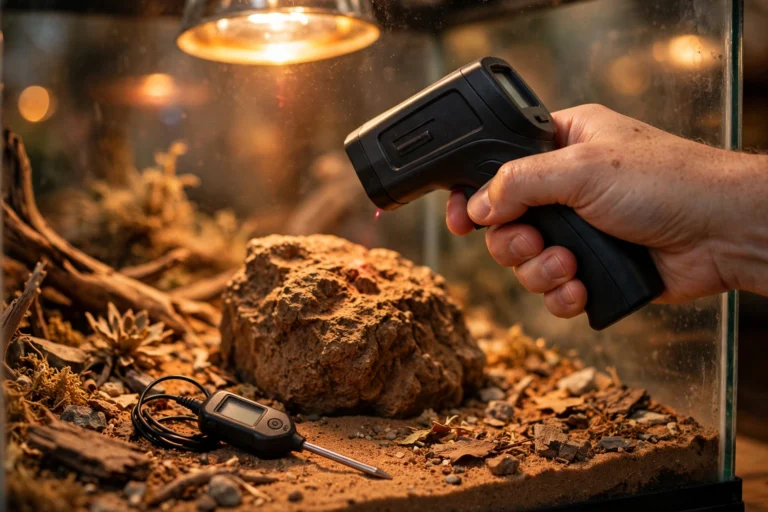
- Do not trust your hand on the glass. Glass lies — measure with a probe thermometer or temp gun every 30 to 60 minutes.
When the power comes back
Verify before you trust. Confirm the basking spot is back to your normal basking temperature targets. Then check the light timer — cheap mechanical timers lose programming in outages and can run hours off-phase for weeks unnoticed.
Wait to feed. Give a full hour of proper basking heat first, then a small meal. Water before food, always.
Watch the recovery. A dragon that basks, brightens, and moves normally within hours is fine. One still showing cold-induced lethargy a full day after temperatures normalized — flat, dark, unresponsive — needs a reptile vet, not more waiting. Cold stress suppresses the immune system, and respiratory infections often follow a week or two later. Note the outage date; if raspy breathing or mucus appears in the following days, that timeline matters to your vet.
Build your outage kit this weekend
Everything in this guide fits in a small box: air-activated hand warmers, two hot water bottles, a fleece blanket, a digital probe thermometer, a ventilated carrier, and your vet’s number taped inside the lid. Assemble it before you need it. Add the warmers and a backup thermometer to your bearded dragon starter kit as emergency supplies, and keep the box where you can grab it in the dark.
What to Read Next
- Bearded Dragon Light Schedule Guide (2026) — reset the day/night rhythm after an outage disrupts it.
- Deep Heat Projector vs Basking Bulb for Bearded Dragons — which heat source recovers your gradient fastest.
- Bearded Dragon Thermostat Setup Guide (2026) — keep the recovery stable and prevent the next temperature emergency.
Outage questions, answered
Can my dragon sleep in bed with me during an outage?
Supervised body-heat sessions are great; sleeping with your dragon is not — crush risk. Stay awake, or return them to the insulated tank.
How often should I check the temperature?
Every 30 to 60 minutes with a probe thermometer or temp gun — more often as the room gets colder.
The room feels fine to me but my dragon is dark and flat.
Your comfort means nothing — you run at 98°F in clothes. Trust the thermometer and the dragon’s behavior, not your own skin.