Tank Decor Ideas That Keep Your Bearded Dragon Active
Most bearded dragon tanks look like a real estate listing: empty, sterile, and staged for the photo. Then the owner wonders why their dragon glass surfs all day. Here is the uncomfortable truth — a bare tank is not minimalism, it is boredom. In the wild these animals patrol territory, climb, dig, and hunt. A tank with a water bowl and a sad plastic plant gives them exactly one activity: pacing.
Enrichment does not mean a jungle. It means giving your dragon choices: climb or hide, bask or cool, dig or perch. Start with the scorecard below — check off what your tank already has and get an honest grade.
Why enrichment is not optional
In the wild, a bearded dragon’s day is busy: patrolling territory, thermoregulating across microclimates, hunting, climbing to survey, digging, hiding from predators. Every one of those behaviors has a neural circuit behind it, and circuits that never fire do not go quiet — they misfire. That is what stereotypic behaviors are: glass surfing, pacing, clawing at nothing. Not “personality.” Not “he is just active.” Under-stimulation.
The fix is embarrassingly simple once you see it: a tank should offer choices. Hot or cool. High or low. Hidden or exposed. Rough or smooth. Every choice you add is a behavior your dragon gets back.
💡 Did you know? Wild bearded dragons are semi-arboreal — researchers regularly find them basking on fence posts, low branches, and rock piles, sometimes several feet off the ground. The “desert ground-dweller” image that justifies flat, branchless tanks is incomplete. Your dragon wants to climb.
The non-negotiable core
Before anything decorative, four items are functional requirements, not enrichment:
| Item | What it does | Placement |
|---|---|---|
| Basking platform | Raises the dragon into the correct UVB/heat zone | Hot end, under both lamps |
| Cool hide | Dark, enclosed retreat for stress relief and sleep | Cool end |
| Warm hide | Security without sacrificing warmth | Warm end, out of direct basking beam |
| Water dish | Drinking, soaking, micro-humidity | Cool end (less evaporation) |
If any of these four are missing, stop reading about enrichment and fix the foundation first. A dragon without a hide does not need a hammock — it needs a hide.
Levels: the cheapest transformation
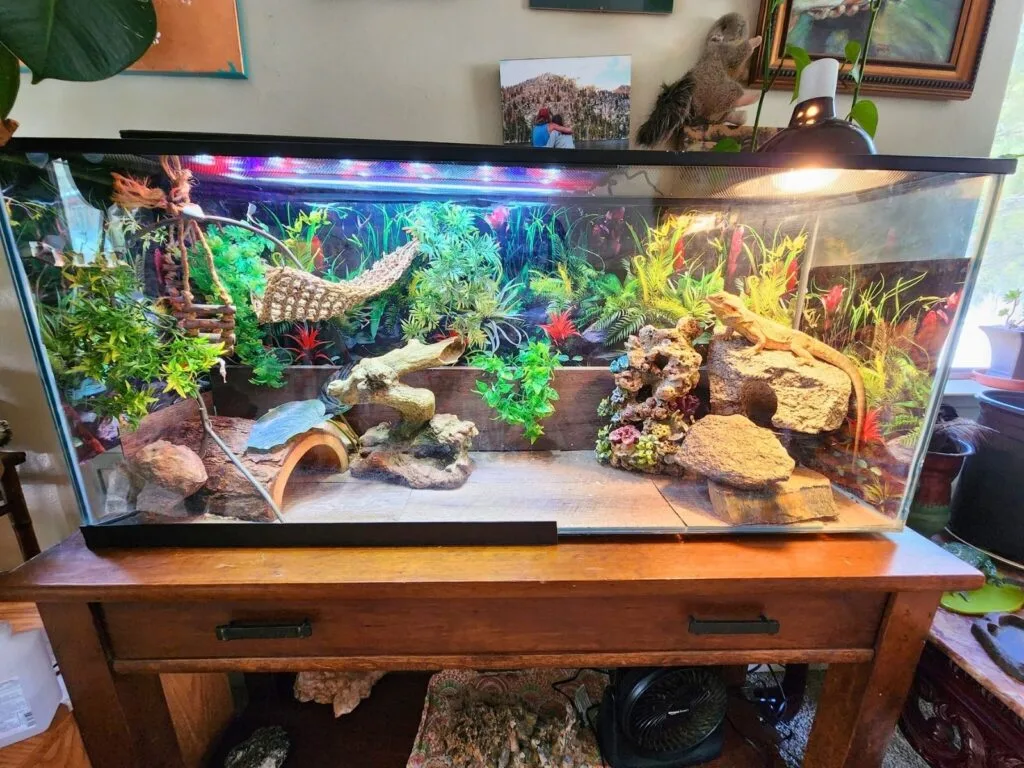
The single biggest upgrade most tanks need costs nothing: stop keeping everything on one flat plane. Stack slate into a stepped platform. Lean cork bark to make a ramp. Put the basking spot on a raised shelf. Suddenly your 4×2×2 has three microclimates instead of one, the dragon can choose its height (which changes its UVB exposure and temperature simultaneously), and the tank looks twice as interesting.
Safety rules for stacking: everything must be stable — a collapsing rock pile can crush a dragon. Test every stack by pushing it firmly; if it wobbles, rebuild it. Heavy items go directly on the tank floor, never balanced on substrate that can shift. And keep climbing structures away from the top screen: a dragon that can reach the screen can reach the heat lamp.
💡 Did you know? The famous bearded-dragon hammocks are controversial for a reason: dragons love lounging in them, but the mesh versions snag claws and the suction cups fail without warning — dropping the dragon. If you use one, get a solid fabric hammock with secure mounts, and hang it low. A fall from the top of the tank onto tile is a vet visit.
Foraging: make them work for it
In the wild, food does not arrive in a bowl. Captive dragons fed exclusively from a dish lose the hunting sequence — stalk, chase, strike — that is core to who they are. Easy fixes:
- Release feeders into the tank instead of a separate bin sometimes (dubias, not crickets — crickets hide and then bite sleeping dragons).
- Clip greens in different spots — hang collards from a branch clip, scatter squash pieces, wedge dandelion greens into bark crevices.
- The blueberry hunt: hide a few blueberries around the tank once a week. Watching a dragon systematically search is the best entertainment in the hobby.
- Rotate feeder types — novel prey triggers stronger feeding responses than the same dubias every day.
Plants: real vs. silk
| Real plants | Silk plants | |
|---|---|---|
| Pros | Humidity micro-zones, nibbling enrichment, looks great | Indestructible, zero maintenance, cheap |
| Cons | Dragons sit on them; need light and watering | No biological benefit; cheap ones look cheap |
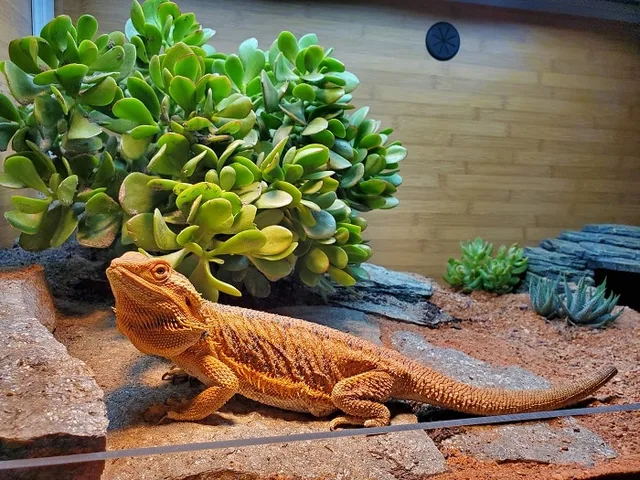
| Best picks | Prickly pear, aloe, haworthia, spider plant | Anything without sharp wire cores or loose parts |
| Verdict | Best if you will maintain them | Better than nothing — and nothing is the alternative for most people |
One warning for both: check that nothing has sharp wire stems, detachable small parts, or pesticide residue. Dragons taste-test their decor.
The monthly rotation habit
Here is the enrichment secret that costs zero dollars: change one thing a month. Move the branch to the other side. Swap the basking platform for a different rock. Hang the greens somewhere new. Rearrange the hides. Novelty triggers investigation behavior — your dragon will spend days re-exploring a tank it previously ignored, just because the furniture moved.
Keep a “decor box” with a few spare items (extra bark, a second hide, different textured tiles) so rotation does not mean buying something every month. Zoos do exactly this — it is called environmental rotation, and it is standard practice for intelligent captive animals. Your dragon qualifies.
💡 Did you know? Bearded dragons can learn simple routines and recognize their keepers — studies on reptile cognition keep revising “how smart” upward. An animal capable of learning is an animal capable of boredom. Enrichment is not pampering; it is meeting the needs of the brain you bought.
What to skip
- Colored “decor” gravel or sand art — ingestion risk, zero function.
- Tiny plastic plants with wire stems — impalement and ingestion hazards.
- Heat rocks — burn risk, always. (Yes, still. No, not even the new ones.)
- Anything you cannot clean — porous, fuzzy, or intricate decor becomes a bacteria hotel. If you cannot wipe it or bake it, do not buy it.
- Overcrowding — enrichment means choices, not clutter. The dragon still needs open floor to walk. If decor blocks the walking lane, remove something.
Decor questions, answered
How much decor is too much?
When the dragon cannot walk a straight line from the basking spot to the cool end without climbing over things. Open floor space is itself enrichment — it is the patrol route.
My dragon ignores all the decor — is enrichment pointless?
Give it two weeks, and check your temperatures first — a cold dragon will not explore anything. Also try moving items: “ignored” often means “in the wrong spot.” The branch nobody touches on the cool end becomes the favorite perch on the warm end.
Are mirrors or “buddy” toys a good idea?
Not recommended — most dragons treat the reflection as a rival (head bobbing, black bearding); a few individuals ignore it, but the risk of chronic stress isn’t worth it. Skip anything that looks like another dragon.
Can I take my dragon outside for enrichment?
Supervised outdoor time is fantastic enrichment — real sun, real smells — with rules: secure harness or enclosed pen (never free-roam; they are faster than you think), no pesticide-treated grass, watch for birds overhead, and bring them in before they cool down. Fifteen to thirty minutes on a warm day.
Do I need to rearrange, or is a good setup enough?
A good setup is 80% of it. The monthly rotation is the remaining 20% — free, easy, and surprisingly effective at triggering curiosity in a “finished” tank.