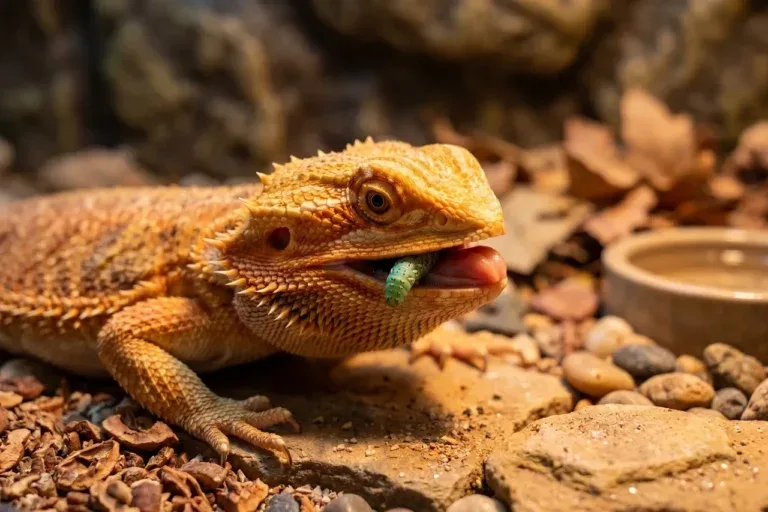
The Bearded Dragon Dusting Schedule That Actually Makes Sense
Calcium dusting is the most routine thing in bearded dragon care and somehow the most argued-about. How often? With D3 or without? What about multivitamins? Ask five keepers and you’ll get seven schedules. The disagreements aren’t random, though — they trace back to one variable most schedules don’t name: your UVB setup.
Answer two questions below and get a dusting schedule calibrated to your actual situation — then read on for why it looks the way it does.
Why dusting exists at all
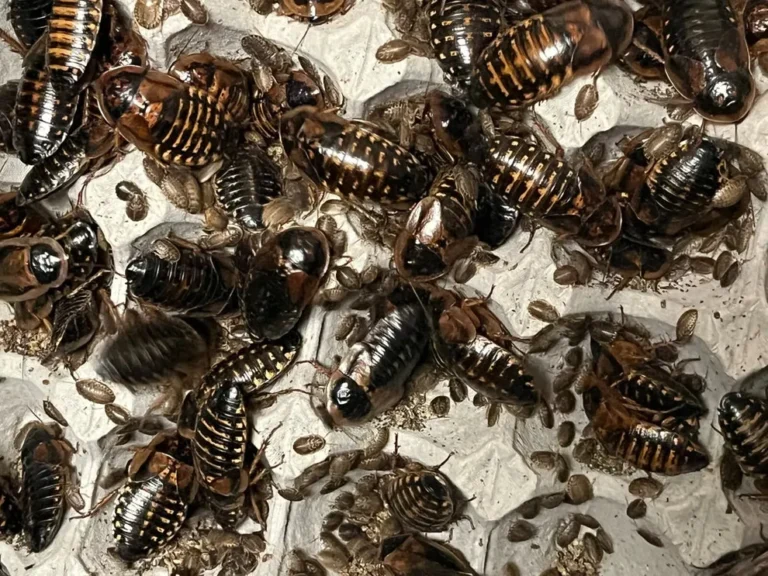
Most feeder insects contain more phosphorus than calcium. Bearded dragons need their overall diet to run roughly 2 parts calcium to 1 part phosphorus. When the ratio inverts — as it does with undusted crickets or dubias — the body still needs calcium for bones, nerves, and muscles, so it pulls it from the skeleton. Keep doing that for months and you get metabolic bone disease: soft jaws, bent limbs, tremors, fractures. It’s the most common nutritional disease in captive reptiles, and it’s a husbandry failure, not bad luck.
Calcium powder exists to fix the ratio. That’s the whole job. Everything else — D3, multivitamins — is a separate question layered on top.
💡 Did you know? A 2026 peer-reviewed study on bearded dragons found that 12 hours of daily UVB raised blood calcium significantly — while the type of supplement (calcium vs. calcium+D3, carbonate vs. gluconate) made no measurable difference. The takeaway researchers keep landing on: fix the UVB first. Supplements are the backup singers, not the headliner.
The three powders, and what each one does
| Powder | Job | How often (typical range) |
|---|---|---|
| Plain calcium (no D3) | Fixes the Ca:P ratio of insects | Every feeding for juveniles; 3–4×/week for adults |
| Calcium + D3 | Calcium plus the vitamin that helps absorb it — insurance for imperfect UVB | 1–3×/week depending on UVB strength and age |
| Multivitamin | Vitamin A (as beta-carotene), B vitamins, trace minerals | 2×/week juveniles; 1×/week adults |
Use a phosphorus-free calcium powder. And here’s the principle that resolves most schedule arguments: plain calcium is hard to overdo; D3 and multivitamins are easy to overdo. When a schedule disagrees with another schedule, the safe default is more plain calcium, less of everything else.
The D3 question (why everyone disagrees)
D3 is the most argued-about number in the hobby: some keepers use D3-calcium five times a week for babies, others barely once a week, and both have healthy dragons. The disagreement dissolves once you see the hidden variable — UVB quality.
Under a strong T5 tube (Arcadia 12%, Zoo Med 10.0, replaced on schedule), the dragon manufactures its own D3 from UVB — that’s the primary source, and research shows UVB-raised dragons achieve far higher safe D3 blood levels than D3-supplemented ones. Dietary D3 on top of strong UVB is redundant at best. Under a weak coil bulb or an expired tube, the dragon can’t make enough D3, and dietary D3 becomes the safety net.
So the real answer: D3 frequency should be inversely proportional to UVB quality. Strong UVB → D3-calcium rarely (~1×/week or less). Weak or uncertain UVB → D3-calcium regularly (2–3×/week) and fix the UVB, because no powder fully replaces the real thing.
| Your UVB situation | D3-calcium frequency | Priority action |
|---|---|---|
| Strong T5 tube, replaced on schedule | ~1×/week or none | Keep the replacement schedule — output decays invisibly |
| Compact/coil bulb | 2–3×/week | Upgrade to a T5 tube; coils underperform across the tank |
| Tube of unknown age | 2×/week until verified | Check install date; replace if past manufacturer lifespan |
| No UVB at all | See a vet, not a schedule | Install proper UVB immediately — this is urgent |
💡 Did you know? Vitamin D3 has a half-life of weeks in the body — it accumulates. That’s why over-supplementation is a slow-motion problem: the dragon looks fine while excess D3 quietly builds toward hypercalcemia and kidney mineralization. “A little extra for safety” is exactly backwards with D3. Precision beats generosity.
How to dust properly
The method matters as much as the schedule:
- Dust the insects, not the salad. Powder falls off greens within minutes; it clings to insects. Put feeders in a bag or cup with a pinch of powder and shake gently — “lightly coated” is the target, not ghost-white.
- Dust right before feeding. Insects groom powder off themselves; a 20-minute delay noticeably reduces the dose.
- Don’t double-dose. If a feeding gets calcium+D3, it doesn’t also need plain calcium. One powder per feeding.
- Replace powders yearly. Vitamins degrade; that three-year-old multivitamin is mostly flavored dust.
Multivitamins and the vitamin A nuance
Multivitamins cover what insects lack: vitamin A precursors, B vitamins, trace minerals. The detail worth knowing: choose a multivitamin that uses beta-carotene (provitamin A) rather than preformed retinol. The body converts beta-carotene to vitamin A only as needed; preformed vitamin A accumulates in the liver, and vitamins A and D are partially antagonistic — megadosing one can interfere with the other.
This is also why all-in-one calcium+multivitamin products deserve caution, not worship or panic. The logic is simple: calcium is needed at almost every feeding, multivitamins once or twice a week. A combined product used at calcium frequency means multivitamin frequency is wrong. Keep them separate and you control each dial independently.
💡 Did you know? Vitamin A stores in the liver for up to six months. Deficiency and excess look nothing alike, but both are husbandry problems — deficiency from never supplementing, excess from enthusiastic daily multivitamins. The 1–2×/week range exists precisely because the liver is a long-term warehouse, not a daily checking account.
When supplements aren’t enough: see a vet
Dusting schedules are maintenance for healthy dragons. They are not treatment. If you see tremors or twitching, a soft or rubbery jaw, swollen or deformed limbs, lethargy, or difficulty walking, that’s suspected metabolic bone disease — and MBD needs a reptile vet, not a schedule adjustment. Blood calcium, X-rays, and prescription-strength intervention are beyond what powder in a bag can do. Early MBD is treatable; advanced MBD causes permanent deformity. Don’t wait to find out which stage you’re at.
Similarly, signs of over-supplementation — vomiting, depression, sudden increases in drinking and urination — warrant a vet visit and an immediate stop to D3/multivitamin products while you get professional guidance.
Supplement questions, answered
Can I skip supplements if I feed black soldier fly larvae?
BSFL have the best Ca:P ratio of any feeder (2.6:1), so they’re the closest to “complete” — but keepers still dust lightly. No feeder covers everything, and multivitamins address gaps beyond calcium. Think “less supplementation,” not “none.”
Is liquid calcium better than powder?
No reputable care source recommends liquid calcium drops as a routine replacement for powder dusting. Liquids have a place in vet-directed treatment, but for daily husbandry, powder on feeders is the standard.
How do I know if I’m dusting enough?
You can’t judge by how white the insect looks — “lightly coated” is qualitative. The real indicators are the dragon: steady growth, firm jaw, no tremors, good energy. If you’re following an age-appropriate schedule with decent UVB and the dragon thrives, you’re dusting enough.
Do I dust the salad too?
It’s mostly wasted — powder slides off greens. Focus dusting on insects. For salads, the bigger lever is offering calcium-rich greens (collards, mustard greens, dandelion) in the first place.
My dragon hates the powder and won’t eat dusted insects. What now?
Use less — a heavy coat tastes chalky and puts dragons off. “Lightly coated” should be barely visible. You can also alternate: dust every feeding but very lightly, rather than heavily a few times a week. If refusal persists, check that the powder isn’t expired (rancid vitamins smell off to them too).