Can Bearded Dragons Eat Kale? The Oxalate Truth
Ask five bearded-dragon forums whether kale is safe and you will get five different answers — one reads like a warning label, another treats it as the perfect daily staple, and the other three argue somewhere in between. The confusion is not random: kale genuinely sits in a nutritional gray zone. It is one of the most nutrient-dense greens available, and it also carries two real (if wildly overblown) caveats. Both camps quote half the story.
So: can bearded dragons eat kale? Yes — kale is not toxic to bearded dragons, and fed the right way it is a genuinely good green. The caveats are oxalates and goitrogens, and both look far less frightening once you see actual numbers instead of adjectives. This guide puts figures on the fear — oxalates per 100 grams, calcium-to-phosphorus ratios, and a head-to-head comparison with five other greens — so you can see exactly where kale stands and how often it belongs in the salad bowl.
The Kale Debate: Two Camps, One Leaf
Camp one says kale is dangerous. The argument centers on oxalates — compounds that bind calcium and stop the body from absorbing it — and goitrogens, brassica compounds said to suppress thyroid function. Some care sheets quietly fold kale into the “avoid” column alongside spinach, and worried owners repeat the warning until it sounds like veterinary fact. The logic feels airtight: bearded dragons are calcium-hungry reptiles, so anything that interferes with calcium must be bad.
Camp two says kale is a perfect staple. They point to the real numbers: kale is rich in calcium, vitamin A, and vitamin C, with a calcium-to-phosphorus ratio of roughly 2.4:1 — better than collard greens, one of the most trusted reptile staples. By most raw measures, kale outperforms half the greens owners already feed daily.
Both camps exaggerate by treating kale as either poison or panacea. The truth is mundane and manageable: kale is a nutritious green with small amounts of two anti-nutrients, and “small amounts” is the operative phrase. The dose and the rotation determine the risk, not the leaf itself.
Myth: Kale is toxic to bearded dragons and should never be fed. Reality: Kale contains no toxin for bearded dragons. Its oxalate level is roughly 1/30th of spinach’s, and at 1–2 feedings per week inside a varied rotation, neither oxalates nor goitrogens reach levels known to cause harm.
Oxalates, Explained With Real Numbers
Oxalic acid is a naturally occurring compound in many plants. In the gut it binds to calcium and forms calcium oxalate, a compound the body cannot absorb. For a reptile whose bones, jaw, and muscle function all depend on dietary calcium, a high-oxalate green effectively starves the dragon of calcium even when the label numbers look fine — the calcium is present, but locked away.
Here is where the numbers settle the debate. These are approximate comparative values per 100 g of raw greens (actual figures vary with variety, soil, and season, so treat them as relative guides):
Oxalates, approximate mg per 100 g: spinach ~600, turnip greens ~50, dandelion greens ~25, kale ~20, collard greens ~10, mustard greens ~10.
Read that again: spinach carries about thirty times the oxalates of kale. The “avoid oxalates” panic was built for spinach, then pasted onto kale by people who never checked the ratio. Kale’s oxalate load is in the same neighborhood as collards and mustard greens — greens nobody warns you about. At typical salad-bowl quantities, the calcium kale itself provides more than compensates for what its modest oxalates tie up.
Kale: ~20 mg oxalates per 100 g. Spinach: ~600 mg per 100 g. Kale’s oxalate level is roughly 30× lower than spinach’s — the same ballpark as trusted staples like collard and mustard greens.
The Calcium-to-Phosphorus Ratio
Bearded dragons need roughly 1.5–2 parts calcium for every 1 part phosphorus. Phosphorus competes with calcium for absorption, so a green with more phosphorus than calcium slowly drains the dragon’s calcium reserves — the classic setup for metabolic bone disease, the deforming and often fatal condition behind most calcium-related vet visits.
Kale shines here. Approximate calcium-to-phosphorus ratios: dandelion greens ~2.8:1, kale ~2.4:1, collard greens ~2:1, turnip greens ~2:1, spinach ~2:1, mustard greens ~1.4:1. Kale’s 2.4:1 sits comfortably above the ideal range, meaning it actively contributes more calcium than phosphorus to the meal.
Note the trap hidden in that list: spinach’s 2:1 ratio looks fine on paper, but its ~600 mg of oxalates bind most of that calcium before absorption — its effective ratio is far worse than the printed numbers suggest. Kale has no such hidden tax. This is exactly why the calcium-to-phosphorus ratio matters as an effective figure, not just a label value — and why calcium dusting remains non-negotiable no matter how good the greens are.
Goitrogens: The Other Half of the Scare
Kale is a brassica — the same plant family as mustard greens, turnip greens, broccoli, and cabbage. Brassicas contain glucosinolates, compounds that in large amounts can interfere with the thyroid’s iodine uptake. The camp-one argument: feed kale regularly, suppress the thyroid, cause goiter.
Keep the scale in view. Goitrogenic effects are a dose and monotony problem: they show up when brassicas are fed as the near-exclusive diet, daily, over long periods. A bearded dragon eating kale once or twice a week as part of a four-or-five-green rotation is not in that territory — there is no documented case of kale-induced thyroid disease in a bearded dragon fed in rotation. Mustard and turnip greens carry similar goitrogen levels and are still standard recommendations; the principle is the same for all of them. Modest, rotating amounts of kale do not threaten the thyroid; kale as the only green on the menu, forever, is a bad idea for several reasons at once.
Head-to-Head: Six Greens Compared
The full picture, side by side. Values are approximate and per 100 g raw; vitamin A in µg RAE:
| Green | Oxalates (~mg/100g) | Ca:P ratio | Goitrogens | Vitamin A (~µg RAE) | The takeaway |
|---|---|---|---|---|---|
| Kale | ~20 | ~2.4:1 | Moderate | ~241 | Excellent numbers; rotate 1–2x weekly |
| Collard greens | ~10 | ~2:1 | Low | ~222 | The safe daily backbone of most rotations |
| Mustard greens | ~10 | ~1.4:1 | Moderate | ~153 | Low oxalates, but supplement calcium alongside |
| Dandelion greens | ~25 | ~2.8:1 | Low | ~342 | Best Ca:P on the list; superb staple |
| Turnip greens | ~50 | ~2:1 | Low–moderate | ~381 | Vitamin-A powerhouse; fine in rotation |
| Spinach | ~600 | ~2:1 (on paper) | Low | ~469 | Nutritious but oxalates block its calcium — treat only |
The table tells the whole story at a glance: kale ranks near the top on calcium contribution and sits in the lowest oxalate tier of this group — far below the turnip greens and dandelion greens that nobody fears. The only green that genuinely earns the “dangerous” label is spinach, and its problem is thirty times worse than kale’s. If kale were unsafe, half the staple greens on this list would be too.
The Verdict and the Safe Feeding Rhythm
The verdict: kale is a good green fed 1–2 times per week inside a varied rotation. It is neither a toxic threat to avoid nor a perfect daily staple to rely on — daily kale leans too hard on one brassica, and daily anything is how nutritional gaps form. Variety is the actual superfood.
A simple four-green rotation that keeps kale in its ideal slot:
- Monday & Friday — collard greens. The dependable backbone: low oxalates, low goitrogens, solid Ca:P.
- Tuesday & Saturday — dandelion greens. The calcium champion of the list at ~2.8:1.
- Wednesday — kale. Midweek nutrient boost: great Ca:P, strong vitamin A, modest oxalates.
- Thursday & Sunday — mustard or turnip greens. Alternating these two keeps vitamin A high and no single brassica dominant.
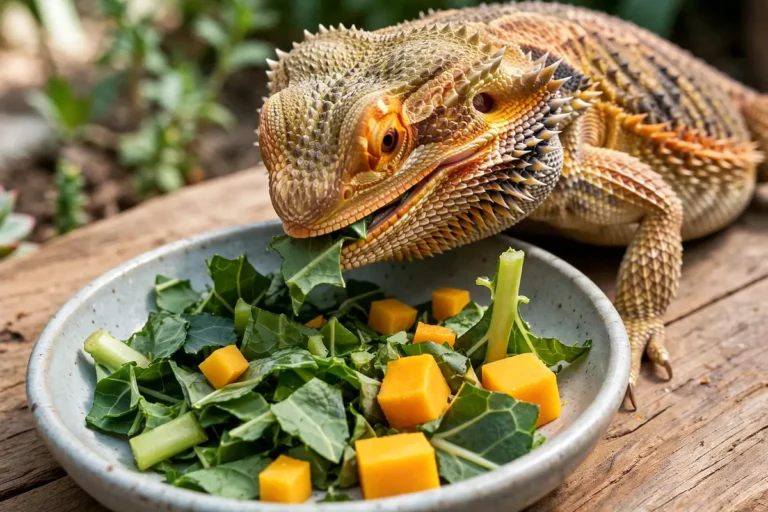
Preparation matters as much as selection: chop leaves finely and mix them together so your dragon cannot pick out favorites and leave the rest, wash everything thoroughly, and serve greens fresh each morning — adults should see a salad daily even if insects are the main event for juveniles. Kale also belongs on our full safe-foods list of tested greens, where you can check anything else you are considering. And remember that no green, however good its numbers, replaces dusting: keep calcium supplementation on schedule (see our calcium supplement guide for the full routine) and focus on building a balanced salad around the rotation above.
Put the rotation into practice — build a balanced salad bowl