What to Buy Before Your Bearded Dragon Comes Home
Here’s the rule that separates smooth first months from expensive ones: the setup comes home before the dragon does. Not the same day. Not “I’ll grab the UVB next weekend.” The full kit — enclosure, lighting, heating, thermometers — bought, assembled, and running before you ever pick out an animal.
Why so strict? Because every shortcut in the setup becomes a problem with a heartbeat. A dragon in an unheated tank is an emergency; a dragon under a weak UVB bulb is a slow-motion vet bill. Get the shopping right once and the next decade is easy.
This is the complete list — what to buy, what to skip, and the order that wastes the least money.
The Enclosure: Buy the Adult Size Once
The single most expensive line item, and the one people most often buy twice. A bearded dragon needs an adult enclosure of 120 gallons — 4x2x2 feet — and no, the baby won’t be “lost” in it. Babies do fine in big enclosures as long as the temperatures are right; what they don’t do fine in is a 20-gallon tank they outgrow in four months.
The classic money-waster goes like this: 20 gallons “for now” ($80), then a 40-gallon ($150), then finally the 120-gallon you should have bought first ($300). That’s $530 for what $300 would have covered. Front-opening enclosures cost a bit more than top-opening tanks but make daily feeding and handling dramatically easier — worth it for an animal you’ll interact with every day for a decade.
Secondhand enclosures are the one place to save big: disinfect thoroughly and a used tank is as good as new. Check local reptile groups — keepers upgrading or downsizing sell 120-gallon setups for a fraction of retail.
Lighting and Heating: The Non-Negotiables
This is the category where cheap substitutes cause the most harm. Two light systems, both essential, doing completely different jobs:
UVB — the T5 tube. A high-output T5 fluorescent tube (10.0 or 12% UVB) spanning roughly half to two-thirds of the enclosure is the standard. This is the bulb that prevents metabolic bone disease, and it’s the one pet-store starter kits almost always get wrong — they include weak coil bulbs that don’t project usable UVB more than a few inches. If your kit has a coil UVB, budget to replace it on day one.
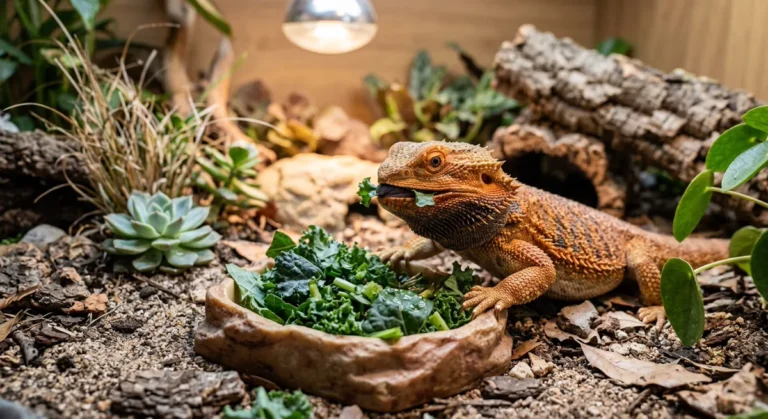
Heat — the basking lamp. A bright white basking bulb in a dome fixture, creating a basking surface of 100-110F with a cool side around 80F. The exact wattage depends on your enclosure and room temperature, which is why you test before the dragon arrives.
And the two instruments that make it all verifiable:
- A dimming thermostat on the heat source. Not a timer, not an on/off switch — a proper dimming or pulse thermostat that holds the basking zone steady. Unregulated heat lamps are how burns and overheating happen.
- Digital thermometers with probes — one for the warm side, one for the cool side. The stick-on dial thermometers sold in kits can be off by 10-20 degrees, which is the difference between “perfect” and “dangerous.” An infrared temp gun for spot-checking the basking surface is the cherry on top.
Substrate: Start Boring
For a baby or juvenile, boring is perfect: non-adhesive shelf liner, ceramic tile, or plain paper towel. They’re cheap, trivially easy to clean, and carry zero impaction risk while your dragon is small and clumsy with its aim.
What to avoid at the start: calcium sand (marketed as “digestible” — it isn’t, reliably), walnut-shell substrate (sharp, indigestible), and any loose substrate for babies. Fancy bioactive soil mixes are wonderful for adults in the right setup, but they’re a project, not a starter item. Nail the basics first; upgrade the flooring later if you want to.
Furniture: Hides, a Basking Platform, and Something to Climb
A dragon needs surprisingly little furniture, but what it needs is specific:
- Two hides — one on the warm side, one on the cool side. A dragon that can’t retreat from heat or light is a stressed dragon. Cork rounds, half-logs, and simple resin caves all work.
- A basking platform — a flat piece of slate or a sturdy branch positioned under the heat lamp, close enough to hit that 100-110F surface temperature. Slate has a bonus: it files nails naturally and holds heat well.
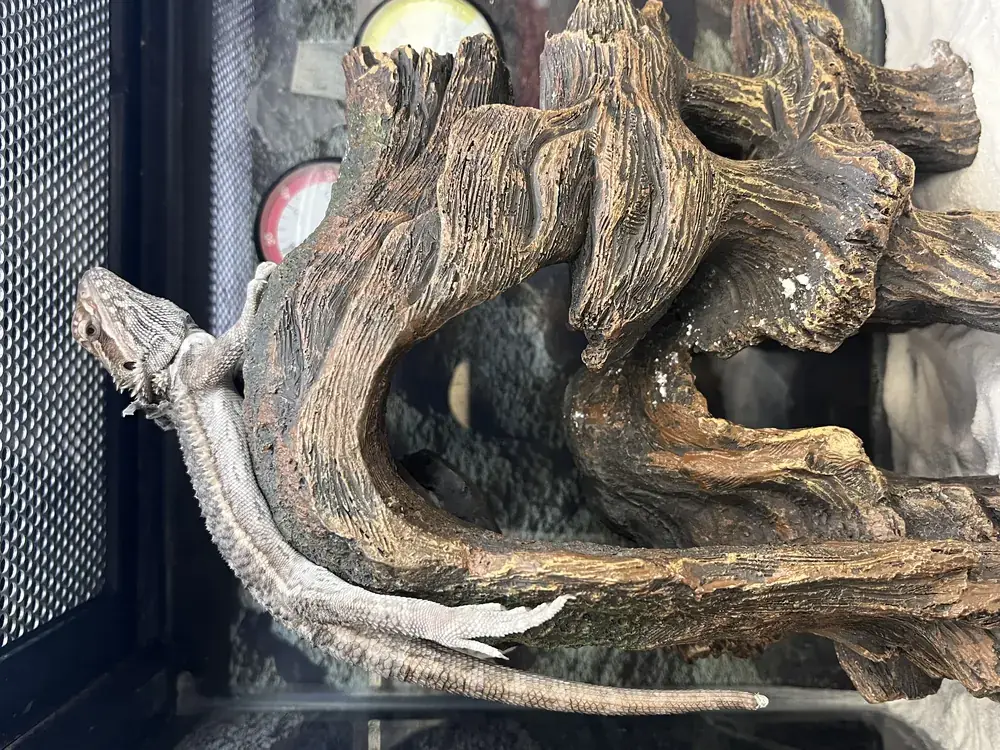
- Climbing decor — branches, grapevine, or reptile-safe wood pieces. Bearded dragons are semi-arboreal and genuinely use vertical space. Anything collected outside needs sanitizing (bake or a veterinary disinfectant, then rinse and dry fully).
That’s the functional core. Everything beyond this — hammocks, background wraps, decorative plants — is enrichment and aesthetics. Nice to have, not day-one essential.
Food and Supplements: The Weekly Shop
The dragon eats from day one, so the food pipeline needs to exist before it arrives:
- Calcium powder with D3 — for dusting feeder insects. The standard approach is lightly coating the insects (shake in a bag), not dumping powder on salads where it falls off uneaten.
- Multivitamin powder — used on a rotating schedule alongside the calcium. The exact rotation depends partly on your UVB strength (strong T5 setups need less supplemental D3), so treat the label as a starting point and your reptile vet as the authority.
- Feeder insects, right-sized — dubia roaches or crickets no longer than the space between the dragon’s eyes. Have the first batch ready; a baby eats dozens of insects daily and “I’ll order some this week” means a hungry dragon.
- Salad greens for week one — collard greens, mustard greens, butternut squash. Even babies should be offered greens daily; they eat more of them as they grow.
- Heavy, shallow dishes — one for salads, one for water. Shallow enough for a baby to climb out of; heavy enough not to tip.
The “Skip It” List
Pet stores are very good at selling you things a bearded dragon doesn’t need. Save your money:
- Coil UVB bulbs — inadequate for bearded dragons. If one comes in a kit, replace it with a T5 tube.
- Calcium sand / vitamin sand — marketed as safe and digestible; keeper experience says otherwise.
- Red or blue “night” bulbs — visible light disrupts sleep. Darkness (or a CHE if truly cold) is correct.
- Misting systems and waterfall bowls — bearded dragons are desert animals; excess humidity causes respiratory issues, not hydration.
- Vitamin-spiked “treat” foods and yogurt drops — sugary junk food marketed as treats.
- Heat rocks — notorious for causing burns; overhead heating regulated by a thermostat is the safe standard.
The Smart Buying Order
Nobody says this has to be bought in one weekend. The sequence that wastes the least money:
- Weeks out: the enclosure. It’s the biggest line item and the easiest to find secondhand — start watching local listings early.
- Next: lighting, heating, and thermostat. Set it all up and run it empty for a full week, logging warm-side, cool-side, and basking-surface temperatures daily.
- Days out: substrate, hides, decor, dishes, supplements. The small stuff.
- Day before: feeder insects and fresh greens.
- Day zero: the dragon — into a habitat that’s already proven, so the only new variable is the animal.
The empty-week test is the highest-value step on this list and it costs nothing. A week of temperature logs tells you whether your basking spot actually holds 105F or swings wildly.
The Bottom Line
The complete starter kit runs roughly $650-$750 at typical prices — enclosure, proper UVB, heating with a thermostat, real thermometers, furniture, and the first round of food and supplements. It’s the biggest check you’ll write in the hobby, and it’s also the one that prevents all the expensive ones later.
Buy the adult enclosure once. Buy the T5 tube, not the coil. Put everything on a thermostat, measure with digital probes, and run it all empty for a week. Do that, and the dragon’s arrival is the easy part — which is exactly how it should be.
Read next: Where to Buy a Bearded Dragon Without Getting Burned