How to Build a Safe Outdoor Enclosure for Bearded Dragons
There is nothing you can buy that beats real sunlight for a bearded dragon. A safe bearded dragon outdoor enclosure turns a patch of garden into free, full-spectrum UVB, genuine heat gradients, and enrichment no indoor setup fully replicates. Dragons with regular outdoor time often bask harder, eat better, and show more natural behavior — digging, scanning the sky, flattening out to soak up the sun.
Done wrong, though, an outdoor pen is one of the fastest ways to harm a bearded dragon. Overheating kills more outdoor dragons than predators do, and most of those deaths trace back to one mistake: glass in the sun. This guide covers the build specs that matter — size, mesh, dig-proofing, predator-proofing — plus the overheating rules, supervision standards, and a climate-by-climate seasonal calendar.
Why Outdoor Time Is Worth Doing Right
Sunlight delivers UVB at intensities no reptile bulb fully reproduces, across the whole body at once — the way evolution designed it. Note that even half-inch hardware cloth filters out a share of UVB, so an open-topped pen with a locking mesh lid beats a fully roofed run. Beyond light, the outdoors is enrichment: uneven ground, real breezes, insects to watch, and digging substrate no indoor tank quite matches.
Treat outdoor time as a supplement, not a replacement — your dragon still needs its indoor UVB and heat for the rest of the day. A few well-timed sessions a week beat daily risky ones.
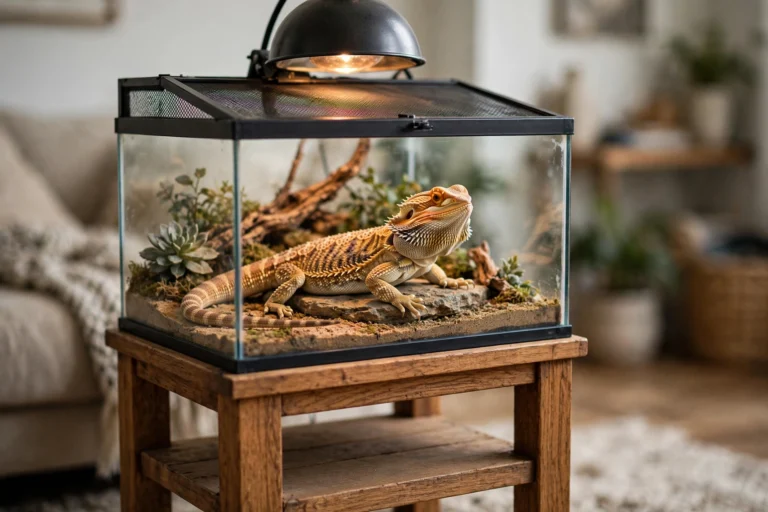
Direct midday sunlight delivers UVB at levels no reptile bulb fully matches — and even in the shade, outdoor light dwarfs a typical indoor setup. But standard glass and clear acrylic block UVB almost entirely, which is why a glass tank carried outdoors gives heat with none of the benefit.
Build Specs: Size, Mesh, and Materials
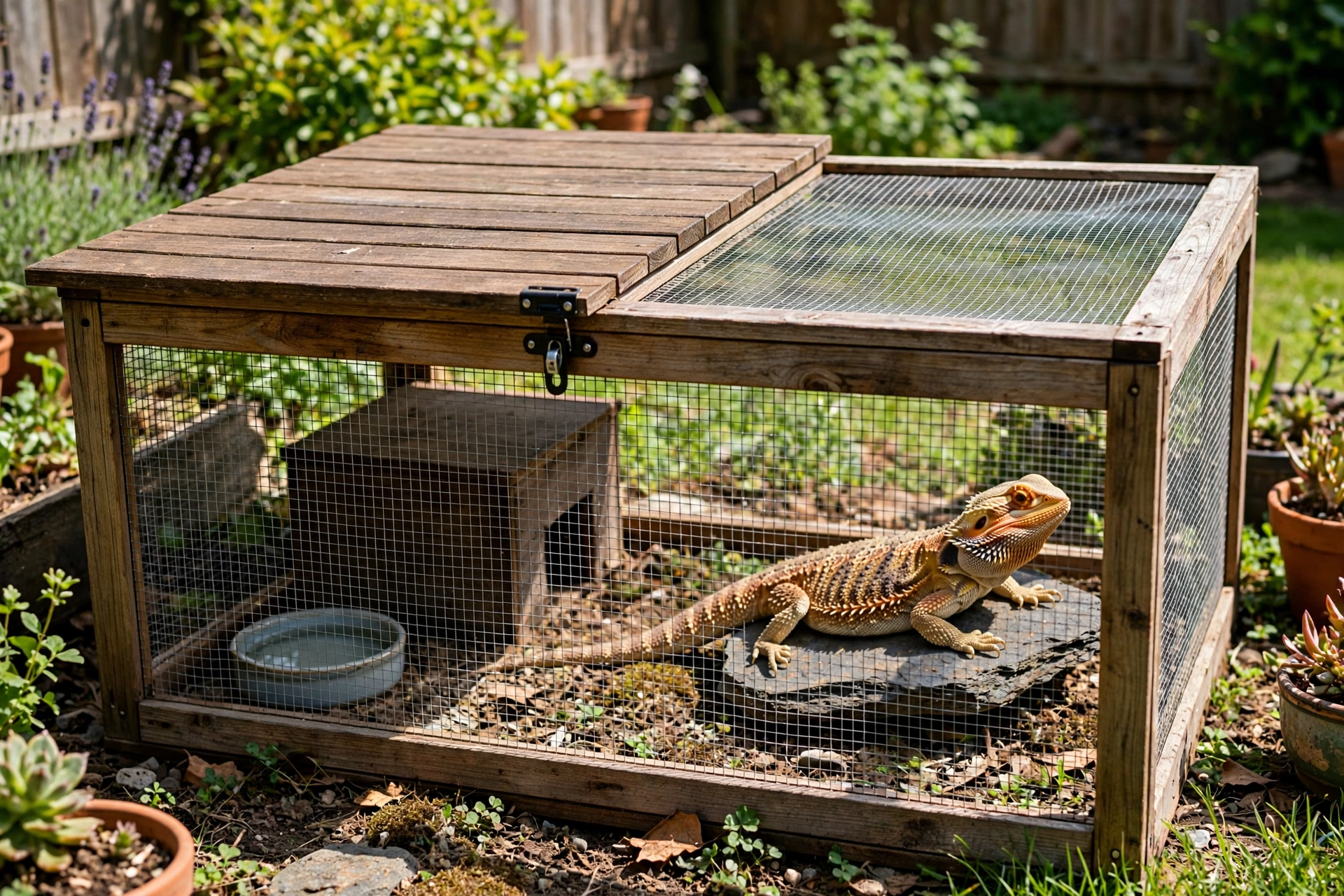
Start with the indoor floor-space rule: our bearded dragon tank size guide sets 4×2×2 feet as the adult minimum, and that minimum applies outdoors too. Outdoor pens are usually bigger — 6×3 feet is a common, comfortable build for one adult — with walls at least 2 feet high, enough to contain a startled dragon and frustrate a casual hawk.
For walls, use half-inch welded hardware cloth — stiff grid mesh, not flimsy hexagonal wire. Chicken wire is a predator invitation: raccoons tear it open and cats work paws through the gaps. Fiberglass window screen is worse — claws shred it in one session and it filters more UVB. Frame the mesh with sealed untreated wood or PVC pipe, and check for sharp wire ends before any dragon goes in.
Every pen needs a locking mesh lid — non-negotiable, even for “just a minute.” A hawk strike takes seconds. Give part of the lid a solid roof panel: that panel is your guaranteed shade zone, and shade is a life-safety feature, not a comfort extra.
The #1 Killer: Overheating
A glass tank in direct sun becomes a solar oven — internal temperatures can climb past 120°F in under half an hour, and heatstroke can kill a trapped dragon in under an hour, often with little warning beyond gaping and going limp. Never put any glass or plastic tank in direct sun, not even for a minute. This single rule prevents most outdoor tragedies.
Even in a proper mesh pen, manage heat minute by minute. Keep at least half the pen’s footprint in solid shade at all times, plus one enclosed hide in the shade zone. Hang a digital probe thermometer in the pen and check it: basking surfaces 95–110°F, cool side 75–85°F. If pen air pushes past roughly 95°F, the session ends and the dragon goes inside — no exceptions.
Always provide a shallow water dish, and test dark surfaces with the back of your hand — black plastic, dark slate, and sun-baked metal can burn feet long before the air feels dangerous.
A sealed glass tank in direct sun can push past 120°F (49°C) in under 30 minutes — far above the 95–110°F basking range bearded dragons need. Heatstroke is fast and often quiet: a dragon that goes limp or gapes continuously in the heat needs immediate cooling and a reptile vet.
Dig-Proofing and Predator-Proofing
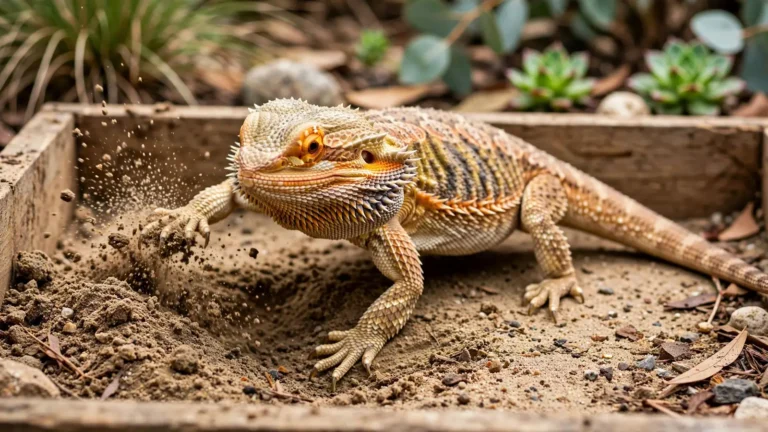
Bearded dragons dig — so an outdoor pen needs a floor plan, not just walls. Bury hardware cloth 6–12 inches deep around the perimeter, or build an L-shaped wire apron extending outward; a determined adult tunnels under a surface-sitting wall in minutes. Where fire ants are active, use a solid or fine-mesh floor and always inspect the site for mounds first.
Predator-proofing is a layered job, because different predators attack differently:
- Cats: half-inch hardware cloth stops paws from reaching in. Never trust “my cat is gentle” — build cat-proof, not cat-tested.
- Hawks and crows: the locking mesh lid is the defense — aerial predators strike in seconds.
- Raccoons: they grab through mesh and open simple hook latches. Use carabiner or padlock-style latches — never chicken wire where raccoons roam.
- Dogs and snakes: a sturdy frame and tight mesh handle both; elevate the pen slightly where ground snakes are common.
Lock every access point, every time. A pen that is predator-proof except for the one latch you forgot is not predator-proof.
What Goes Inside the Pen
Outfit the pen like a simplified indoor setup: a flat basking surface (slate or flagstone holds heat well), one enclosed hide fully in the shade zone, and a shallow, tip-proof water dish. If you have worked through our bearded dragon tank setup checklist, mirror its essentials outdoors — a defined basking spot, a cool retreat, and clean water.
Dragons genuinely use a digging corner of clean, pesticide-free topsoil or play sand, plus edible plants like dandelion greens or hibiscus for nibbling and cover. Skip anything treated with pesticides or fertilizers, substrates a dragon might gorge on, and water deep enough to be a drowning risk. Simple, clean, and shady beats elaborate.
Supervised vs Unsupervised: The Rules
The default rule is supervised, always — you within sight of the pen, thermometer checked, water full, shade confirmed. Unsupervised time is only on the table when every box is ticked: locked and fully predator-proof, guaranteed shade, mild weather well inside safe temperatures, a short duration — and you still within earshot. Heat and unsupervised never mix.
Some dragons never settle in a pen, pacing the walls instead of basking. For those, harness training offers a different route to safe outdoor time — same sunlight, more freedom, you as the predator shield. A collapsible mesh pen also doubles as a travel enclosure; our guide to traveling with a bearded dragon covers the full packing list.
The Seasonal Calendar: When Your Climate Allows It
The explorer above encodes the month-by-month reality, but the rules are simple: start only when the air is at least 75°F, and end the session if pen air climbs past roughly 95°F. Spring and fall are prime season almost everywhere; summer means early mornings in hot climates; winter is mostly off except midday windows in warm regions.
Desert keepers get a long season with brutal summers (June–August is dawn patrol only); northern keepers get a short window from about May to September. When in doubt, skip the day — a missed session costs nothing.
Myth: Bearded dragons are desert animals, so they can handle any heat. Reality: wild dragons survive extreme heat by retreating underground and shuttling between sun and shade — they thermoregulate by moving. A dragon trapped in a sun-baked pen with no shade cannot do what a wild dragon does, and it overheats instead.
When to Skip Outdoor Time
Outdoor time is for healthy, settled dragons. Skip it — and call a reptile vet if anything looks off — when your dragon is lethargic, refusing food, breathing with clicks or wheezes, showing eye or nose discharge, or recovering from injury or a procedure. New arrivals should settle indoors first; a stressed dragon in a new pen is a flight risk. When health is in question, caution wins: keep the dragon inside and let the vet decide.
👉 Next step: The indoor setup checklist — mirror its essentials outdoors