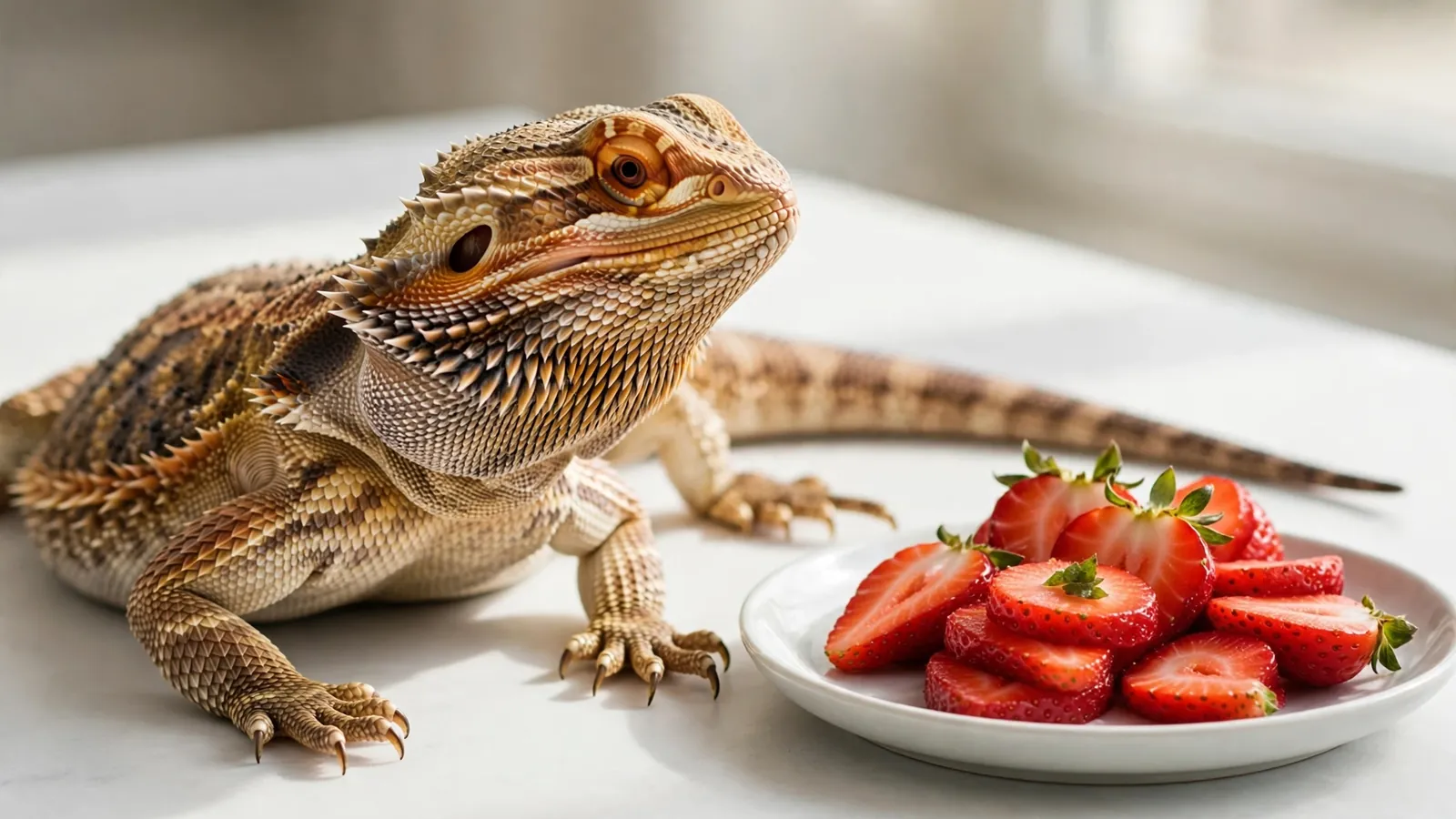
Can Bearded Dragons Eat Strawberries? Nutrition, Oxalates & Safe Portions
Yes, bearded dragons can eat strawberries — and unlike some fruits, this one comes with a genuinely good nutrition story. Strawberries are low in sugar for a fruit, loaded with vitamin C, and most dragons find them irresistible. But there are two honest caveats no treat guide should skip: their calcium-to-phosphorus ratio runs the wrong way, and they carry moderate oxalates that can interfere with calcium absorption.
This guide gives you the full picture — including a sortable nutrition comparison against the other popular berries — plus exact portions and prep.
| Berry | Sugar (g) | Ca:P ratio | Vitamin C (mg) | Oxalate level |
|---|---|---|---|---|
| Strawberry | 4.89 | 1 : 1.5 | 58.8 | Low |
| Blueberry | 9.96 | 1 : 2 | 9.7 | Low |
| Raspberry | 4.42 | 1 : 1.2 | 26.2 | Low–moderate |
| Blackberry | 4.88 | 1.3 : 1 | 21.0 | Low |
| Mango | 13.66 | 1 : 1.3 | 36.4 | Moderate |
Sugar, calcium, phosphorus, and vitamin C figures are USDA-derived per 100 g. Oxalate levels are relative tiers, not lab measurements — published oxalate figures vary between studies, so this column ranks the fruits against each other rather than quoting exact milligrams. Sort the table to find the lowest-sugar or best-ratio option at a glance.
Strawberry nutrition, decoded
Sort the table above by sugar and you will see strawberries sitting near the bottom — about 4.9 g of sugar per 100 g, roughly half the sugar of blueberries and a third of mango. Sort by vitamin C and strawberries shoot to the top at 58.8 mg per 100 g. For a reptile treat, that is an unusually good combination: genuinely low sugar with a real vitamin payload.
Gram for gram, strawberries contain more vitamin C than oranges (58.8 mg vs. about 53 mg per 100 g). Vitamin C supports immune function and collagen formation — useful, though dragons synthesize their own, so treat this as a bonus rather than a reason to overfeed.
The oxalate question, answered honestly
Oxalates are natural plant compounds that bind to calcium in the digestive tract, forming crystals the body cannot absorb. Foods high in oxalates can therefore work against the calcium supplementation every bearded dragon depends on. Strawberries sit in the low-to-moderate oxalate tier — well below the real offenders like spinach, but not negligible either.
What this means in practice: strawberries are a poor vehicle for calcium, and they should never be served as the calcium-bearing part of a meal. Dust the salad’s greens with calcium as usual (see the calcium and supplements guide), and let the strawberry be what it is — a tasty, low-sugar extra riding on top of an already calcium-sound meal. Fed that way, the oxalate content is a footnote, not a problem.
How much strawberry is safe?
For an adult dragon: a slice or two — roughly a tablespoon of diced strawberry — once or twice a week. That is the whole portion guidance. Strawberries should slot into the fruit allowance (no more than about 10% of total diet) alongside whatever other treats you rotate. Juveniles under 6 months should get fruit only rarely; their growth demands protein and staple greens first.
One more honest note: strawberries are not a health food that justifies bigger portions. The low sugar is relative — it is still fruit sugar, and dragons did not evolve eating cultivated berries at all. Small and occasional beats generous and regular every time.
The green leafy tops of strawberries are safe for bearded dragons too — they are just leaves, and dragons can nibble them. Most dragons ignore the tops in favor of the red flesh, but there’s no need to surgically remove every trace of green before serving.
Prep: wash, hull, dice
- Wash thoroughly. Strawberries are famously pesticide-heavy among commercial fruits, so rinse well under running water. Organic is a reasonable upgrade here if the budget allows.
- Remove the stem and hull. The white core is tough and flavorless — cut it out.
- Dice small. Pea-sized pieces for adults; smaller for juveniles. Whole strawberries are a choking risk for young dragons and an unnecessary one for adults.
- Serve at room temperature and mix into the daily salad rather than offering a bowl of pure fruit. A strawberry slice buried in collard greens is enrichment; a strawberry platter is dessert.
Balancing treats across the week
Strawberries work best as part of a treat rotation, not a treat monopoly. Alternate fruit treats with insect treats — a hornworm here, a strawberry slice there — so no single sugar source dominates. The treat-insects guide covers the bug side of that rotation, and the master safe-foods list keeps the whole diet in proportion.
Myth: “Strawberry seeds are dangerous — you have to pick them all out.” Reality: the tiny seeds on a strawberry’s surface are harmless and pass straight through. Nobody in the history of reptile keeping has had a vet emergency over strawberry seeds. Dice and serve; don’t perform seed surgery.
When to skip the strawberries
- During a greens strike. If your dragon is already refusing greens in favor of sweet foods, cut all fruit until the salad habit is rebuilt.
- For obese dragons. A dragon on a vet-supervised weight-loss plan doesn’t need fruit sugar, however “low” it is.
- For babies. Hatchlings and young juveniles need their limited stomach space for protein and calcium-rich greens, not fruit.
Strawberries for picky eaters
Strawberry has a legitimate tactical use: converting greens-refusers. The bright color and strong smell make a diced strawberry one of the best salad toppers for a dragon that turns its nose up at a plain bowl of collards. Dice it fine, scatter it through the greens rather than piling it on top, and gradually reduce the amount over a couple of weeks as the dragon gets used to eating the whole salad. The goal is a dragon that eats greens with or without the garnish — the strawberry is training wheels, not a permanent fixture. If the pickiness is entrenched, the salad builder guide has the full step-down strategy.
Can bearded dragons eat strawberry tops and leaves?
Yes, the green tops are safe — they’re simply leaves. Most dragons prefer the fruit, but the tops won’t hurt them.
Are frozen strawberries safe?
Yes, once completely thawed to room temperature. Never serve frozen or half-frozen, and avoid anything packed in syrup or with added sugar.
Can strawberries cause diarrhea in bearded dragons?
Too much fruit of any kind can loosen stools because of the sugar and water content. Stick to the once-or-twice-weekly portion and it shouldn’t be an issue.
Which berry is healthiest for bearded dragons?
On the numbers, strawberries and blackberries lead — low sugar, decent vitamin C, and the best calcium profiles of the group. Sort the comparison table above to see exactly how each one ranks.
Do strawberries need to be organic?
Not necessarily, but strawberries do carry heavier pesticide residues than most fruits. If you buy conventional, wash them thoroughly; if organic fits the budget, it’s a sensible upgrade for this particular fruit.
My dragon ate a whole strawberry — is that an emergency?
No. A one-time overindulgence isn’t dangerous; you might see looser stool for a day. Just skip fruit for the next week or two and return to normal portions afterward.