Baby Bearded Dragon Tank Setup: The First-Year Blueprint
Here is the mistake almost every first-time owner makes with a baby bearded dragon: they set up the tank once. A hatchling arrives at around 3 inches and can pass 16 inches before its first birthday — a setup that was perfect in month one is a cramped, hard-to-heat box by month six. This is a first-year blueprint: what the tank looks like at 0–2 months, what changes at 3–12 months, and when to make the final move to the adult enclosure.
The hatchling setup (months 0–2)
A hatchling is a 3-to-9-inch insect-hunting machine with the coordination of a toddler. The tank must be small enough for it to catch food, warm enough to digest it, and simple enough to keep spotless.
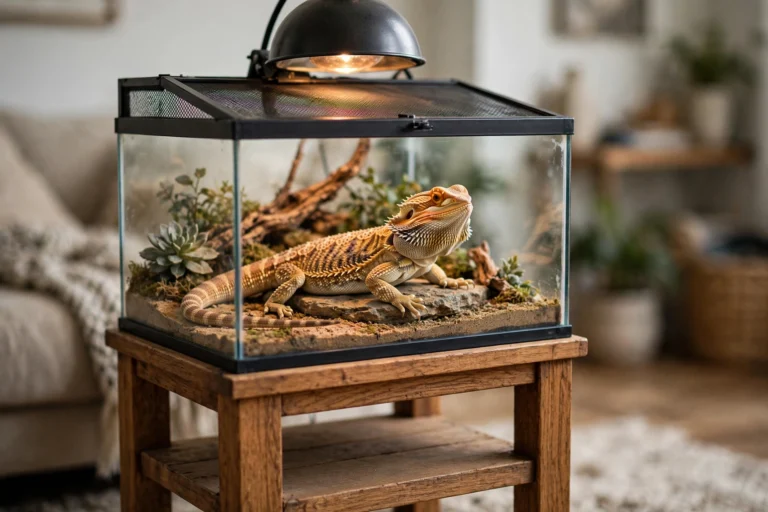
- Tank: a 20-gallon long works for the first couple of months. Alternatively, buy the 40-gallon breeder early and section off half with a divider — same small hunting ground now, no second purchase later. Watch for stress signs (constant hiding, refusing food) and shrink the section if the space feels too big.
- Substrate: paper towels. Cheap, sterile, and they let you monitor droppings — often the first sign something is wrong. Juveniles gulp substrate while lunging at insects, so loose material is off the table at this age. See our guide to baby-safe substrate options for the full rundown.
- Heat: babies like it hot — 105–110°F on the basking surface, 75–85°F at the cool end, nights above 65°F. Measure the surface with an infrared temp gun; stick-on dial thermometers are decorative, not instruments. Our breakdown of baby basking temps explains the hotter juvenile setting.
- UVB: a linear T5 HO tube at 10–12% output spanning two-thirds of the tank, 10–12 inches above the basking spot. This is the highest-stakes piece of baby gear: a fast-growing skeleton without adequate UVB heads straight toward metabolic bone disease. Read our UVB for juveniles guide before mounting anything.
- Decor, sized down: two small hides (warm end and cool end), a low basking platform, and a very shallow water dish. Skip tall branches — a 4-inch dragon falling off a 12-inch branch is an injury report waiting to happen.
A bearded dragon typically hatches at 3–4 inches and can reach 16 inches or more by 12 months — roughly quadrupling in length in a single year. That is why the starter tank is a rental, not a purchase: plan the upgrades before you need them.
The juvenile setup (months 3–12)
Somewhere around 2–3 months (or 9 inches — length beats the calendar as a trigger), the 20-gallon starts feeling cramped and hunting success drops. Time for the 40-gallon breeder, 36×18×18 inches, which carries most dragons to the half-year mark.
- Substrate upgrade: swap paper towels for ceramic tile or non-adhesive shelf liner — still solid and zero ingestion risk, but sturdier and better looking. Loose substrate stays off the menu until adulthood.
- Climbing gear: by 3–4 months coordination has caught up with ambition. Add a couple of secured branches and a larger basking platform — vertical space is free enrichment.
- Bigger hides, same rule: one at each end of the gradient, stable enough not to tip. A hide should feel snug; a juvenile rattling around in an adult-sized cave won’t use it.
- Light schedule: keep 13–14 hour days year-round for the first 6–12 months. Long days signal “growing season”; short winter days signal brumation, which a growing juvenile should not be doing.
- Feeding station: offer finely chopped greens every day, even when ignored. Juveniles are insect-driven, but daily exposure is what turns an adult into a greens eater. Our age-by-age breakdown covers the full sizing by age progression.
Wait 30–60 minutes after lights-on before the first feeding — a cold dragon cannot digest properly, so basking comes first and breakfast second. Serve the last insects 2–3 hours before lights-off: food sitting in a cooling gut overnight is a genuine impaction risk. Juveniles fit 3–5 small meals inside that window.
The big decision: buy small now or buy big once?
There are two honest ways to furnish the first year. Here is the actual trade-off:
| Factor | Start small, upgrade twice | Buy the adult 4×2×2 once (sectioned) |
|---|---|---|
| Total cost | Lower now, higher over the year — three tanks and three rounds of decor | Higher now, lower overall — one tank, one full decor set |
| Hatchling stress risk | Lower — small space feels secure | Higher if mismanaged — a tiny dragon in a huge empty box can stop eating |
| Temperature gradient | Easy to dial in at each stage | Needs deliberate zoning behind the divider |
| Effort | Two full tear-down-and-rebuild moves | One build; slide the divider as the dragon grows |
The sectioned-adult-tank route wins on cost and effort if you do it properly: divider in place from day one, hides and heat clustered in the small section, and a close eye on behavior for two weeks. Constant hiding, refusing food, or frantic glass surfing means the section needs shrinking — not that the strategy failed. Either way, reach the adult 4×2×2 ft (120-gallon) minimum by month 8–12.
Baby-specific gear rules most guides skip
UVB distance gets tricky in shallow tanks
A 20-gallon long is only about 12 inches tall. Add a basking platform and the dragon’s back can end up 6 inches from a screen-mounted tube — too close for a 10–12% T5 HO. In shallow starter tanks, mount the UVB inside under the screen (which also dodges the mesh filtering a big share of output) and set the platform so the dragon sits 10–12 inches below the tube. Re-measure when you move to the taller adult tank — the geometry changes, and so does the safe distance.
Scale every opening to the dragon — and measure twice
Hide doorways should fit the current dragon, not the adult it will become; a hatchling will ignore a hide it must cross an exposed lobby to reach. Same for the water dish: shallow enough that a 4-inch dragon walks out effortlessly, at the cool end, refilled daily. And run two digital probes — one at the basking surface, one at the cool end — plus the IR gun for spot checks. Babies dehydrate and overheat faster than adults because there is simply less of them: a 5-degree error matters more at 4 inches than at 20.
Thermostat everything, guard everything
Every heat source goes on a thermostat — even a “small” 60W bulb in a 20-gallon can spike past 120°F in a warm room. Bulbs must be positioned or guarded so the dragon cannot touch them; thermal burns are among the most common juvenile injuries because babies climb on everything, including dome fixtures.
The 24-hour test run (do this before the dragon arrives)
Assemble everything, set the timer, and run the full setup for at least 24 hours before move-in day. Log the basking surface, warm end, and cool end morning, midday, and evening; confirm the gradient holds and nights don’t crash. Five baby-setup mistakes to check for:
- An unsectioned mansion: a hatchling loose in a full 120-gallon with no divider — hunting fails, stress climbs.
- Loose substrate: sand or crushed walnut for a baby risks impaction; start solid.
- A coil UVB as the only UVB: it cannot cover even a 20-gallon evenly — use the linear tube.
- Dial thermometers: they read air near the glass, not the basking surface. Digital probes plus an IR gun.
- No thermostat or timer: manual light-switching fails the first busy week. Automate both on day one.
Baby tank questions, answered
Can a baby go straight into a 120-gallon tank?
Yes, with a divider sectioning off a 20-to-40-gallon-sized area for the first few months. Without it, most hatchlings show stress — hiding constantly, refusing food, glass surfing. Slide the divider out gradually as the dragon passes 9–12 inches and hunts confidently.
When exactly do I upgrade from the 20-gallon?
Use length, not the calendar: around 9 inches, usually 2–3 months. If hunting still succeeds and the gradient holds, a few extra weeks won’t hurt — but don’t wait until the dragon looks cramped, because temperatures get hard to manage well before that.
Do babies really need hotter basking temps than adults?
Yes — 105–110°F for babies versus 100–105°F for adults. Juveniles are growing fast and digesting constantly, and extra heat supports that metabolism. Ease toward the adult range around 6 months as growth slows.
What to read next
Ready to shop? Run through our shopping checklist — every item sized for the first year, so you buy once and buy right.