7 Brumation Mistakes First-Time Bearded Dragon Owners Make
Your bearded dragon is sleeping all day, ignoring food, and hiding in the cool corner — and if this is your first winter together, you’re probably oscillating between worry and the urge to “just check” on them every few hours. That’s normal. What’s not normal is how many first-timers accidentally turn a perfectly safe brumation into a stressful one through completely avoidable mistakes. Here are the seven I see most, what to do instead, and a checklist that keeps you calm from the first yawn to the spring wake-up.
Mistake 1: Assuming it’s brumation without a vet check
This is the big one, because every other mistake on this list is survivable except this one. Lethargy, appetite loss, and hiding are also the symptoms of parasites, respiratory infection, and impaction. A dragon that “brumates” with an untreated parasite load can decline fast, because brumation suppresses the immune system while the parasites keep feeding.
The rule is simple: first brumation gets a vet check, every time. A reptile vet visit with a fecal test before the long sleep rules out the lookalikes and gives you a baseline weight. It’s the cheapest insurance in reptile keeping, and it turns every worry below into a non-issue. If you’re ever unsure whether you’re seeing brumation or illness, our brumation vs. illness checker walks through the differences — but it doesn’t replace the vet visit.
Mistake 2: Letting them brumate with a full gut
A brumating dragon’s digestion essentially stops. Food sitting in a cool, inactive gut doesn’t wait politely — it ferments and rots, which can cause dangerous bacterial overgrowth. This is why experienced keepers do a wind-down, not a hard stop: over 2–3 weeks, daylight hours shrink gradually, feedings get smaller and less frequent, and the dragon gets several full basking days after its last meal to clear everything out.
If your dragon has already gone to sleep and you realize they ate recently, don’t panic and don’t try to wake them to “fix” it — just note it, keep the basking spot available during the day, and mention it at the vet check. Next year, start the wind-down earlier.
🔍 Myth vs reality
Myth: “Brumation is just reptile hibernation — they sleep straight through for months.” Reality: Brumating dragons wake periodically, may drink, sometimes bask for a day, then go back under. Days of activity mid-brumation are normal, not a sign something’s wrong.
Mistake 3: Waking them constantly to “make sure they’re OK”
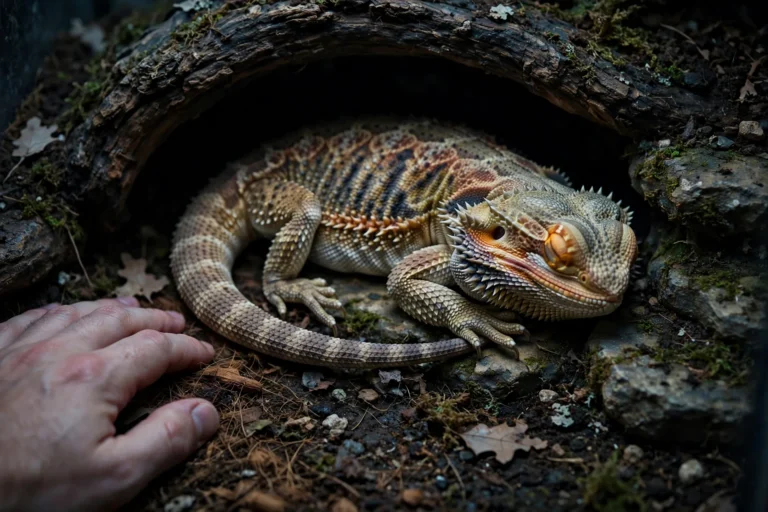
The 2 a.m. flashlight check. Lifting the hide “just to see.” Picking them up for a reassuring cuddle. Every disturbance costs a brumating dragon precious energy and spikes stress hormones — the exact opposite of the restful torpor their body is trying to maintain. Think of it this way: you wouldn’t shake a hibernating bear awake to check its pulse.
Set a schedule and stick to it: a visual check every few days (no touching), a weigh-in every two weeks (quick and gentle), and that’s it. Write the schedule down. The urge to check is emotional; the schedule is rational. Trust the schedule.
Mistake 4: Force-feeding during brumation
It comes from love: “he hasn’t eaten in three weeks, he must be starving.” He isn’t. A healthy adult enters brumation carrying fat reserves precisely for this purpose, and their metabolism has slowed to a fraction of normal. Syringe-feeding a brumating dragon risks aspiration (food into the lungs) and dumps undigestible matter into a dormant gut — the problem Mistake 2 was trying to avoid.
The only exception is a vet’s explicit instruction. If a reptile vet has examined your dragon and prescribed assisted feeding, follow that plan exactly. Otherwise, food stays out of the picture until the dragon wakes up and asks for it themselves.
Mistake 5: Removing the water bowl
“He’s not drinking, so why keep the bowl?” Because brumating dragons do wake for water — often at night when you’re not watching — and dehydration is a genuine brumation risk. Keep a shallow bowl in the cool end, refresh it every few days, and consider it non-negotiable tank furniture until spring.
Some keepers offer a brief lukewarm soak every few weeks during a natural wakeful spell, which doubles as a hydration top-up and a chance to observe the dragon’s condition. Keep it short, keep it calm, and put them straight back afterward.
📊 Stat
A healthy adult typically loses under 10% of its pre-brumation body weight across the whole brumation period. If you weighed 500 grams going in, anything above about 450 coming out is within the normal range — no intervention needed.
Mistake 6: Panicking over normal weight loss
Seeing the scale drop week after week triggers every new owner’s alarm — but some loss is the entire point of fat reserves. The threshold that matters is about 10% of pre-brumation weight, measured with minimal-disturbance weigh-ins every two weeks. Gradual, small declines are normal. What’s not normal: a sudden sharp drop, visible thinning of the tail base or hip area, or weight loss paired with discharge, wheezing, or lethargy during a wakeful period.
This is exactly why the pre-brumation baseline weight matters so much. Without it, you’re guessing; with it, you have a number and a rule. Weigh the same way each time (same scale, same time of day) and log it — the trend is the whole story.
Mistake 7: Trying to prevent — or force — brumation
Both directions backfire. Keeping lights at full summer blast all winter to “prevent” brumation fights the dragon’s biology and often just produces a stressed, semi-lethargic animal anyway. Conversely, chilling the tank deliberately to “trigger” brumation in a dragon that isn’t ready — especially a juvenile under a year old, which shouldn’t brumate at all — is dangerous.
The right move is to follow the dragon’s lead: when appetite drops and naps lengthen in late fall, ease into the wind-down described above. If your adult never brumates despite the season, that’s fine too — not every individual does, and a non-brumating adult with good appetite and energy needs no intervention. For the full seasonal playbook, see Bearded Dragon Brumation: The Complete Care Guide.
💡 Did you know
In the wild, bearded dragons brumate through the Australian winter (roughly May to August) when temperatures drop and food disappears. Pet dragons follow the same ancient programming even in heated homes — shortening daylight through a window is often the trigger, not cold.
The first-timer’s calm brumation checklist
If the seven mistakes above feel like a lot to hold in your head, that’s what the checklist at the top is for. The short version: vet check and baseline weight before, water bowl and hands-off during, patience after. Brumation has worked fine for millions of dragons without human micromanagement — your job is mostly to set the stage, then get out of the way.
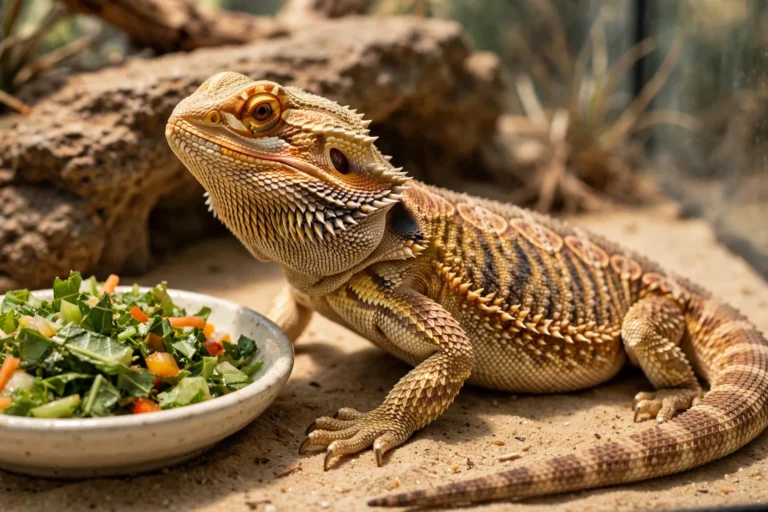
One last reassurance: almost every first-timer is convinced something is wrong during week three. Almost every one of them watches a perfectly healthy dragon wake up in spring, drink deeply, and demolish a salad like nothing happened. Follow the checklist, trust the 10% rule, and you’ll be telling next year’s new owners the same thing.
What to read next
- Bearded Dragon Brumation: The Complete Care Guide (2026) — the full seasonal playbook, start to finish.
- Is Your Bearded Dragon Sick or Just Sleeping? — rule out illness before assuming brumation.
- Why Is My Bearded Dragon Not Eating? 12 Causes and Fixes — for appetite issues outside brumation season.