How to Read Your Bearded Dragon’s Body Language
Your bearded dragon can’t tell you what’s wrong, but it is constantly telling you how it feels. Every arm wave, head bob, beard puff, and color shift is a sentence in a language that evolved long before humans started keeping reptiles in glass boxes. Learning to read that language is the single highest-leverage skill a keeper can develop — it tells you when your dragon is content, when it’s stressed, when it’s sick, and when it just wants to be left alone.
The catch: bearded dragon body language is almost entirely about context. The same flattened body that means “I’m happily soaking up heat” at 9 a.m. under the basking lamp means “I’m terrified” when a stranger’s hand swoops in from above. This guide gives you the full signal vocabulary — and the context rules that make it readable.
The one rule that decodes everything: speed and setting
Before memorizing individual signals, learn the master rule. In bearded dragon communication, slow usually means submission and fast usually means dominance. A slow, lazy arm wave is an appeasement gesture. A rapid, vigorous head bob is a dominance display. The same body parts, different speeds, opposite messages.
The second half of the rule: setting changes meaning. Ask two questions about every signal — where is the dragon? and what just happened? A dragon gaping under the basking lamp is cooling off. A dragon gaping on the cool side of the tank, away from any heat source, may be struggling to breathe. Same mouth, different diagnosis.
💡 Did you know? The black beard isn’t paint — it’s physics. Bearded dragons darken their throat pouch using chromatophores, specialized pigment cells that disperse melanin on demand. The same cells let a cold dragon darken its whole body to absorb heat faster in the morning. Color change does double duty: temperature control and communication.
Submission and appeasement signals
These are the “I’m not a threat” messages, and you’ll see them most often in juveniles, females, and new dragons still figuring out their world.
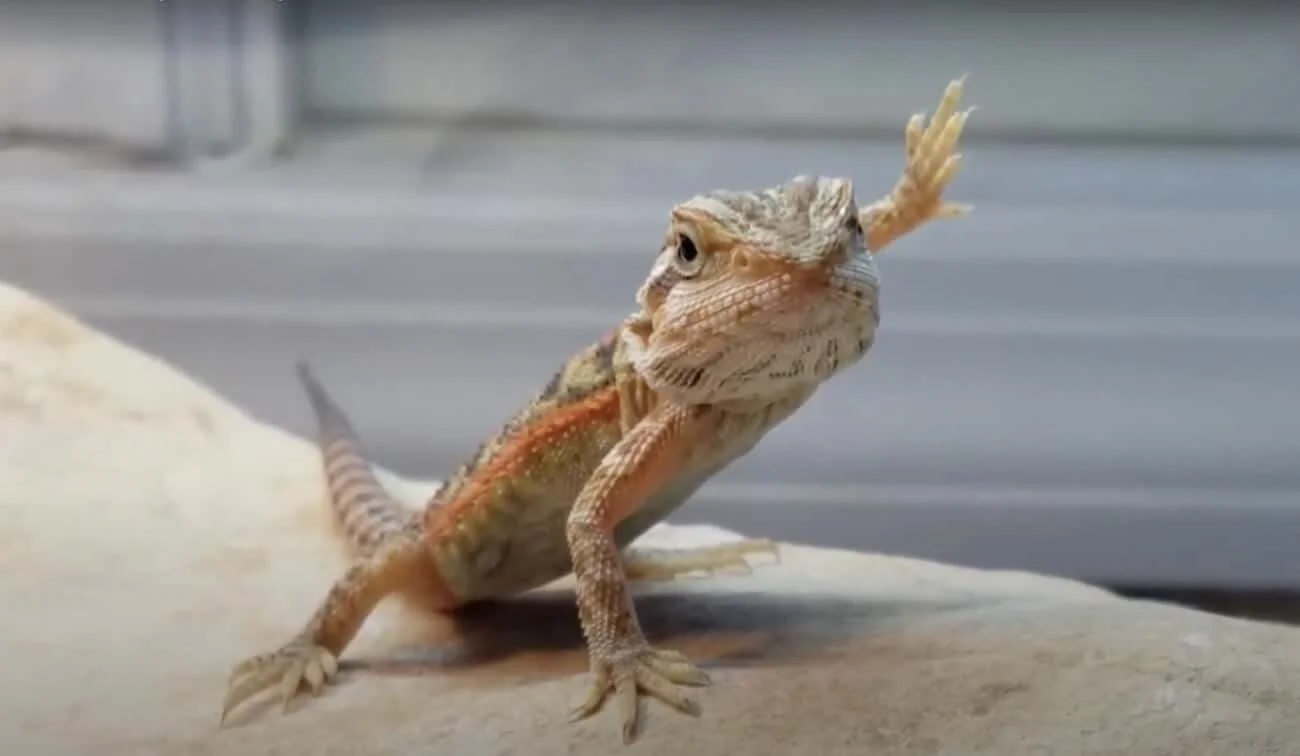
Arm waving is the most famous — a slow, circular lift and rotation of one foreleg. Despite what pet-store folklore says, waving is not a friendly hello. It’s submission: the dragon is telling a larger animal (another dragon, a dog, you) that it isn’t looking for trouble. Young dragons wave the most; adults in a stable, solitary setup may rarely do it at all.
Slow head bobbing is the subtler cousin — gentle, unhurried nods, often paired with arm waving. It reads as acknowledgment or appeasement rather than challenge. If your dragon does this toward you, it’s not being sassy; it’s being polite.
One caution: a weak, twitchy, poorly coordinated “wave” is not the social wave at all. Jerky, uncoordinated limb movements belong in health territory, not behavior territory — if the wave looks wrong, look at the dragon’s overall condition and husbandry first.
Dominance and territorial displays
Flip the speed dial and the same gestures turn assertive. Fast, vigorous head bobbing — the whole head pumping up and down — is a dominance display or mating ritual, and it comes almost exclusively from males. Males bob at rivals, at females during breeding season, at their own reflection, and occasionally at their keeper. It’s the reptile equivalent of puffing out your chest.
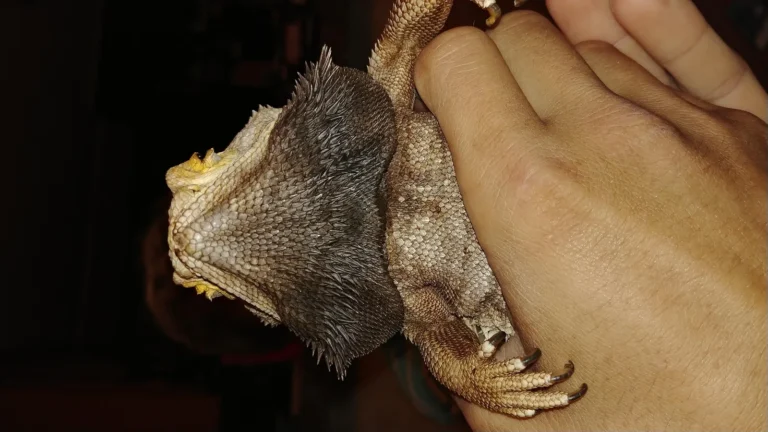
The black beard is the exclamation point. When the throat pouch darkens and puffs out, the dragon is making itself look bigger — a threat display, a territorial warning, or a surge of breeding-season arousal. A male bobbing furiously at his own reflection with a jet-black beard is showing off, not suffering.
But the black beard is also the signal with the widest meaning range, which is why context matters so much. The same dark beard can mean stress, fear, cold (darkening to absorb heat), or illness. A black beard plus lethargy, appetite loss, or labored breathing is not a display — it’s a reason to call a reptile vet.
| Signal | What you’ll see | Usually means |
|---|---|---|
| Arm wave | Slow circular foreleg lift | Submission — “not a threat” |
| Slow head bob | Gentle, lazy nods | Appeasement or acknowledgment |
| Fast head bob | Rapid vigorous pumping | Dominance or mating display (males) |
| Black beard | Throat darkens, often puffed | Threat, arousal, stress — or illness |
| Beard puff (no darkening) | Beard flares, stays normal color | Morning stretch or shed-related |
| Hissing + flattening | Open mouth, wide flat body | “Back off” — defensive warning |
Contentment signals: what a happy dragon looks like
A comfortable bearded dragon has a recognizable “all is well” profile: light, even body color, relaxed flat basking posture, bright clear eyes, and a steady appetite. Learn this baseline and deviations from it become your early-warning system.
Pancaking — flattening the body wide against a warm surface — is usually a happy dragon maximizing heat and UVB absorption. You’ll see it most on cool mornings under the basking lamp. The same flattening means something different when the dragon is startled: in the wild, going flat is also a fear response that hides the animal from predators and stiffens its spines. Basking spot + morning = content. Sudden flattening when startled = fear.
Tongue flicking is curiosity in action. Rapid little flicks of the tongue gather scent and chemical information about objects, food, and animals — the dragon is actively investigating its world. An exploring, tongue-flicking dragon with a gently raised tail is an engaged dragon.
Bright, saturated colors are the mood ring reading you want. A warm, comfortable, healthy dragon shows its best colors; a cold, stressed, or ill dragon dulls and darkens. If your dragon’s colors look washed out for days, check temperatures first and health second.
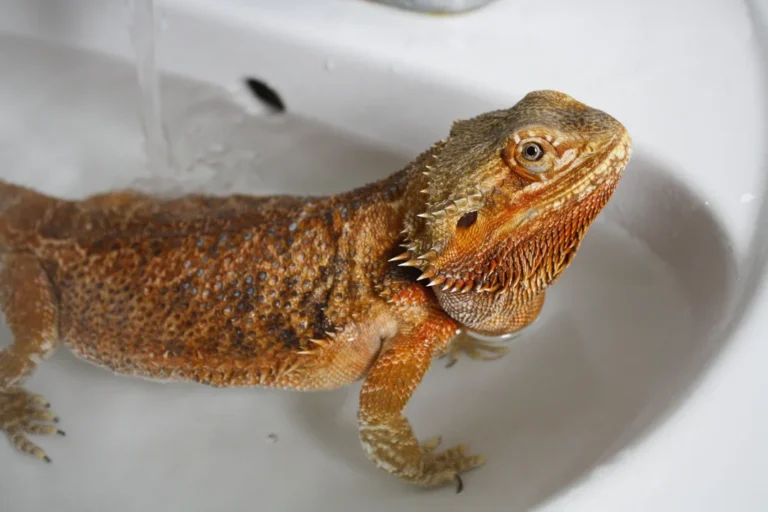
🔍 Myth vs. reality: “My dragon closes its eyes when I hold it — it trusts me.” Not necessarily. A dragon that closes its eyes while being held or petted may be showing a stress or discomfort response, not affection — it’s shutting out something it doesn’t like. (Closing the eyes while basking is a different story: that’s usually just a warm, relaxed dragon dozing.) Read eye-closing with the rest of the body. Relaxed posture plus closed eyes during a bath is fine; squirming plus closed eyes means put the dragon down.
Thermoregulation behaviors (not emotions at all)
Some of the most commonly misread “body language” isn’t communication — it’s climate control. Bearded dragons are ectotherms, and several dramatic-looking behaviors are just the animal managing its temperature.
Gaping — sitting with the mouth held open under the basking lamp — is the big one. It looks alarming and means nothing alarming: the dragon is dumping excess heat, the reptile equivalent of a panting dog. One lab-cited figure puts the gaping trigger at roughly 36.9°C (about 98°F) of body temperature. The rule that matters: gaping under the heat lamp is normal; gaping on the cool side, away from heat — especially with discharge or labored breathing — warrants a vet visit.
Eye bulging terrifies new keepers: one or both eyes swell outward dramatically for a few seconds. In the vast majority of cases it’s pre-shed behavior — the dragon is stretching the skin around its eyes to loosen it before a shed. Brief episodes with no squinting, cloudiness, or discharge, in a dragon that’s eating and acting normally, are transient and harmless. Persistent bulging with squinting, rubbing, or appetite loss is a vet matter, not a shed matter.
Morning darkening is the same principle applied to the whole body: a cold dragon darkens to absorb heat faster, then lightens up as it warms. If your dragon looks dark every morning and bright by midday, that’s not a mood swing — it’s a solar panel adjusting itself.
📊 Stat: Bearded dragons are solitary by nature — they don’t thrive in groups, and housing multiple dragons together causes competition and chronic stress. If you’re seeing constant black beards, head bobbing, and chasing in a shared tank, that’s not social behavior. That’s a housing problem with a simple fix: separate enclosures.
Warning signals: when behavior means “back off” or “vet”
Hissing is the clearest defensive warning in the vocabulary — an audible “back off,” often paired with a flattened body and open mouth. New dragons hiss at hands reaching from above (that’s how predators arrive), at their own reflection, and at anything that startles them. Respect it: slow down, give space, and rebuild trust gradually instead of forcing contact.
Learn the escalation ladder: arm wave (polite) → black beard (serious) → hissing and gaping at you (warning) → tail whipping or biting (last resort). A dragon that has to bite you has been ignored through several earlier, clearer messages. The goal of learning body language is to never get that far.
And learn the line between behavior and illness. These combinations skip the behavior guide and go straight to a reptile vet: persistent black beard with lethargy or appetite loss; gaping away from heat with discharge or noisy breathing; eye bulging that doesn’t resolve, with squinting or rubbing; any sudden behavior change in a dragon that was previously settled. Behavior tells you how the dragon feels; only a vet can tell you why.
Decode any signal with the decoder
Reading about twelve signals is one thing; identifying them in the moment is another. Use the interactive decoder below — tap any signal to get what it looks like, what it usually means, and whether it’s normal, worth watching, or a reason to give the dragon space.
Bearded Dragon Body-Language Decoder
Tap a signal to see what it means — and when it matters.
Body language questions, answered
Why does my bearded dragon wave at me?
It's showing submission, not saying hello. Arm waving is an appeasement gesture directed at something the dragon perceives as larger or dominant — which, from the dragon's perspective, includes you. It's most common in juveniles and new dragons, and it usually fades as the dragon settles in and learns you're not a threat.
My male head-bobs at his reflection constantly. Should I cover the glass?
Yes, that's a good fix. He reads his reflection as a rival male and will display at it indefinitely, which is wasted energy and chronic low-grade stress. Covering the reflective sides of the tank (backgrounds on three sides work well) removes the "rival" and the behavior usually stops within days.
Is it normal for my dragon's beard to be black every morning?
Brief morning darkening that fades as the dragon warms up is usually thermoregulation, not stress. What's not normal is a beard that stays black all day, especially combined with hiding, appetite loss, or lethargy. Track the pattern: fades by midday is fine, persists all day is a vet conversation.
Why does my dragon flatten out when I pick it up?
Flattening when handled is usually a fear response — the dragon is trying to look bigger or brace itself. It often happens when the approach comes from above (triggering the overhead-predator instinct) or when handling sessions run too long. Scoop from the side and underneath, keep early sessions short, and end before the dragon gets squirmy.