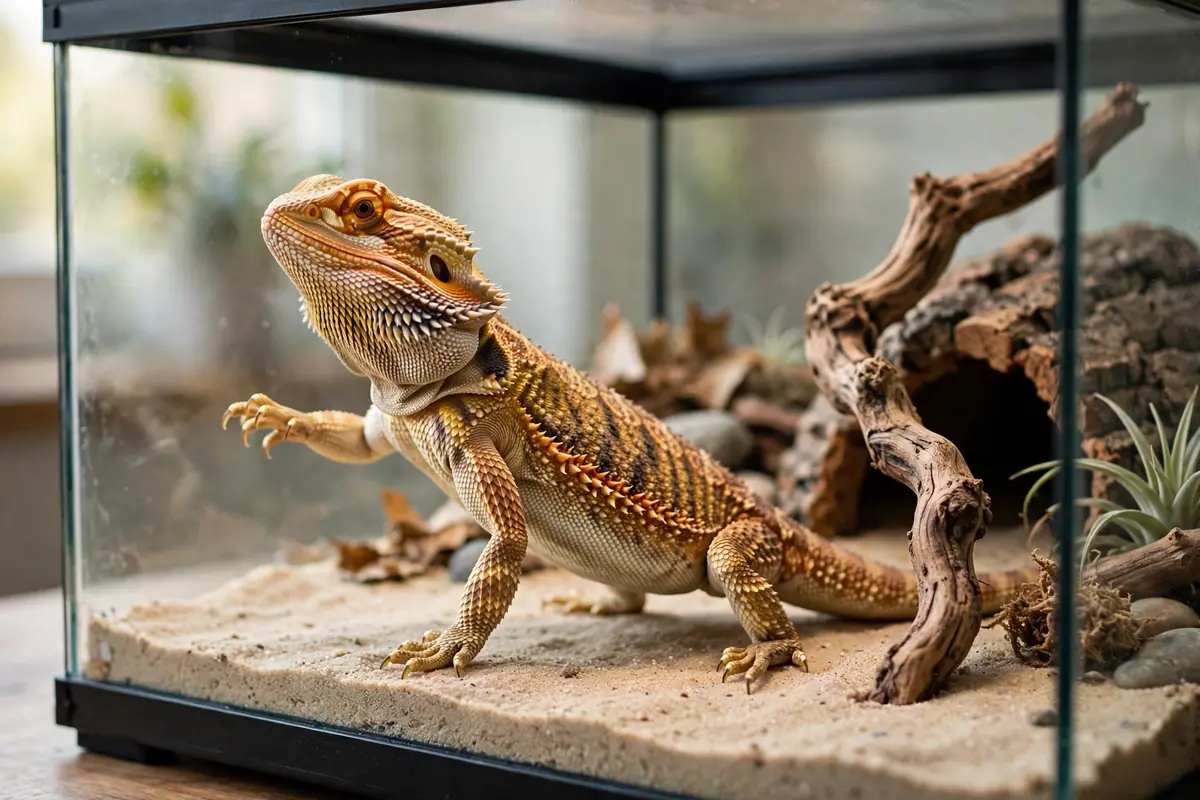
How Long Does Bearded Dragon Relocation Stress Last?
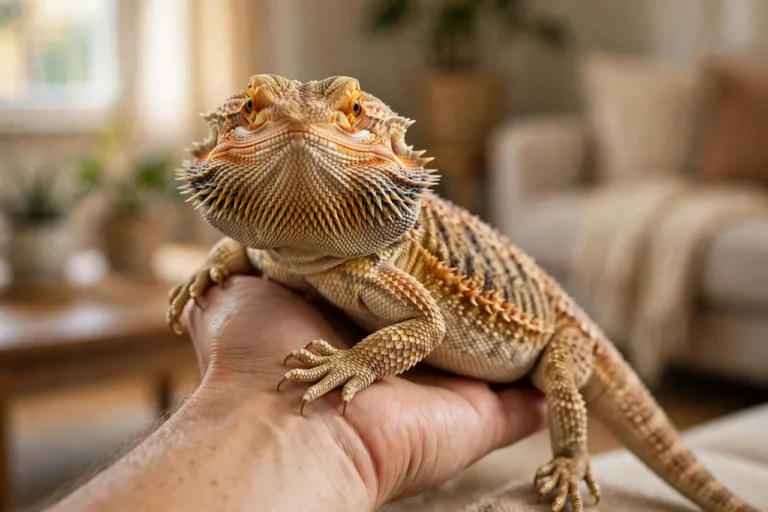
You just brought home your bearded dragon, and instead of the basking, bug-chasing buddy you imagined, you’ve got a dark-bearded statue wedged behind the water dish that hasn’t eaten in two days. Welcome to bearded dragon relocation stress — the completely normal adjustment period almost every new dragon goes through. Understanding what’s normal, how long it lasts, and which signs actually warrant worry will save you a lot of midnight Googling.
What relocation stress is
Imagine being lifted out of everything you’ve ever known — the smells, the sounds, the routine, the hands that feed you — and dropped into a strange glass box. That’s your dragon’s first week. New sights, new sounds, new temperatures, and a brand-new giant (you) reaching into its world all trigger a stress response: appetite drops, colors darken, and hiding becomes the full-time job.
This isn’t a flaw in your dragon or your setup. It’s the expected cost of moving, and nearly every healthy dragon passes through it on the way to settling in. The keepers who sail through this phase share one trait: they measure progress in weeks, not hours, and let the dragon set the pace. Give it that grace period and most dragons reward you with a complete personality turnaround.
The settling timeline
Younger dragons often settle faster than rehomed adults, and a correct setup (proper basking temps, UVB, hides on both ends) shortens the timeline noticeably. Asking the right questions when you buy from a breeder — about feeding routines and handling history — also helps you recreate familiar patterns at home.
Reality: the opposite. Dragons left mostly alone for the first week or two — fed on a predictable routine, watched from a distance — learn that you’re safe far faster than dragons that get grabbed daily while terrified. Patience now buys trust later.
Settling-in or red flag? The table
Twelve common new-home behaviors, sorted honestly. Use the search box to find a specific behavior, or filter to see only the normal settling signs vs. the ones that should send you to a vet.
🔎 New-Home Behavior Checker
| Behavior | Normal settling sign | Red flag — see a reptile vet |
|---|
What NOT to do during the settling period
Good intentions cause most settling-period setbacks. Avoid these:
- Don’t rearrange the tank. Every decor change resets the “learn the territory” clock. Set it up right once, then leave it alone for the first month.
- Don’t introduce new pets, people parades, or loud handling sessions. One calm caretaker doing one predictable routine beats a welcoming committee.
- Don’t withhold food to “make” the dragon eat. Skipping offered meals doesn’t build appetite under stress — it just adds hunger to the stress. Offer daily; let the dragon decide.
- Don’t panic at every dark beard. Checking the table above once is diligence; hovering and re-checking hourly stresses you both. Review setup, then give it time.
- Don’t change everything at once if something looks off. New bulb and new substrate and new feeding schedule in one day tells you nothing about what helped. Change one variable, wait, observe.
When the timeline doesn’t fit: brumation and illness
Relocation stress has a doppelganger problem: two other things look similar but need different responses.
Brumation. If you bring home an adult in autumn or winter and it gets sleepy, eats less, and hides for weeks, you may be seeing brumation (reptile hibernation-like slowdown) rather than — or layered on top of — relocation stress. The key difference: a brumating dragon is calm and stable, not visibly stressed, and the slowdown follows the season. Never let a new, unweighed, or possibly-ill dragon brumate without a vet check first.
Illness. Parasites, respiratory infections, and other health problems can all mimic “just stressed” — lethargy, appetite loss, hiding. The differentiator is trajectory: relocation stress improves week over week. Anything that plateaus or worsens after two weeks, or any red-flag behavior from the table, deserves professional eyes. A new-dragon wellness exam with a fecal test is one of the highest-value vet visits in the hobby — it rules out the scary stuff early, when it’s cheapest to fix.
How to help your dragon settle faster
- Hands off for the first week (or two). Feed, water, spot-clean — that’s it. Let the dragon watch you be boring and safe.
- Keep a strict routine. Lights on/off at the same times, food at the same time. Predictability is calming.
- Double-check the setup. Basking spot 100–110°F, cool side around 80°F, UVB covering the basking zone, hides on both ends. A dragon that can’t thermoregulate can’t settle.
- Offer food daily, remove pressure. Put the salad and insects in, walk away. Eating in private counts.
- Introduce yourself gradually. Rest your hand in the tank without grabbing. Talk near the enclosure. Let curiosity replace fear on the dragon’s schedule.
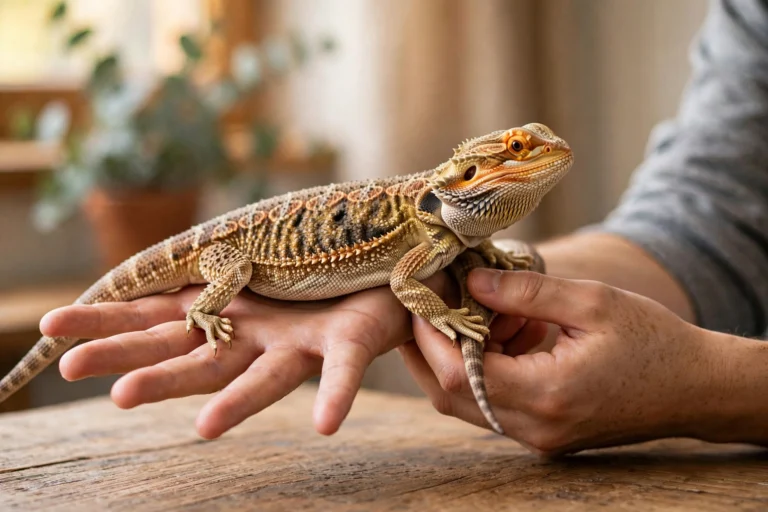
- Start short handling sessions only once the dragon is eating and basking regularly — a few calm minutes, low over a soft surface.
Frequently asked questions
How long does relocation stress last?
Typically one to two weeks, sometimes stretching to three or four for shy individuals or rehomed adults. Appetite is usually the last thing to fully normalize.
My dragon is glass surfing. Is that relocation stress?
Often, yes — it’s restless exploring of unfamiliar boundaries. Check the table above: brief surfing that fades within a couple of weeks is normal; frantic nonstop surfing with a black beard deserves a setup review.
Should I cover the tank with a towel to reduce stress?
Partially covering the sides (not the top — keep ventilation and lights clear) can help a very nervous dragon feel less exposed in week one. Remove it gradually as the dragon settles.
Why is my dragon’s beard black?
A dark or black beard is a general stress and communication signal — extremely common during the settling period. Our guide to black beard meaning breaks down what different contexts signal, and arm waving is another new-home behavior that usually fades with familiarity.