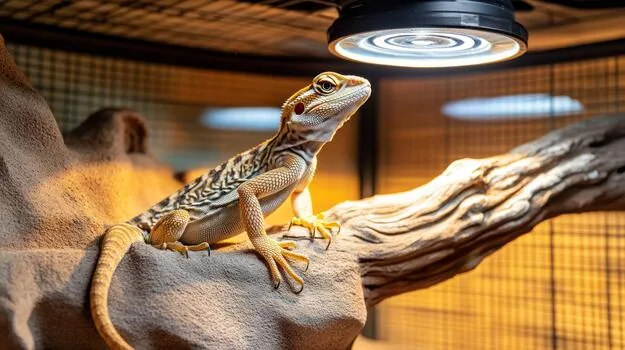
Exact Basking Temperatures for Bearded Dragons by Age
If bearded dragon care has a master variable, it’s temperature. Digestion, appetite, immune function, activity level — all of it runs on heat. Get the basking spot right and half the “problems” new owners panic about never happen. Below are the exact numbers, and a checker that grades your setup in ten seconds.
The exact numbers
These are surface temperatures — what the basking rock itself reads — because that’s what your dragon’s belly feels:
| Age | Basking surface | Warm-side air | Cool end | Nighttime |
|---|---|---|---|---|
| Baby (0–6 mo) | 105–110°F | ~90°F | 80–85°F | 65–75°F |
| Juvenile (6–18 mo) | 100–110°F | ~90°F | 80–85°F | 65–75°F |
| Adult (18+ mo) | 95–110°F | 85–90°F | 75–80°F | 65–75°F |
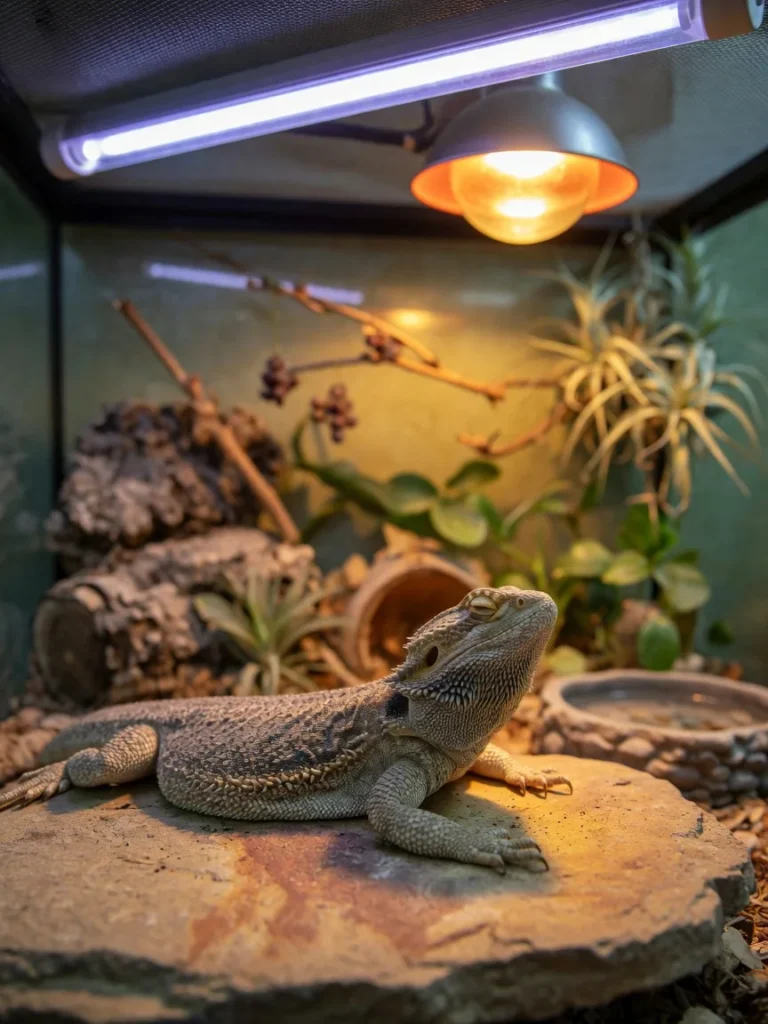
Babies run hotter — they need the extra heat to power ridiculous growth rates. Adults are flexible across the whole range. And here’s the visual version of what your tank should feel like from one end to the other:
Heat is a schedule, not a setting
The numbers above are only half the story. The other half is timing — because a dragon can’t use heat it hasn’t absorbed yet. Watch one on a normal morning: lights come on, it shuffles out of its hide, flattens itself under the basking lamp like a solar panel, and only then starts looking interested in food. That warm-up isn’t laziness. It’s the engine starting.
Digestion is a heat-powered process. A bearded dragon needs its core temperature up around 97°F before its gut can do real work — which is exactly why the basking surface runs hotter than the body. Feed a cold dragon and the food just sits there: undigested insects ferment in a cool gut, appetite shuts down, and owners end up troubleshooting “not eating” when the real problem was breakfast served before the engine was warm. Make a habit of it and you’re on the quiet road to impaction — food that can’t move becomes a blockage, and the impaction guide covers that chain in full.
The practical rule: lights on at least an hour before the first feeding, and the last meal a good two hours before lights-out, so everything is processed while the tank is still warm. Get the rhythm right and the pattern appears within days: bask, eat, bask, wander, bask again. That’s a healthy dragon running its heat clock exactly as designed.
The thermostat: cheap insurance
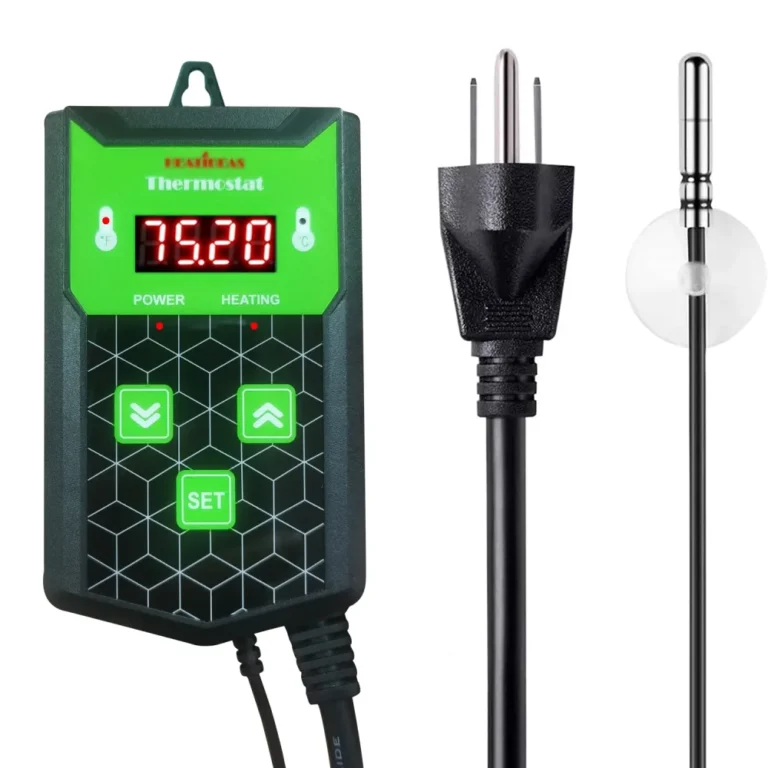
A $30 on/off thermostat is the most underrated device in reptile keeping. Plug the basking lamp into it, put its probe at the basking spot, set it to cut around 105°F — and your dragon can never be cooked by a heat wave, a wattage miscalculation, or a lamp that slipped lower. Dimming thermostats cost more but are smoother (no clicking on and off all day). Either way: the thermostat doesn’t replace measuring, it replaces worrying.
Seasonal adjustments
Set-and-forget is how dragons get chilled in January and cooked in July — because tank temperatures track room temperature more than most owners expect. A room that swings 10°F between seasons drags the basking spot along with it, and the bulb that was perfect in October is wrong by February.
Winter is the usual culprit: cold rooms, drafty windows, exterior walls. If the basking surface won’t hold 95°F even with the lamp lowered, step the wattage up — and re-check in January, not just at setup. Watch for the sneaky version too: a tank against a cold window can have a fine basking spot and a cool end that has quietly dropped into the 60s.
Summer runs the other direction. A hot room plus a basking lamp can push the spot past 115°F without you changing a thing — raise the lamp an inch or two, drop the wattage, or improve ventilation around the tank.
The fix is a ritual, not a gadget: temp gun out, four times a year, two minutes per check. Measure the basking surface, the warm side, and the cool end, and adjust the hardware to match the season. Nighttime drops are a separate question — if your house falls below 65°F after dark, the night heating guide covers ceramic heat emitters and when you actually need one.
Put the heat where the UVB is
Here is a detail most setup guides skip: heat and UVB are a package deal biologically, not just two items on a shopping list. Your dragon manufactures vitamin D3 in its skin from UVB exposure — but that chemical process runs on warmth. A dragon sitting under UVB while cold synthesizes D3 poorly. The two need to arrive together, the way they do from the actual sun.
That is the real reason the basking lamp and the UVB tube belong side by side, overlapping on the same spot. Put them at opposite ends and you force a choice your dragon will get wrong every time: it picks warmth, basks under the heat lamp all day, and soaks up zero UVB. Months of that is the classic road to metabolic bone disease — with a UVB tube technically installed and doing nothing.
At each seasonal re-check, verify the overlap, not just the numbers: one bright, warm patch where heat and UVB land together, fading into the cool retreat at the other end. The UVB guide has the exact mounting distances to make that overlap happen.
How to measure (your dial is lying to you)
Those stick-on dial thermometers measure the air temperature at the glass — and they’re routinely 10–20°F off from the basking surface, which is the number that matters. You need one of these instead:
- An infrared temp gun (~$15). Point it at the basking rock. Instant surface reading. This is the single best purchase in reptile keeping.
- A digital probe thermometer, with the probe zip-tied or taped at the basking spot. Great for continuous monitoring.
Use both if you can: the probe for always-on monitoring, the gun for spot-checking every surface in the tank.
4 temperature mistakes that cause “mystery” problems
- The whole tank is one temperature. No gradient means no thermoregulation — the dragon can’t warm up or cool down. Lethargy and appetite loss follow.
- Basking spot under 95°F. They can’t digest. Undigested food sits in the gut, appetite shuts down, and owners end up on the not-eating troubleshooting page when the real problem was a weak bulb.
- Heat rocks. Notorious for causing burns — they develop unregulated hot spots, and dragons will sit on them until injured because their heat-sensing is poor on their bellies.
- Colored “night” bulbs. Red and blue night lights disrupt sleep. Dragons need darkness. If your house drops below 65°F at night, use a ceramic heat emitter — heat with zero light.
Temperature questions, answered
My basking spot won’t get hot enough — what do I change?
One thing at a time: higher wattage bulb, lamp hung lower, or basking rock raised closer to the lamp. Re-measure after each change. Most “too cold” setups are fixed by a $10 bulb swap.
Can the basking spot be too hot?
Yes — sustained surface temps over 115°F risk burns. Signs your dragon agrees it’s too hot: constant gaping, pressing against the cool-end glass, refusing to bask at all.
Do I need heat at night?
Only if your room drops below 65°F. Above that, lights out and let them sleep cool — it’s natural. Below that, a ceramic heat emitter on a thermostat.
Why is my dragon gaping (mouth open)?
Usually just thermoregulation — like a dog panting. Occasional gaping while basking is normal. Constant gaping combined with lethargy or mucus is a vet visit.