7 Bearded Dragon Lighting Mistakes Even Experienced Keepers Make
The worst lighting setups often belong to the most experienced keepers — not because they do not care, but because a setup that worked “fine for years” quietly drifts out of spec. Bad lighting is the most common cause of serious illness in pet bearded dragons, and it is almost always preventable. Run the 60-second audit below, then scroll to your misses. Most keepers are making three of these.
Metabolic bone disease is the most common serious illness in captive bearded dragons, and it is a husbandry disease — caused by the setup, not bad luck. The fix costs about forty dollars: one tube, mounted at the right distance, replaced on time.
1The starter-kit coil bulb is still in the dome
It came free with the tank, so it must be fine. It is not. Compact and coil UVB bulbs throw a narrow cone of UVB instead of the wide gradient a bearded dragon needs, and output varies wildly between bulbs — the dragon ends up with bright spots and dead zones it cannot navigate. They have even been linked to eye problems in basking species.
Why it matters: UVB is how your dragon makes vitamin D3, and D3 is what unlocks calcium from food. Patchy UVB means patchy calcium absorption — the slow road to metabolic bone disease in a dragon that “has UVB.”
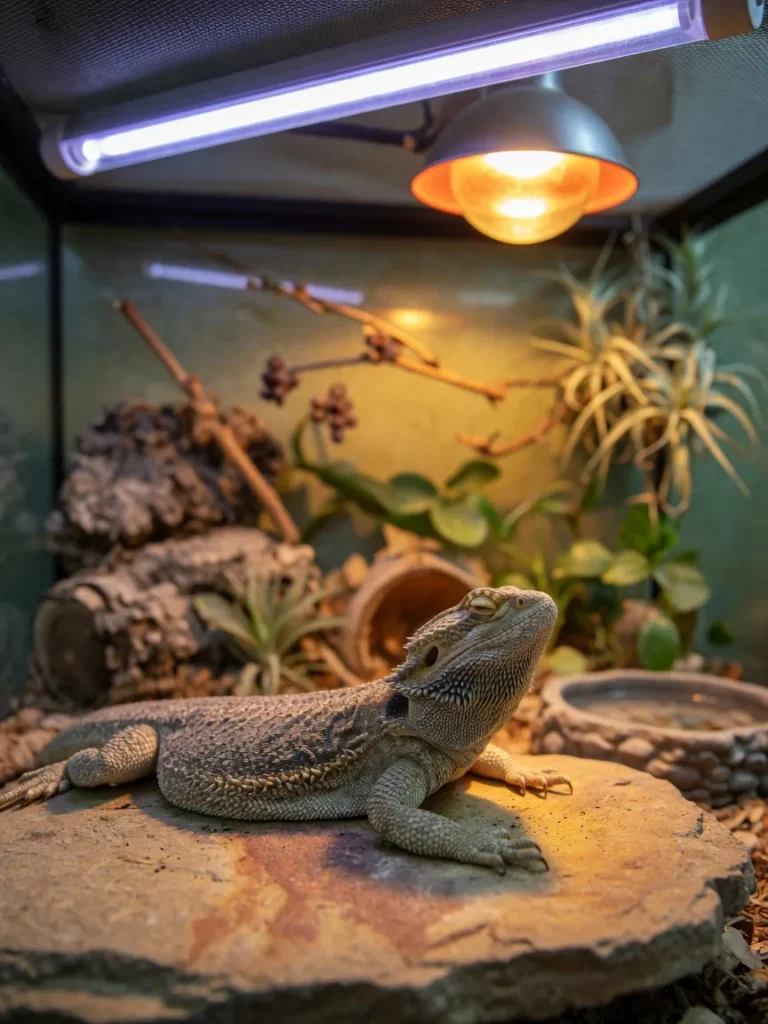
The fix: a linear T5 HO tube — Arcadia 12% or Zoo Med ReptiSun 10.0 — spanning two-thirds of the tank in a fixture with a reflector. The highest-impact upgrade in reptile keeping, for about forty dollars.
2The UVB is mounted where half of it never arrives
Distance is everything with UVB, and most of it is lost before it reaches the dragon. Fine mesh screen can block up to half the output; wide-hole screen still eats roughly a third. Hang the fixture too high on top of that, and the rays arriving at the basking spot are a rumor.
Why it matters: keepers measure bulb-to-floor, mount over dense mesh, and end up with near-zero UV exactly where the dragon basks. The tube is technically installed and doing nothing — the classic silent setup failure.
The fix: for a T5 HO 12% or 10.0, aim for 12–18 inches above the basking spot over mesh, or 18–24 inches mounted inside. Measure bulb to your dragon’s back, not the tank floor. When in doubt, mount the fixture inside — the biggest single upgrade most setups can make.
3The tube has not been changed since installation day
This one catches veterans more than beginners. The tube still turns on and the tank looks bright, so the UVB must be fine. It is not. The UVB-emitting phosphors degrade with use while the visible light stays bright — a two-year-old tube can look perfect and produce essentially zero UVB.
Myth: “The bulb still turns on, so it’s still working.”
Reality: visible light and UVB output decay on completely different schedules. The part you can see outlives the part that matters by a year or more. Trust the calendar, never your eyes.
Why it matters: this is how dragons get MBD “out of nowhere” eighteen months into a good setup. Nothing changed visibly — the invisible part just expired.
The fix: replace T5 HO tubes every 12 months, T8 every 6, and write the install date on the tube end with a marker. Want certainty instead of a calendar? A Solarmeter 6.5 UV index meter reads the actual UV hitting the basking spot.
4A red bulb “keeps them warm” all night
The pet-store logic sounds reasonable: red light is dim, dragons supposedly cannot see it, so it gives nighttime heat without disturbing sleep. Every clause of that sentence is wrong. Bearded dragons have photoreceptors sensitive to red wavelengths — a red bulb illuminates their enclosure all night.
Bearded dragon eyes contain photoreceptors sensitive to red light up to about 702 nanometers. The “invisible” night bulb is perfectly visible to them — it just looks dim to you.
Why it matters: light at night suppresses melatonin and fractures sleep — which means chronic stress, weaker appetite, and a dampened immune system. The red bulbs at night habit is one of the most common slow-burn mistakes in the hobby.
The fix: total darkness at night, every night — dragons handle drops into the mid-60s°F naturally. Only below 65°F do you need supplemental heat: a ceramic heat emitter (heat, zero light) on a thermostat. Our night heating options guide covers the whole decision.
5The heat runs with no thermostat watching it
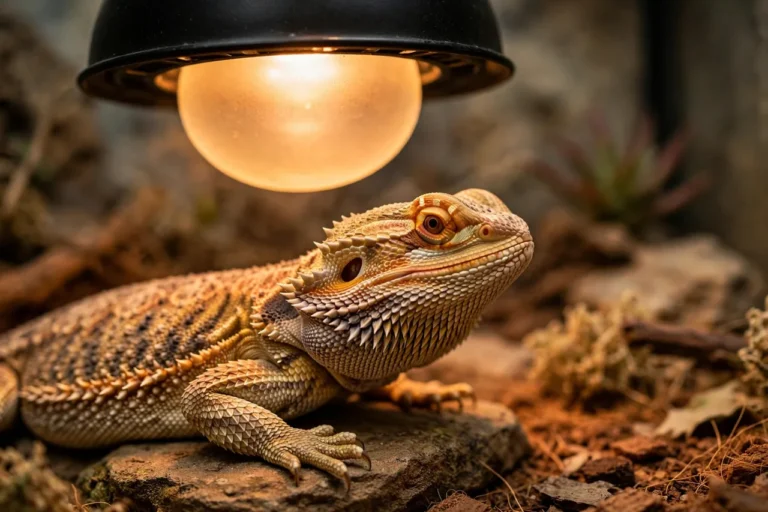
A basking lamp plugged straight into the wall assumes nothing ever changes: the room never heats up, the lamp never slips, the wattage was never misjudged. Summer afternoons break that promise — so do wobbly dome clamps and a bulb grabbed from the wrong box.
Why it matters: an unregulated basking spot can swing 20°F with the seasons and the room. Too hot for a week and you get a burned dragon that stops basking — and the owner “fixes” it by moving the lamp closer. A $30 thermostat breaks that cycle.
The fix: plug every heat source into an on/off thermostat, probe at the basking spot, cut around 105°F. Dimming models cost more but skip the all-day clicking. The thermostat does not replace measuring — it replaces worrying.
6The whole tank sits at one temperature — or the basking spot is a guess
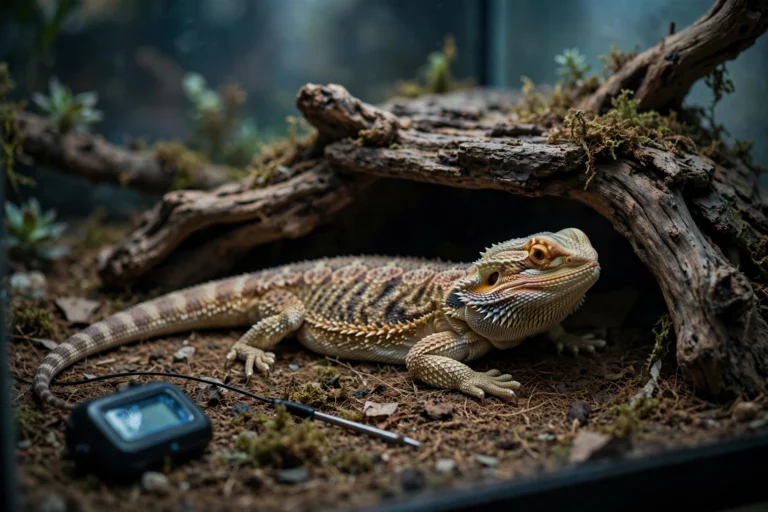
Two versions of the same mistake. Version one: a small tank, an oversized bulb, and nowhere to escape the heat — the dragon cannot thermoregulate because there is no gradient. Version two: the basking spot was set by vibes, measured once with the stick-on dial from the starter kit, and never checked again.
Claim: “The stick-on thermometer says 95°F, so the basking spot is 95°F.” Verdict: false. Stick-on dials measure air temperature at the glass and routinely read 10–20°F off from the basking surface — the number your dragon’s belly actually feels.
Why it matters: digestion is heat-powered. A dragon needs its core near 97°F before its gut can do real work, which is why basking surfaces run hotter than the body. Feed a cold dragon and the food just sits there — appetite shuts down and owners troubleshoot “not eating” when the real problem was a weak bulb. Babies need 105–110°F at the basking surface, adults 95–110°F, and the cool end should hold 75–85°F.
The fix: buy a $15 infrared temp gun, point it at the basking rock, and believe the number. Add a digital probe at the basking spot for continuous monitoring. And no heat rocks, ever — they develop unregulated hot spots, and dragons sense belly heat so poorly they will sit on one until burned.
7The lights run on your memory instead of a timer
Lights on “around 8,” off “when I go to bed” — except weekends, late nights, and the week you worked overtime. Your dragon’s circadian rhythm does not care about your schedule; it cares about consistency. An erratic photoperiod is a quiet, chronic stressor behind restless behavior and unpredictable appetite.
Bearded dragons evolved under one of the most consistent light cycles on the planet. Twelve to fourteen hours of light and heat, then true darkness, is the operating system their hormones run on.
The fix: a plug-in outlet timer costs less than a pizza and removes you from the loop. Set 12–14 hours on, darkness the rest, same time daily. For seasonal nuance — longer days in summer, shorter in winter — our light schedules guide has the full breakdown.
The 10-minute fix-up
Work this list top-down until your setup passes the audit:
- Kill the coil bulb — linear T5 HO tube with a reflector fixture.
- Fix the distance — 12–18″ over mesh, 18–24″ mounted inside, bulb to dragon’s back.
- Check the calendar — past 12 months (T5) or 6 (T8)? Replace and date the new one.
- Go dark at night — unscrew anything colored; below 65°F, a ceramic heat emitter on a thermostat.
- Thermostat the heat — probe at the basking spot, cut at 105°F.
- Measure properly — temp gun on the basking surface, gradient verified end to end.
- Timer everything — 12–14 hours on, dark the rest, same time daily.
An afternoon’s work, no new tank required. Dragons perk up within days of a corrected setup — and the most expensive mistake is leaving things as they are.
What to read next
💡 Building or rebuilding a setup? Grab the lighting checklist in our bearded dragon starter kit so every bulb, fixture, and timer lands in the cart the first time.