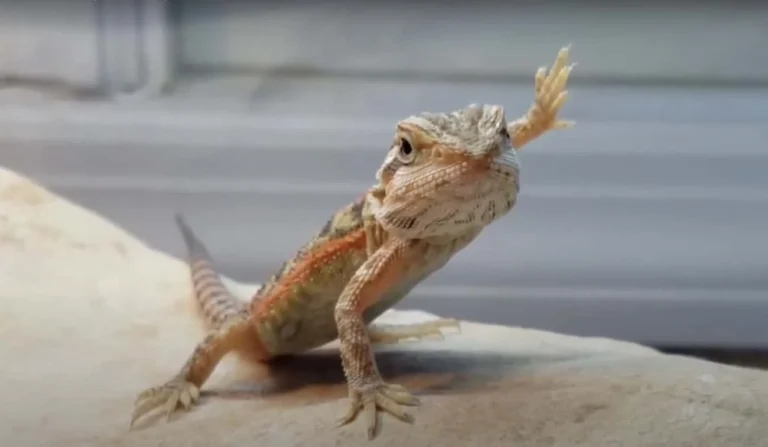
What Arm Waving and Head Bobbing Really Mean
No, your bearded dragon isn’t waving hello — but what it’s actually doing is more interesting. Arm waving and head bobbing are two halves of an ancient social language: one says “I come in peace,” the other says “I’m in charge here.” Most owners see one or the other in isolation and either melt (“he waved at me!”) or worry (“why is he bobbing at the wall?”). Tap the behaviors you’re seeing in the decoder below for a combined read, then learn what each signal really means.
The myth: "He's waving hello"
It's the most charming misread in reptile keeping. A bearded dragon lifts one foreleg, rotates it in a slow circle, and every human in the room melts. But the wave isn't a greeting — dragons don't greet. It's an appeasement signal aimed at something the dragon perceives as bigger or potentially threatening: you towering over the tank, the dog across the room, or its own reflection. "Hello" is our story; "please don't hurt me, I'm harmless" is theirs. Knowing the real meaning doesn't make it less cute — it just keeps you from missing what the dragon is actually telling you.
Arm waving means submission and appeasement
In the wild, bearded dragons wave at larger dragons to defuse confrontations — a slow, deliberate arm circle that says "I acknowledge your dominance; no challenge here." Captive dragons aim the same signal at whatever looms largest in their world. Juveniles wave the most, because almost everything is bigger than they are, and most outgrow constant waving as they gain size and confidence.
The wave itself is always slow and rhythmic — that's how you distinguish it from random leg movement or the frantic paddling of a stressed dragon. One arm, slow circles, calm body. That's the signal.
Head bobbing means dominance display
Bobbing is the wave's opposite number: rapid, assertive up-and-down head pumps that say "I'm in charge." Males do it most, especially in spring, and the audience is usually a reflection, another pet, or occasionally the owner at feeding time. A bobbing dragon often pairs the display with a blackened, puffed beard for maximum effect — the full swagger package.
Unlike waving, bobbing is fast and emphatic. Slow and circular means submission; fast and vertical means dominance. Once you see the two side by side, you'll never confuse them again.
Bob speed itself carries information. Rapid-fire bobs — several per second — are peak dominance or breeding-season intensity, usually aimed at a rival or a potential mate. Slow, deliberate bobs are often courtship: a male bobbing slowly at a female is running a different program than a male machine-gunning bobs at his reflection. And brief, half-hearted bobs at feeding time are usually just excitement bleeding over into display behavior — the dragon equivalent of talking with your mouth full.
Do females wave and bob too?
Yes — both sexes use both signals, which surprises owners who assume it's all male behavior. Females wave readily (submission is submission regardless of sex) and bob too, though typically less frequently and less intensely than males. A female's bob is often slower and shorter-lived: a few pumps to establish "this basking spot is mine," then back to business.
Where sex really shows is seasonality. An adult male in spring may bob for weeks on end at anything that moves; females rarely sustain that level of display. If your female suddenly starts bobbing intensely, check for the usual triggers first — a new reflection, a rearranged tank, or another animal in sightlines — before assuming hormones.
🔍 Myth vs reality
Myth: "Waving means he's happy to see me, and bobbing means he's angry." Reality: Waving means "I submit" and bobbing means "I'm dominant" — neither maps to human happy/angry. A waving dragon can be perfectly content; a bobbing dragon is usually just showing off, not raging.
When waving is completely normal
Most waving needs no response at all. It's expected in: juveniles under six months (they wave at everything), newly rehomed dragons (everything is big and scary for two weeks), dragons that can see their reflection (the "rival" never leaves, so the appeasement never stops), and multi-pet households where a cat or dog is visible from the tank. In all these cases, the wave is working as designed — a polite social signal in a world full of giants.
If constant reflection-waving bothers you (or seems to tire the dragon), covering the lower few inches of the glass or adding a background to that panel usually ends it within days.
When waving signals real stress
Waving crosses from "normal communication" into "worth investigating" when it's paired with hiding, appetite loss, dark stress marks on the belly, or frantic rather than slow movements. A dragon that waves and hides and won't eat isn't being polite — it's overwhelmed. The usual suspects, in order: temperatures wrong (too hot or too cold), not enough hiding spots, too much handling too soon, or a predator-visible tank placement.
Work the list methodically rather than changing everything at once — fix heat first, since thermal stress amplifies every other stressor. Our bearded dragon stress signs guide walks through the full diagnostic in order.
Reading combinations: the decoder's real lesson
Single signals are vocabulary; combinations are sentences. Wave plus black beard means something different from wave alone (submission toward a specific perceived threat, not general politeness). Bobbing plus puffing plus black beard is the full dominance theatrical production. Gaping plus basking is thermoregulation; gaping plus lethargy plus mucus is a vet visit. The decoder above handles the common pairings, but the principle generalizes: always ask "what else is happening?" before deciding what a behavior means.
💡 Did you know
The arm wave is so slow and deliberate that researchers describe it as one of the most ritualized signals in lizard communication — closer to a formal bow than a casual gesture. Some dragons even alternate arms, like a tiny slow-motion semaphore.
Should you ever worry about waving?
Almost never, on its own. Waving is not a symptom of anything — it's not a neurological tick, not a seizure, not a sign of metabolic bone disease, despite what worried forum threads sometimes suggest. True neurological problems look completely different: uncontrolled tremors, stargazing (head tilted back and held), or inability to right themselves. A slow, voluntary, alternating arm circle is communication, full stop.
The only waving-adjacent worry is what it might be telling you about the environment — chronic waving at a reflection or a looming pet is a husbandry hint, not a health crisis. Adjust the tank, not the dragon.
Body-language quick reference
| Signal | Core meaning | Usual response |
|---|---|---|
| Slow arm wave | Submission / appeasement | None needed; check for reflection triggers if constant |
| Fast head bob | Dominance display | None needed; normal in adult males |
| Black beard | Intensity (context decides) | Read the context; vet if persistent + symptoms |
| Gaping while basking | Heat venting | None needed |
| Pancaking | Heat absorption | None needed |
| Glass surfing | Restlessness / stress | Check heat, space, boredom, season |
For the complete vocabulary — all twelve signals and how they combine — see How to Read Your Bearded Dragon's Body Language.
📊 Stat
Juvenile bearded dragons wave far more often than adults — keepers consistently report that most babies wave regularly while most adults rarely do. It's not a phase they're "growing out of" socially; they're literally growing past the size where everything reads as a threat.
What to read next
- How to Read Your Bearded Dragon's Body Language — the full 12-signal vocabulary.
- Is Your Bearded Dragon Stressed? 8 Signs to Watch — when signals point to real stress.
- Why Is My Bearded Dragon Glass Surfing? 7 Causes and How to Stop It — the restlessness signal, decoded.