Why Is Your Bearded Dragon Bobbing Its Head?
Your bearded dragon locks eyes with something across the room — and starts pumping its head up and down like a tiny dashboard bobblehead. Is it saying hello? Picking a fight? Flirting? The answer is: it depends on the speed. Bearded dragon head bobbing is one of their richest communication signals, and the tempo carries the entire message: slow bobs mean deference, fast bobs mean dominance. Learn to read the speed, and you can read your dragon’s mind — at least on the topics it cares about, which are territory, hierarchy, and mating season.
Slow bob vs. fast bob: compare the two signals
Toggle between the two bobs below. Each panel breaks down the speed, the typical context, what your dragon is saying, and what you should do about it.
Head-bob translator
Slow bob: “I am not a threat”
| Speed | Slow, smooth, deliberate up-and-down nodding — relaxed, unhurried. |
|---|---|
| Typical context | A smaller or younger dragon facing a larger one; a female responding to a male; a dragon meeting new people or acknowledging another dragon’s presence. |
| What it means | Submission and appeasement. The dragon is signaling deference — “I defer to you, no fight here.” Often paired with the slow circular arm wave, the companion submission signal. |
| What you should do | Nothing — this is healthy social communication. If your dragon slow-bobs at you, it is simply acknowledging you as the bigger presence. Carry on as normal. |
The slow bob: submission and appeasement
The slow bob is the gentle one — a calm, rhythmic nodding that looks almost thoughtful. You will see it most from younger dragons and females, the individuals most often in the position of deferring to someone bigger. A female may slow-bob back at a courting male to signal receptiveness; a juvenile may slow-bob at a new owner, essentially saying “I come in peace.”
The slow bob’s constant companion is the arm wave — that smooth, circular lift of one forelimb. The two signals travel together so often that they form a single message of appeasement. If you have not decoded the wave yet, our guide on why bearded dragons wave pairs perfectly with this one. When you see slow-bobbing plus waving, you are watching textbook deference, and the correct owner response is simply to let it happen.
The fast bob: dominance, territory, and courtship
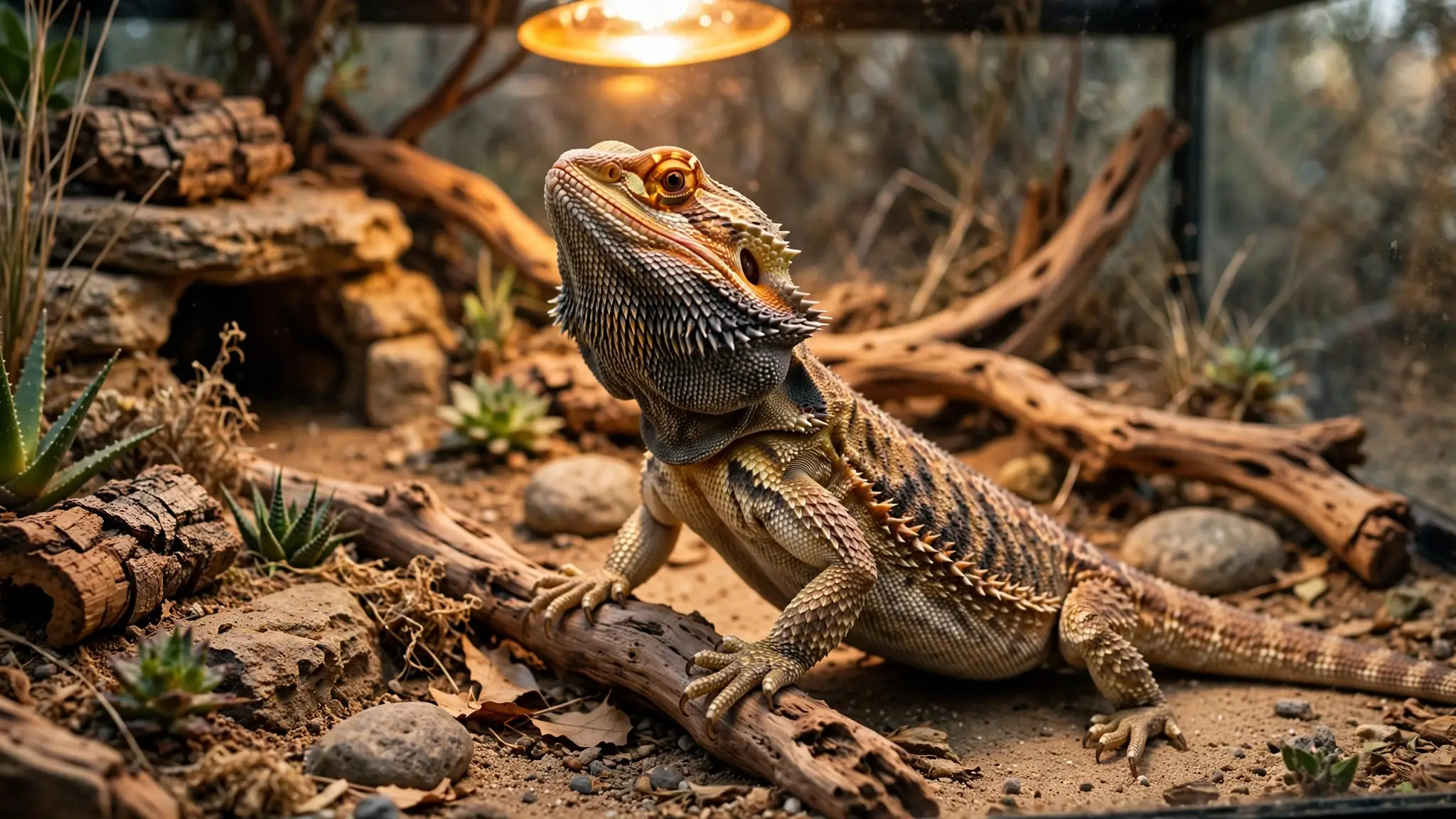
The fast bob is the dramatic one: rapid, jerky head-pumping, frequently combined with a puffed-out, darkened beard. This is overwhelmingly a male display, and it peaks during breeding season in spring and early summer, when hormones turn every male into a tiny territorial debater. If you are unsure whether your dragon is male or female, the intensity of bobbing season is itself a clue — see male vs. female bearded dragon for the full comparison.
In courtship, the male’s vigorous bobbing advertises his fitness to the female, who may answer with slower bobs or arm waves of her own. In territorial mode, the same fast bob is aimed at rivals — other males, the cat walking past the tank, or the “other dragon” in the glass. When bobbing teams up with a jet-black beard, read our black beard meaning guide to decode the full display, because the combination is louder than either signal alone.
Bobbing at reflections: the rival in the glass
One of the most common fast-bob triggers is also the most avoidable: the dragon’s own reflection. Bearded dragons are highly visual, and a dragon does not understand mirrors — it sees another dragon holding eye contact in its territory and responds the only way it knows how. Glass surfing, reflection bobbing, and general restlessness often travel together as stress signs when the “rival” never leaves.
The fix is environmental, not behavioral: cover the lower portion of the glass with a background, rearrange decor to break up reflective sightlines, or reposition the tank away from whatever the dragon is bobbing at. Once the phantom rival disappears, the bobbing usually stops within days.
Bobbing at you: curiosity or challenge?
Sometimes the audience is you. A slow bob directed at a new person is typically acknowledgment or mild appeasement — the dragon sizing up the big newcomer. A fast bob at you is rarer and usually territorial: it happens most with adult males during breeding season, or when you reach into the tank in a way the dragon reads as an intrusion. Neither is aggression in the biting sense; both are communication. If your dragon fast-bobs at your hand, withdraw calmly, approach from the side rather than looming overhead, and give it a minute. Meeting a display with a bigger display — chasing, grabbing, or looming — is how trust gets broken.
How to respond to each type
- Slow bob: no action needed. It is healthy communication — acknowledge calmly and continue what you were doing.
- Fast bob at a reflection: remove the trigger (backgrounds, sightline breaks).
- Fast bob at another animal: increase distance; never house bearded dragons together to “work it out” — especially two males.
- Seasonal fast bobbing: expect it in spring, keep routines steady, and wait it out. Hormones fade.
- Fast bob with stress signs (glass surfing, black beard that will not fade, appetite loss): audit the environment — temperatures, lighting, tank size, and hiding spots.
When head bobbing is a concern
True social bobbing is smooth and rhythmic, whatever the speed. What does not belong in this guide is bobbing that looks weak, twitchy, jerky in an uncoordinated way, or more like a tremor than a signal — especially if it comes with lethargy, a tilted head, or difficulty eating. That is not communication; it can indicate a neurological or health problem, and it warrants a reptile vet visit. Similarly, if fast bobbing becomes near-constant with no identifiable trigger and is paired with other behavior changes, have the husbandry — and the dragon — checked.