Reptile-Safe Sealants: What You Can and Can’t Use
The tube of sealant you grab at the hardware store can be the difference between a rock-solid custom background and a tank your dragon should never live in. Most caulks and adhesives release fumes while they cure, and some — the ones with mold inhibitors — never become safe at all. The good news: the safe options are cheap, easy to find, and clearly labeled once you know what to look for.
The one rule that decides everything
Safe sealants for a reptile enclosure share one trait: 100% silicone with no mold, mildew, or antimicrobial additives, fully cured before the animal goes anywhere near it. The label is the whole test. If the tube brags about “mold-free,” “mildew-resistant,” “kitchen & bath,” or “with Bioseal,” put it back on the shelf — those additives are biocides designed to leach out and kill living things, which is the opposite of what you want sealed inside a warm, humid box with your dragon.
The classic safe pick is plain GE Silicone I for windows and doors — not GE Silicone II, which carries a mold inhibitor, and never any kitchen-and-bath formula. Aquarium-labeled silicones are the zero-guesswork option: they cost a little more, but the tube says exactly what it is.
How to read a caulk tube in 30 seconds
Stand in the hardware aisle and run this checklist before any tube goes in your basket:
- Front label: look for “100% silicone” plus “Window & Door” (or “aquarium safe”). Reject anything that says kitchen, bath, tub, tile, mold, or mildew.
- Back label: scan for the words mildewcide, antimicrobial, Bioseal, or “mold-free protection.” One hit and the tube goes back.
- The number: with GE products, the Roman numeral matters — I is the plain formula, II carries the inhibitor. Same brand, same shelf, completely different safety.
- When in doubt: the aquarium-labeled tube costs a dollar or two more and removes every question. For a first build, that’s cheap insurance.
Sealants that are safe (once cured)
- GE Silicone I (Window & Door): the hobby standard. No mold inhibitors, bonds well to glass, cheap and everywhere.
- Aquarium-specific silicone: the safest off-the-shelf choice — formulated with zero biocides by definition.
- Momentive RTV100-series (e.g., RTV108): professional-grade 100% silicone many tank manufacturers actually use; stronger bond than hardware-store tubes.
- Hot glue (non-toxic sticks): fine for lightweight decor — no fumes once cool — but the bond is weak and fails under weight or heat, so keep it to small jobs.
- Cyanoacrylate super glue (gel): safe once polymerized; the gel type is easier to control on porous surfaces like ceramic or rock.
Check any product before you buy it
Sealants to never use
The unsafe list is shorter than most people expect — but every item on it is a product someone has genuinely put in a reptile tank:
- GE Silicone II / anything with Bioseal: the mold inhibitor leaches continuously. Same brand, same shelf, one Roman numeral apart from the safe one — this is why you read the tube, not the brand.
- Kitchen-and-bath silicone (any brand): mildewcides by design. DAP, Loctite, store brands — if it says kitchen, bath, or mildew-resistant, it stays out of the tank.
- E6000 and solvent craft glues: brutal fumes, perchloroethylene, and a Prop 65 cancer warning. Fine for jewelry; never for a vivarium.
- Solvent-based construction adhesives: they off-gas for weeks, and a bearded dragon's lungs sit inches from every surface in a 4×2×2. Not a beginner material.
Curing rules: the smell test is the law
Curing is a chemical process, not a drying one, and the timeline depends on bead thickness, airflow, and humidity. Work through this checklist before any animal moves in:
- Give thin beads 48 hours minimum — seams, decor joints, and corner fillets. Thick structural beads and foam get a full 7 days, longer in a cold garage.
- Ventilate aggressively. Cure in open air with airflow, not sealed inside a closed tank — trapped fumes slow the cure and concentrate exactly where you don't want them.
- Do the vinegar-smell test. Acetoxy silicone releases acetic acid (vinegar smell) as it cures. If you can still smell it, the cure isn't done. Zero smell, zero shortcuts.
- Never heat-cure with the animal present. Heat speeds curing, but heat lamps on fresh silicone or foam just bake fumes into the enclosure air.
- Wash before stocking. A wipe-down with plain water after curing removes surface residues — one more reason our guide to what cleaners are safe matters even for brand-new builds.
Where sealant actually matters in a beardie tank
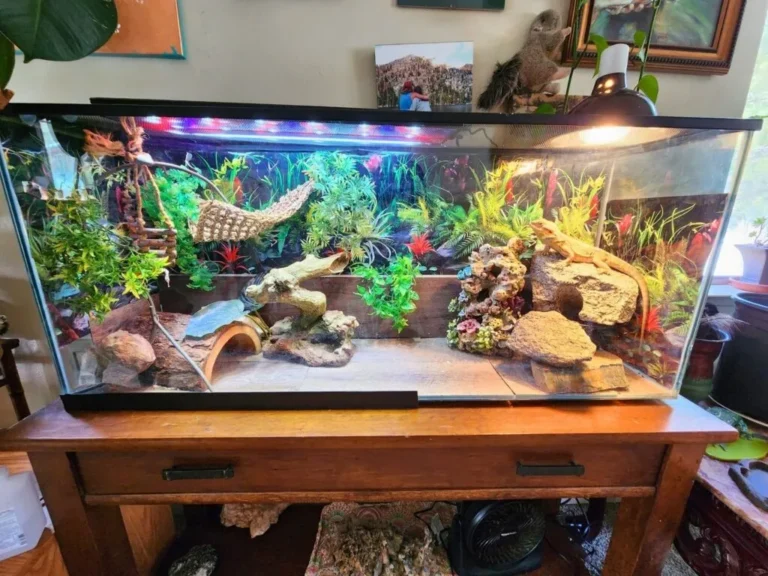
You don't need sealant for a basic glass tank — but the moment you customize, it shows up everywhere:
- Background builds: foam carved into rock walls gets sealed with grout, then a water-based non-toxic sealer. Unsealed foam crumbles, and feeder insects will chew raw foam — a double problem.
- Bioactive builds: sealing a bioactive build means waterproofing the drainage layer and any wood edges so constant moisture doesn't rot the enclosure from the inside.
- Decor: sealing decor — branches, hides, and ledges — keeps porous materials from soaking up waste and bacteria.
- Substrate barriers: a silicone bead along the bottom edges works as one of the simplest substrate barriers, keeping loose substrate out of the track of sliding doors.
Sealant questions, answered
Can I use the silicone I already have if it says "mold-free"?
No. "Mold-free" and "mildew-resistant" are marketing names for biocide additives — exactly the chemicals that make a tube unsafe. Buy a fresh tube of plain 100% silicone; it's a few dollars, and a half-used mystery tube isn't worth the gamble.
How long before my bearded dragon can go in?
After thin silicone beads: 48 hours minimum plus a passed smell test. After thick beads, foam, or grout: 7 days minimum. When in doubt, wait longer — nothing about a cure timeline is improved by rushing it.
Is hot glue really safe? It seems too easy.
For light decor, yes — non-toxic hot glue has no fumes once cooled. The catch is strength, not safety: it lets go under weight, heat, or humidity. Use it for small cosmetic pieces, silicone for anything structural.
What about sealing the outside of the tank?
Outside-only applications are far more forgiving since fumes dissipate into the room, not the enclosure. Still avoid the harshest solvents — and never assume "outside" means you can skip ventilation while it cures.