What to Do When Your Bearded Dragon Can’t Poop
Every bearded dragon owner hits this moment: you scan the enclosure, do the mental math, and realize it has been four days — or six, or nine — since the last poop. The good news: a missed poop or two is one of the most common and most fixable issues in bearded dragon care, and most cases clear up with the home-care ladder below.
The skill that matters is telling slow digestion from a real blockage: constipation means stool is moving slowly; impaction means something is physically blocking the digestive tract, and that belongs with a reptile veterinarian. This guide covers what is normal at each age, the five usual causes, six safe home remedies in order, and the exact red flags that mean home care is over. For a fast read, run your signs through the red-flag radar — it scores what you are seeing and tells you which zone you are in.
How Often Should a Bearded Dragon Poop?
Poop frequency is mostly a function of age, diet, and temperature — and “normal” is wider than most new owners expect.
Babies (under about 3 months) are poop machines: once a day is typical, sometimes twice, since they eat almost entirely insects and their metabolism runs hot. Juveniles (3–12 months) usually go daily to every other day as greens enter the diet.
Adults (over 12 months) are where owners worry needlessly. Daily to once a week can be completely normal for a healthy adult. A dragon that eats well, basks actively, and passes normal stool every five to seven days is typically fine — especially in cooler months, when a slower metabolism stretches the interval. During brumation, some adults barely poop for weeks, which is expected when they are barely eating.
What matters most is your dragon’s own baseline: one that has pooped every two days for a year and suddenly stops for a week is telling you something; one that has always gone weekly is just being itself. If you are unsure what “normal” looks like, compare against what normal bearded dragon poop looks like — color, form, and the white urate tell you as much as the calendar.
Why Bearded Dragons Get Constipated
Constipation almost always traces back to husbandry, not bad luck. Five gaps cause the large majority of cases — fix the gap and the gut usually restarts on its own.
Dehydration. Bearded dragons are desert animals, but “desert” does not mean they run dry without consequence. Many will not drink from a standing bowl, dry feeders carry little moisture, and low winter humidity compounds it. Mild dehydration thickens stool and slows everything down — wrinkled skin and sunken eyes are the usual tells.
A basking spot that runs too cool. Digestion is heat-driven: enzymes and gut motility both depend on the animal reaching its preferred body temperature. A basking surface stuck in the low 90s instead of 100–110°F means food sits in the gut barely moving. This is the single most overlooked cause, and the cheapest to fix.
Low fiber. Insect-heavy diets with few greens are the classic setup for slow digestion, especially in adults that should eat a large daily salad. Fiber adds bulk; without it, stool compacts and stalls.
Too little movement. Gut motility follows activity. A dragon parked all day in one basking spot digests more slowly than one that climbs, explores, and hunts.
Swallowed substrate. Loose substrates — sand, crushed walnut shell, and similar particulate beddings — get scooped up with food or hunting lunges and can clump in the digestive tract. This is the cause most likely to cross from simple constipation into a physical blockage. If your setup uses loose substrate, read our guide to when constipation becomes impaction so you know exactly where that line sits.
A bearded dragon’s gut is effectively solar-powered. Below a basking surface of roughly 95°F, gut motility drops off sharply — which is why a dragon in a too-cool enclosure can keep eating for days while nothing moves through. Check heat before reaching for remedies.
The 6-Step Home Remedy Ladder
Work these in order — each step builds on the last, and most mild cases resolve by step three. Give the early steps 24–48 hours before judging them, but skip straight to the red flags below if warning signs appear.
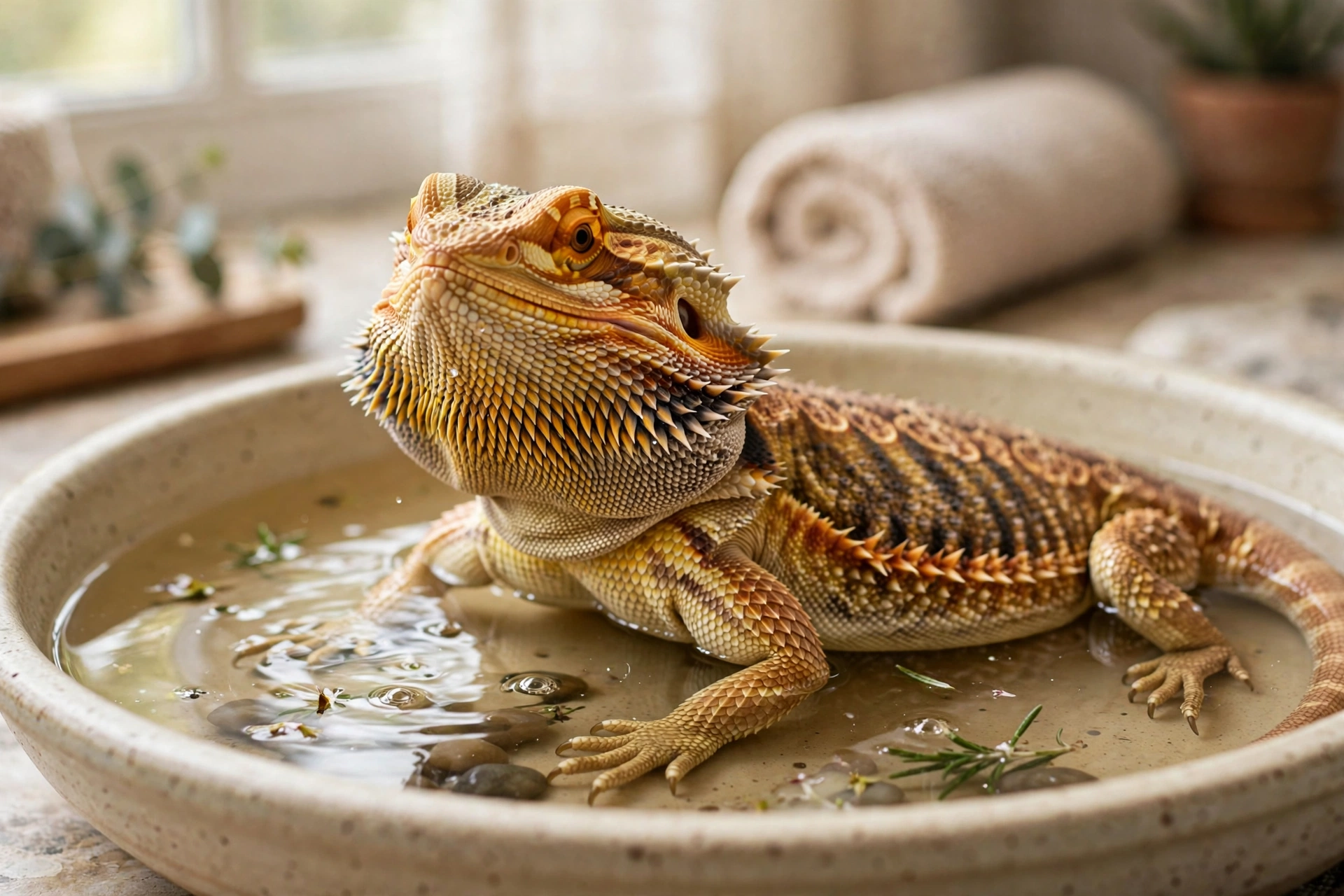
- Give a proper warm soak. Lukewarm water at 85–92°F (29–33°C), shallow enough to stand in comfortably, for 15–20 minutes, supervised throughout. Warmth relaxes the digestive tract and water hydrates through the vent — many dragons poop right in the bath. Get the details right with the warm soak technique in our full bathing guide.
- Push hydration from every angle. Drip water on the snout until the dragon starts lapping, mist the greens so every bite carries water, and offer moisture-rich hornworms. Our hydration strategies guide covers what actually works for dragons that ignore water bowls.
- Verify basking temperatures with a real thermometer. Aim an infrared temp gun at the basking surface itself: 100–110°F for adults, with a cool side around 75–85°F. Dial and stick-on gauges lie; temp guns do not. Once temperatures are truly correct, allow 24–48 hours of sustained heat.
- Add fiber-rich foods. Grated butternut squash, plain canned pumpkin (no spices, no sugar), and chopped collard, mustard, or dandelion greens add the bulk that keeps stool moving. A blueberry or a little papaya tempts reluctant salad-eaters. Skip iceberg lettuce — mostly water, almost no nutrition.
- Try a gentle belly massage. During or right after a soak, use one fingertip for slow, light strokes from the chest toward the vent — the direction everything must travel — for two or three minutes. If the dragon tenses up, darkens its beard, or scrambles away, stop.
- Get the dragon moving. Supervised floor time for 15–20 minutes — exploring, climbing, hunting a few feeders — stimulates gut motility. The classic winning combination is a warm soak followed by active floor time.
Myth: A drop of olive oil or mineral oil — or a children’s laxative — is a safe home fix. Reality: Never dose oils, laxatives, or any “remedy” liquids at home. Aspiration into the lungs is a genuine risk, and forcing material through a partially blocked gut can turn a manageable problem into an emergency. If soaks and husbandry fixes are not working, that is information for a reptile vet — not a cue to escalate dosing yourself.
Red Flags: When Constipation Becomes Impaction
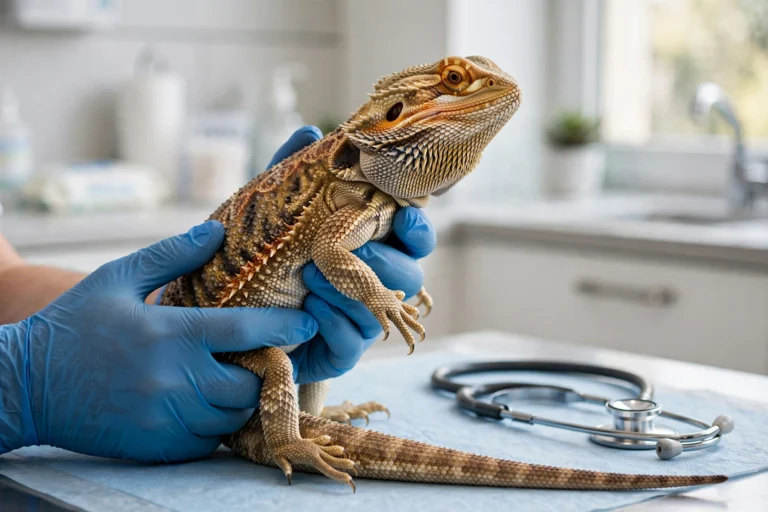
Home care has a boundary, and these signs mark it. If you see any of the following, stop the remedy ladder and contact a reptile veterinarian promptly — describe the signs, how long it has been since the last stool, and what you have tried. Only a vet can confirm a blockage.
- Straining with no result, repeated over a day or more.
- A bloated, firm, or visibly swollen belly.
- Lethargy combined with no stool — hiding, skipping basking, moving very little.
- Black beard with restlessness or visible discomfort.
- Refusing food for more than a couple of days alongside no stool.
- Hind-leg weakness or dragging.
- No stool for 10+ days despite warm soaks and verified temperatures.
Learn the full picture in our guide to when constipation becomes impaction — and save your reptile vet’s number before you ever need it.
Fact check: “My dragon hasn’t pooped in a week — is that impaction?” Not on its own. A healthy, active adult with a soft belly, normal appetite, and no straining is usually just on a slow cycle. Impaction is a pattern of signs (straining plus bloating plus lethargy plus appetite loss), never a single number on the calendar. When in doubt, a reptile vet visit settles it.
Prevention: Keep Things Moving
Routine beats rescue: verify basking temperatures monthly with a temp gun (bulbs weaken with age); offer adults a fresh fibrous salad daily and start babies on greens early; keep a hydration routine of soaks, wetted greens, and snout drips; provide climbing branches and supervised floor time; and choose substrate with ingestion in mind — solid surfaces for juveniles, dish-feeding if you use anything loose.
Fiber-rich salads keep things moving — build a better bowl with our complete salad guide.