Front-Opening or Top-Opening Terrarium: Which Is Better?
Front-opening or top-opening — it sounds like a small detail when you’re shopping for a terrarium, but it changes how you feed, clean, handle, and heat your bearded dragon every day for the next decade. Get it right and daily care feels effortless. Get it wrong and every interaction starts with a small wrestling match.
Here’s the honest version: for bearded dragons, front-opening enclosures win more often than not. But “usually” isn’t “always” — top-opening tanks have genuine strengths that suit some keepers better. This guide runs both styles through four practical rounds — access, cleaning, heat and lighting, and cost — so you can pick the one that fits your life. If you’re starting from zero, our setup checklist covers everything else the tank needs beyond its doors.
The Short Answer
Bearded dragons are terrestrial prey animals. A hand swooping down from above looks exactly like a hawk to their instincts — the flattened body, the darkened beard, the bolt for cover. A front-opening terrarium lets you approach at eye level, which skips that panic response entirely. That’s the single biggest reason experienced keepers recommend front-opening enclosures for this species.
That said, a top-opening tank is not a welfare disaster. Plenty of healthy, calm dragons live in standard glass aquariums. The question is which design makes your daily routine smoother. Take the quiz for a personalized answer, then read the four rounds to understand the why behind it.
Which Terrarium Fits You? The 60-Second Quiz
Answer six quick questions about your routine and setup. Each answer explains itself as you go — no wrong answers, just an honest match.
Round 1: Access and Handling
Front-opening wins this round most decisively. In the wild, danger comes from above — a bearded dragon’s brain never got the memo that your hand isn’t a predator. Every reach from above asks your dragon to override a survival instinct.
With front-opening doors, your hand enters at the dragon’s level — the same low, slow approach every good taming routine recommends. Handling stays calmer, especially in the first months when trust is still being built.
A shadow passing overhead reads as a hawk to a bearded dragon — even tame ones can flinch at a hand dropping from above. It’s millions of years of evolution, not bad temperament.
Top-opening tanks aren’t doomed here — the stress comes from the sudden overhead grab, not the lid itself. Keepers who open the lid, pause, then reach in at a shallow angle from the front side end up with equally calm dragons; it just takes more deliberate technique. If your dragon already shows signs of chronic stress, check Is Your Bearded Dragon Stressed? 8 Signs to Watch to see whether overhead approach stress might be a contributor.
Front-opening
- Pro: eye-level approach skips the predator response
- Pro: easier hand-feeding and daily interaction
- Con: bold dragons may bolt out — handle in a secure room
Top-opening
- Pro: biggest opening for lifting out decor
- Con: default approach triggers the predator instinct
- Con: calm taming sessions are harder through a lifted lid
Round 2: Cleaning
Here’s where it gets interesting: the two designs win at different kinds of cleaning. Front-opening doors are unbeatable for daily spot-cleans — slide, scoop, wipe, done in under a minute. Twice a day, the friction of unlatching a full screen lid while balancing the heat lamp on it gets old fast.
But for the full deep-clean, top-opening takes the round. With the entire lid off, every corner is reachable and hides, branches, and dishes lift straight up instead of angling through a door frame — ideal if your style is one thorough weekly session.
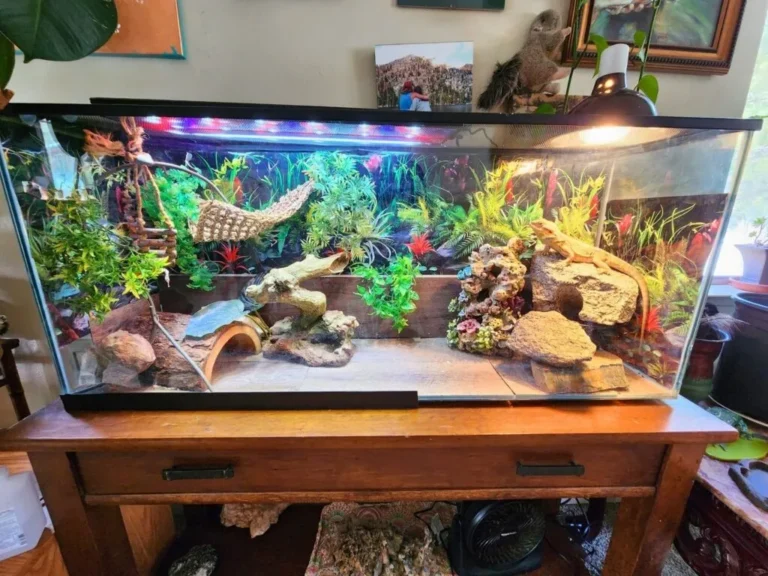
The community-recommended minimum for an adult bearded dragon is a 4×2×2 ft (120-gallon) enclosure. At that size, cleaning access matters more than most shoppers expect.
One practical note for either style: deep substrate layers and heavy decor make every cleaning harder. Keep the layout simple enough to service — our guide on How to Clean and Disinfect a Bearded Dragon Tank covers the full routine, and good cleaning access starts with hides and dishes you can actually lift out. Pick ones light enough to move — The Best Hides for Bearded Dragons Cover Both Ends of the tank without weighing a ton.
Front-opening
- Pro: fastest spot-cleans — slide and scoop
- Con: decor must angle through the door frame
- Con: door tracks collect substrate
Top-opening
- Pro: whole-tank access; lift everything straight up
- Con: spot-cleans mean removing the lid and its lamps
- Con: leaning deep into tall tanks is awkward
Round 3: Heat, Lighting, and Ventilation
This round is genuinely split. Front-opening enclosures — especially PVC — hold heat far better than glass aquariums: solid or vented tops trap warm air instead of letting it pour upward, so basking bulbs run at lower wattage and temperatures stay more stable.
Top-opening tanks flip the advantage: domes rest directly on the mesh, so repositioning a basking spot is a five-second slide — handy when dialing in a new setup. The tradeoff: heat escapes straight up, forcing higher wattages and wider swings, and the mesh blocks a meaningful share of UVB, which is why top-screen UVB mounting deserves its own planning.
A top-opening tank does not automatically mean a stressed, cold dragon. The stress issue is sudden overhead grabs, and the heat issue is solvable with proper wattage and a thermostat. Front-opening simply makes the low-stress setup the default.
Front-opening
- Pro: superior heat retention, especially PVC
- Pro: solid tops allow stacking and tidy mounting
- Con: repositioning lamps takes more effort
Top-opening
- Pro: easiest lamp placement — domes sit on the mesh
- Pro: maximum ventilation
- Con: heat escapes upward; higher wattages needed
- Con: mesh blocks a share of UVB
Round 4: Cost
No contest on sticker price: top-opening wins. A used 40- or 75-gallon glass aquarium costs a fraction of a purpose-built front-opening enclosure, and new glass tanks are stocked everywhere. If the budget is tight — and after lamps, thermostat, and decor, it often is — a glass tank with a screen lid is the pragmatic choice that gets a dragon housed safely this week.
Front-opening enclosures, particularly PVC models from reptile-specialty brands, typically cost two to three times what a comparable glass tank does, plus freight shipping on the large sizes. The counterargument is total cost of ownership: better insulation means lower-wattage bulbs and less electricity over a 10-plus-year lifespan, and a 4×2×2 bought once beats buying a 40-gallon now and upgrading later. It’s a cash-flow question as much as a husbandry one.
Front-opening
- Pro: buy once — a 4×2×2 lasts the dragon’s life
- Pro: lower running costs via better insulation
- Con: 2–3× the upfront price; freight on large sizes
Top-opening
- Pro: cheapest safe housing, new or used
- Pro: available everywhere secondhand
- Con: higher-wattage bulbs cost more over time
- Con: most keepers upgrade later, paying twice
The Verdict
For bearded dragons, front-opening is the better default: calmer handling, easier daily care, better heat retention, and a design that stacks if your hobby grows. The premium is real — so is the decade of daily convenience it buys.
Top-opening remains a completely legitimate choice when budget, space, or an existing tank points that way — just handle with the overhead instinct in mind, size your heating for the extra loss through the mesh, and plan your UVB mounting deliberately. A well-run top-opening tank always beats a neglected front-opening one.
Frequently Asked Questions
Conversion kits exist, but they’re fiddly and rarely seal as well as a purpose-built enclosure. For most keepers it’s simpler to run the aquarium as-is with good handling technique and put the conversion money toward the eventual 4×2×2 upgrade.
Not necessarily. Many front-opening PVC enclosures use solid tops with vents and fixtures mounted inside or on top. If yours has a screen section, the same UVB-through-mesh rules apply as with any top-opening tank.
Only if you let it — which is why locks matter. Quality front-opening enclosures have keyed or sliding locks; use them. Beardies are stronger and more determined than they look.
Front-opening, by a wider margin than with adults. Babies are at peak skittishness and the overhead-predator response is strongest in young animals. Calm early handling pays dividends for years.
What to Read Next
Still shopping for the dragon to go with the tank? Here’s what to look for when buying the tank — and the dragon that’ll live in it.